
Managing Non Conformance with Microsoft Dynamics 365 Supply Chain Management

 |
| Non Conformance business process |
- Improved safety of manufactured products
- Manage product recalls
- Better process equals more effective products
- Gain consumer confidence with product reliability
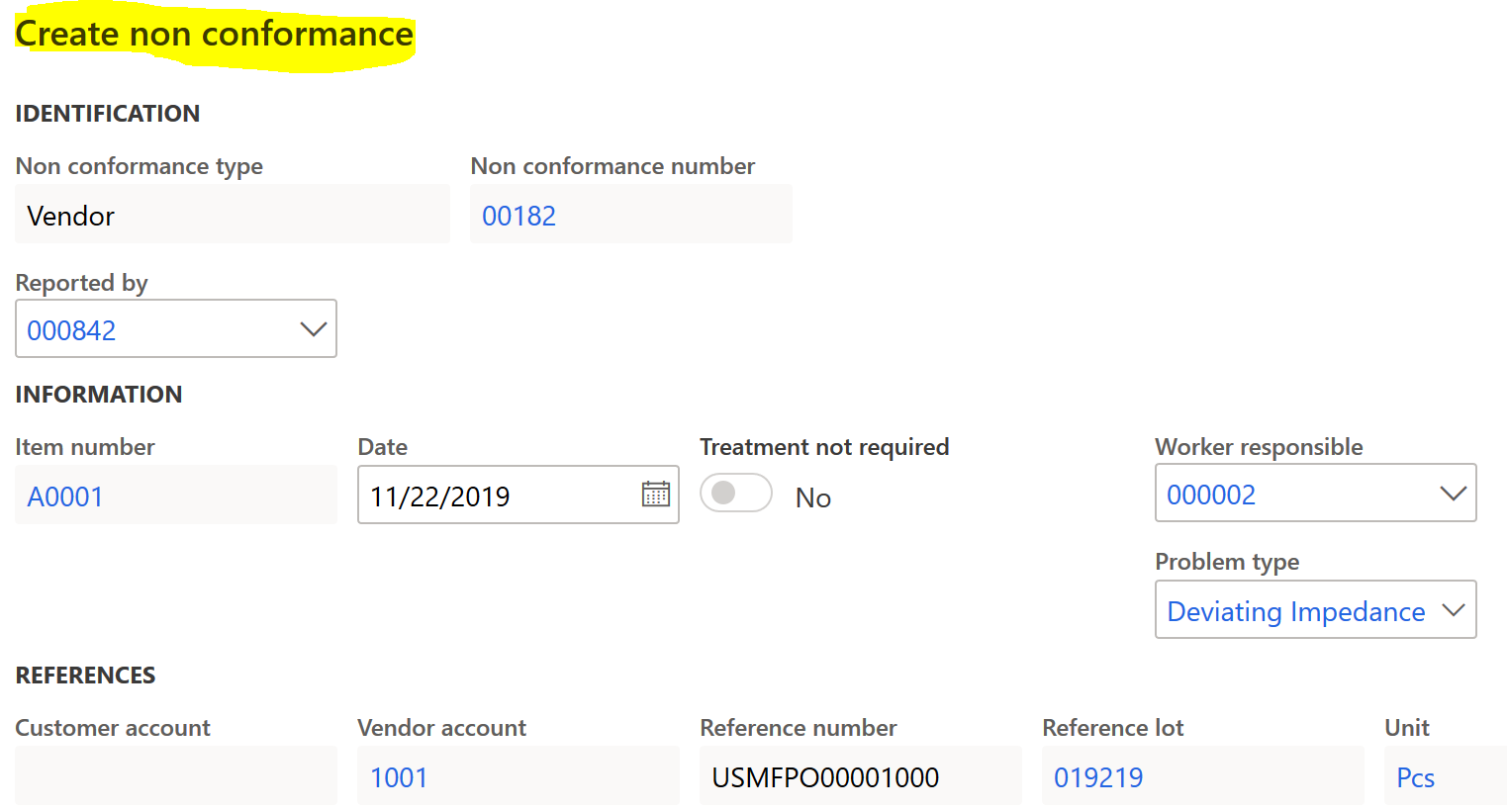 |
| Create Non conformance |
3. Approve and print Non Conformance Tag – The Tester can than approve and print the Tag and attach to the product. This becomes a visual indicator on the product itself. Tester will move the product/s to a caged or locked area along with other non conforming products.
 |
| Tag |
 |
| Corrections |
- Vendors with recurring # of non conforming products – to improve vendor performance
- Products with highest # of non conformance – to improve process results
- Corrections most applied – to re-design the production process
Published on:
Learn more
Related posts
Designing an effective Power Platform Tenant strategy
In today's landscape where AI and digital transformation is at the forefront, leveraging tools like Microsoft's Power Platform can revol...
10 Things to consider when managing Enterprise Apps - Microsoft Dynamics 365 on cloud - Part-2
This is part 2 of the blog series that sheds light on 10 things you should consider while managing enterprise applications like Microsoft Dyna...
10 Things to consider when Managing Enterprise Apps - Microsoft Dynamics 365 on Microsoft Cloud
Managing an enterprise application such as Microsoft Dynamics 365 on Microsoft Cloud can be a daunting task. Once the application is launched,...
Azure DevOps Pipelines with Power Platform - Part-1 The Benefits
In today's world, organizations require secure, efficient, and reliable tools to streamline their software development processes. Microsoft's ...
Dynamics 365 - 2023 Wave-1 - Customer Service part-1
In this blog post, the author delves into the upcoming Dynamics 365 - 2023 Wave-1 update and more specifically, the changes coming to the Cust...
What's New in Power Platform - Process Mining
In the latest 2022 release of Power Platform, the focus is on Process Mining using the Process Advisor. The blog discusses why there is a need...
What's New in Power Platform - 2022 Release wave 2 - Managed Environments
Microsoft Power Platform has released the 2022 Release Wave-2, which includes many new features and enhancements to existing functionality. In...
Enhancing legacy ERP systems with Microsoft Power Platform
On-premise ERP systems have been the go-to systems for businesses globally for over three decades, but their lack of modern technology can be ...
Microsoft Dynamics 365 Omnichannel for Customer Service – Part-1 – Unified Routing
In today's enterprise landscape, work routing plays a vital role in intelligently directing incoming customer service records, allowing for th...
Microsoft Dynamics 365 Omnichannel for Customer Service – Part-1 – Unified Routing
In the world of enterprise, routing work-related records to their destined endpoint is vital for efficient workflow management. This is especi...