Migrating iSeries (AS/400) Legacy Applications to Azure with Infinite

The platform was first introduced as the AS/400 (Application System/400) on June 21, 1988 and later renamed to the eServer iSeries in 2000. The IBM System i is IBM's previous generation of midrange computer systems for IBM i users, and was subsequently replaced by the IBM Power Systems in April 2008.
One feature that has contributed to the longevity of the IBM System i platform is its high-level instruction set (called TIMI for "Technology Independent Machine Interface" by IBM), which allows application programs to take advantage of advances in hardware and software without recompilation.
The AS/400 has been a very robust platform in the past decades, offering the compatibility mentioned above, which has allowed customers to keep building up their legacy applications with no or minimum migration effort involved.
But times have changed.
Now, one of the biggest decisions IT managers have to make is how and where to run data center applications in order to lower costs and increase business agility.
There are multiple options including server virtualization, internal clouds, public clouds and external private clouds.
If you plan to keep maintaining your legacy applications written in RPG, COBOL and CL for the next few years, but you also want to move the AS/400 workloads to Azure, there is a very interesting solution: Infinite Corporation.
Infinite provides a very similar development and production environments as the AS/400: menus, command line, user interface (green screens). The software product is called Infinite i. It is a suite of utilities, compilers and services that allow RPG and COBOL applications run and perform in Azure as if they were in the AS/400. The source code has to be recompiled in Azure to be deployed natively.
For development, you still have available utilities like PDM (Programming Development Manager), SEU (Source Entry Utility), DFU (Data File Utility) and SDA (Screen Design Aid), where you can write screens (display files), physical and logical files, source code (RPG, COBOL, CL) and execute and debug programs.
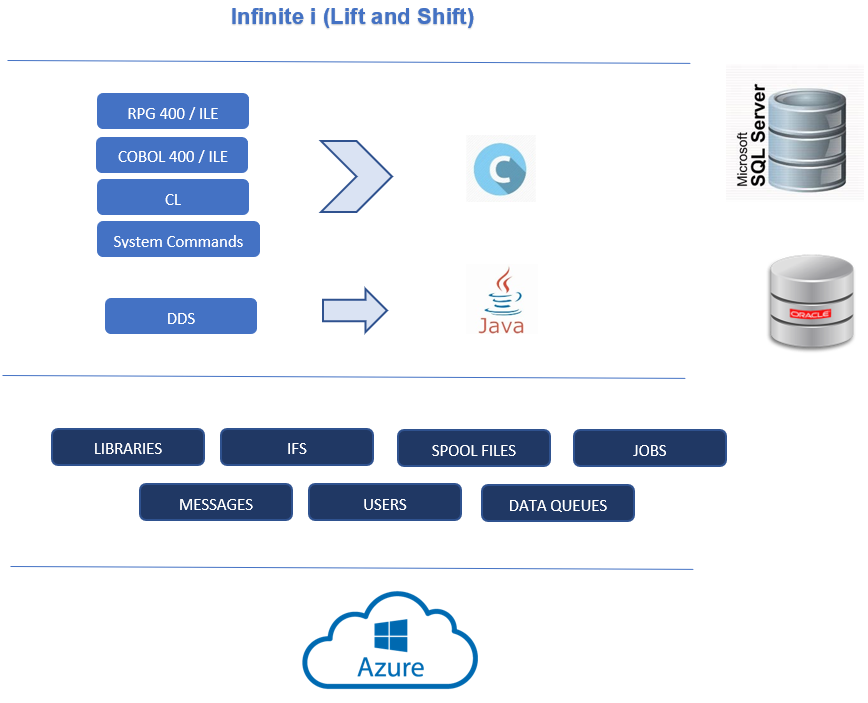
In order to run on Azure, the RPG, COBOL and CL applications are converted to C (business rules) and JAVA (user interface). You are also free to modify the C and JAVA source code rather than the legacy source code.
The DB2 database is replicated in Azure by converting it to either SQL Server or Oracle to run on Windows Server or Linux.
Advantages:
- Reduce hardware and software infrastructure costs
- Modernize applications source code and databases
- Improve the maintenance and deployment of the converted applications
- Smooth transition from the AS/400 to Azure
For more information, please contact the AS/400 Division at the Azure Global Engineering team.
Published on:
Learn moreWe can help you with Migrating iSeries (AS/400) Legacy Applications to Azure with Infinite
If you want help implementing, troubleshooting, or improving this product, contact us and we’ll point you in the right direction.
Related posts
Large-scale docking for drug design on Azure
“Only 10 total drugs in 46 years have been intentionally developed for childhood cancer and have reached FDA approval (reference). Childhood ...
E2E deployment of a production ready NDv4 (A100) cluster targeting large deep learning training
Introduction The NDv4 series is very popular for running large deep learning training jobs, which require lots of floating-point perfo...
Performance considerations for large scale deep learning training on Azure NDv4 (A100) series
Background The field of Artificial Intelligence is being applied to more and more application areas, such as self-driving cars, natural langua...
Best Practice for Running Cadence Spectre X on Microsoft Azure
Co-authors: Richard Paw and Andy Chan Electronic Design Automation (EDA) consists of a set of software (tools) and workflows for design...
Spack in a Multi-User HPC Environment on Azure
Spack is a package management tool designed for HPC environments. In this article we will demonstrate how to install and configure Spack...
AzureHPC Lustre Marketplace Offer
The AzureHPC Lustre Marketplace offer provides a fast and easy way to deploy a Lustre Filesystem on Azure. The features include: Deplo...
Mainframe Migration to Microsoft Azure with Intel Architecture on Your Terms.
IntroductionMainframes are still in wide use today for business-critical applications in many industries. According to a 2021 survey by IBM, 7...
Why Organizations are Entrusting Microsoft Cloud with their Mainframes
There is a resurgence of interest and renewed priority to transform core enterprise systems. This resurgence is largely driven by rapidly shif...
Automated HPC/AI compute node health-checks Integrated with the SLURM scheduler
Overview It is best practice to run health-checks on compute nodes before running jobs, this is especially important for tightly coupl...
GPU Monitoring using Azure Monitor
Overview Today, many highly parallel HPC/AI applications use GPU to improve the run-time performance. It is important to be able to monitor t...