
NEW WHITEPAPER: Build Serverless Apps with Event Grid and Azure Functions

Check out our new whitepaper:
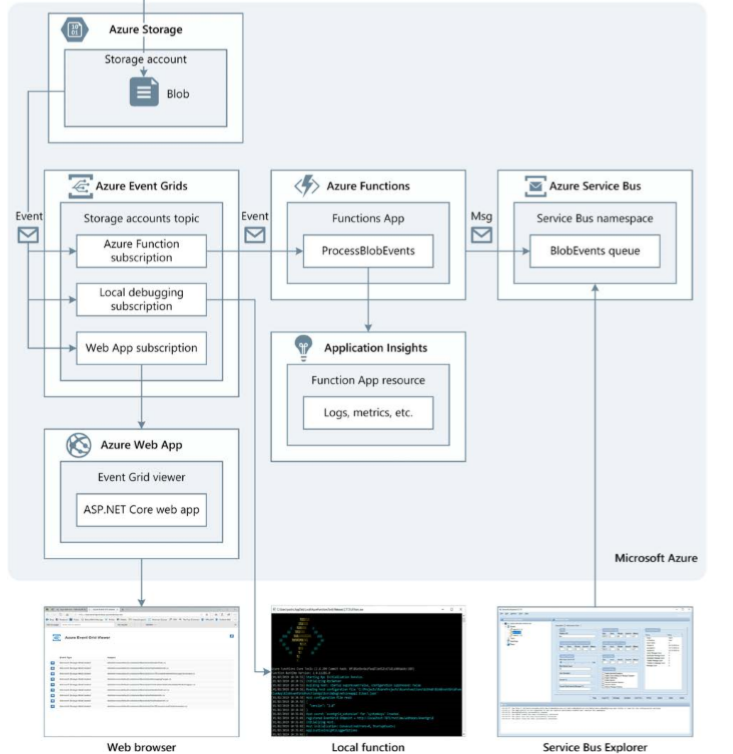
You can build and run serverless apps at scale using Azure managed services that handle the infrastructure for you. The key is to use Azure Event Grid, a fully managed intelligent event routing service as demonstrated by Paolo Salvatori of Azure Global Customer Engineering and AzureCAT. A GitHub sample is included so you can see how. In this sample, Azure Functions receives and processes the events any time a blob is created, updated, or deleted in a given container inside an Azure storage account.
Download the whitepaper from Azure.com:
A team of AzureCAT advisors recently adapted this approach for engineers working on an event-driven, big data project, and their solution is presented here. This solution was originally designed to process data captured during tests of a self-driving car, but it can be used to handle events generated by many types of Azure services. The GitHub sample demonstrates how to create a serverless application using Azure Functions to receive and process events any time a blob is created, updated, or deleted in a given container inside an Azure storage account. You can generalize this approach to handle any event generated by an Azure Event Grid event producer, including Azure subscriptions, resource groups, and Azure Event Hubs. Many event sources and event handlers can be used to build an event-driven serverless or microservice-based solution.

AzureCAT Guidance
"Hands-on solutions, with our heads in the Cloud!"
Published on:
Learn moreWe can help you with NEW WHITEPAPER: Build Serverless Apps with Event Grid and Azure Functions
If you want help implementing, troubleshooting, or improving this product, contact us and we’ll point you in the right direction.
Related posts
Large-scale docking for drug design on Azure
“Only 10 total drugs in 46 years have been intentionally developed for childhood cancer and have reached FDA approval (reference). Childhood ...
E2E deployment of a production ready NDv4 (A100) cluster targeting large deep learning training
Introduction The NDv4 series is very popular for running large deep learning training jobs, which require lots of floating-point perfo...
Performance considerations for large scale deep learning training on Azure NDv4 (A100) series
Background The field of Artificial Intelligence is being applied to more and more application areas, such as self-driving cars, natural langua...
Best Practice for Running Cadence Spectre X on Microsoft Azure
Co-authors: Richard Paw and Andy Chan Electronic Design Automation (EDA) consists of a set of software (tools) and workflows for design...
Spack in a Multi-User HPC Environment on Azure
Spack is a package management tool designed for HPC environments. In this article we will demonstrate how to install and configure Spack...
AzureHPC Lustre Marketplace Offer
The AzureHPC Lustre Marketplace offer provides a fast and easy way to deploy a Lustre Filesystem on Azure. The features include: Deplo...
Mainframe Migration to Microsoft Azure with Intel Architecture on Your Terms.
IntroductionMainframes are still in wide use today for business-critical applications in many industries. According to a 2021 survey by IBM, 7...
Why Organizations are Entrusting Microsoft Cloud with their Mainframes
There is a resurgence of interest and renewed priority to transform core enterprise systems. This resurgence is largely driven by rapidly shif...
Automated HPC/AI compute node health-checks Integrated with the SLURM scheduler
Overview It is best practice to run health-checks on compute nodes before running jobs, this is especially important for tightly coupl...
GPU Monitoring using Azure Monitor
Overview Today, many highly parallel HPC/AI applications use GPU to improve the run-time performance. It is important to be able to monitor t...