
Instance level public ip address configuration in the cloud service.

An Instance-Level Public IP Address (PIP) unlike the Virtual IP Address (VIP) is not load balanced. While the virtual ip is assigned to the cloud service and shared by all virtual machines and role instances in it, the public ip is associated only with a single instance’s NIC. The public ip is particularly useful in multi-instance deployments where each instance can be reachable independently from the Internet. The picture below illustrates the value of PIP and differentiates it from the VIP. The blog will help you understand how to configure the instance level public ip.
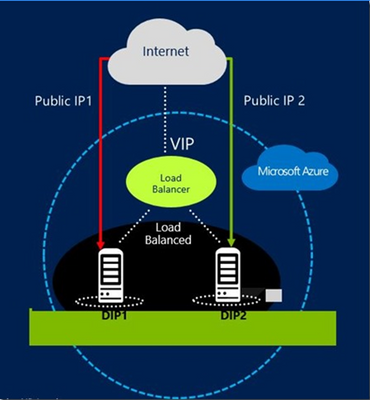
For some background knowledge, please find the reference Instance-Level Public IP Address | Azure Blog and Updates | Microsoft Azure.
Classic cloud service:
- How to configurate instance level public ip by role:
<?xml version="1.0" encoding="utf-8"?>
<ServiceConfiguration serviceName="TestVirtualnetwork" xmlns="http://schemas.microsoft.com/ServiceHosting/2008/10/ServiceConfiguration" osFamily="6" osVersion="*" schemaVersion="2015-04.2.6">
<Role name="WebRole1">
<Instances count="1" />
<ConfigurationSettings>
<Setting name="APPINSIGHTS_INSTRUMENTATIONKEY" value="xxx" />
</ConfigurationSettings>
</Role>
<Role name="WebRole2">
<Instances count="1" />
<ConfigurationSettings>
<Setting name="APPINSIGHTS_INSTRUMENTATIONKEY" value="xxx" />
</ConfigurationSettings>
</Role>
<Role name="WebRole3">
<Instances count="1" />
<ConfigurationSettings>
<Setting name="APPINSIGHTS_INSTRUMENTATIONKEY" value="xxx" />
</ConfigurationSettings>
</Role>
<Role name="WebRole4">
<Instances count="1" />
<ConfigurationSettings>
<Setting name="APPINSIGHTS_INSTRUMENTATIONKEY" value="xxx" />
</ConfigurationSettings>
</Role>
<NetworkConfiguration>
<VirtualNetworkSite name="Group <resource group> <virtual network name>" />
<AddressAssignments>
<InstanceAddress roleName="WebRole1">
<Subnets><Subnet name="subnet001" /></Subnets>
<PublicIPs><PublicIP name="PubIP" domainNameLabel="pip" /></PublicIPs> // with domain
</InstanceAddress>
<InstanceAddress roleName="WebRole2">
<Subnets><Subnet name="subnet003" /></Subnets>
<PublicIPs><PublicIP name="PubIP"/></PublicIPs> // without domain
</InstanceAddress>
</AddressAssignments>
</NetworkConfiguration>
</ServiceConfiguration>
2. How to know current public ip of role:
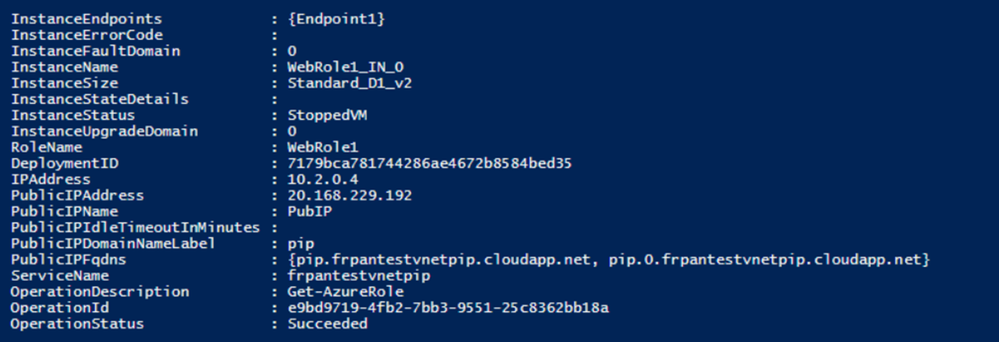
- Powershell: We can use the Powershell command Get-AzureRole (Azure.Service) | Microsoft Learn based on the module Azure. With the above setting, we can see the difference from the Instance Details of each role instance.
Get-AzureRole -ServiceName <Cloud Service Name> -Slot Production -RoleName WebRole2 -InstanceDetails

Get-AzureRole -ServiceName <Cloud Service Name> -Slot Production -RoleName WebRole1 -InstanceDetails
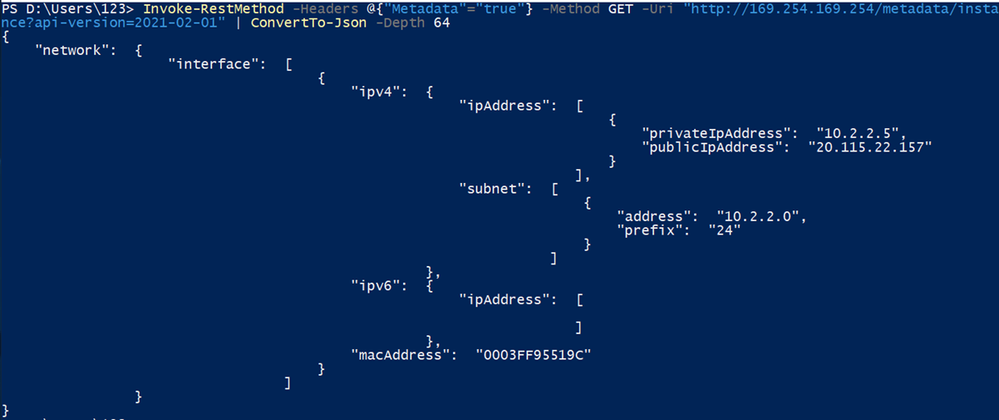
- The Azure Instance Metadata Service (IMDS) provides information about currently running virtual machine instances. You can use it to review your virtual machines’s NIC level setting. Azure Instance Metadata Service for Windows - Azure Virtual Machines | Microsoft Learn
-
Invoke-RestMethod -Headers @{"Metadata"="true"} -Method GET -NoProxy -Uri http://169.254.169.254/metadata/instance?api-version=2021-02-01 | ConvertTo-Json -Depth 64
Cloud Service Extended Support:
1. How to configurate instance level public ip by role:
<?xml version="1.0" encoding="utf-16"?>
<ServiceConfiguration xmlns:xsd="http://www.w3.org/2001/XMLSchema" xmlns:xsi="http://www.w3.org/2001/XMLSchema-instance" serviceName="Test_cloudservice" osFamily="6" osVersion="*" schemaVersion="2015-04.2.6" xmlns="http://schemas.microsoft.com/ServiceHosting/2008/10/ServiceConfiguration">
<Role name="TestWebRole">
<ConfigurationSettings>
<Setting name="Microsoft.WindowsAzure.Plugins.Diagnostics.ConnectionString" value="UseDevelopmentStorage=true" />
</ConfigurationSettings>
<Instances count="2" />
</Role>
<Role name="TestWorkerRole">
<ConfigurationSettings>
<Setting name="Microsoft.WindowsAzure.Plugins.Diagnostics.ConnectionString" value="UseDevelopmentStorage=true" />
</ConfigurationSettings>
<Instances count="1" />
</Role>
<NetworkConfiguration>
<VirtualNetworkSite name="test001VNet" />
<AddressAssignments>
<InstanceAddress roleName="TestWebRole">
<Subnets>
<Subnet name="default" />
</Subnets>
<PublicIPs>
<PublicIP name="PubIP" domainNameLabel="pip" />
</PublicIPs>
</InstanceAddress>
<InstanceAddress roleName="TestWorkerRole">
<Subnets>
<Subnet name="default" />
</Subnets>
</InstanceAddress>
<ReservedIPs>
<ReservedIP name="Group TESTCSES cses-prod" />
</ReservedIPs>
</AddressAssignments>
</NetworkConfiguration>
</ServiceConfiguration>
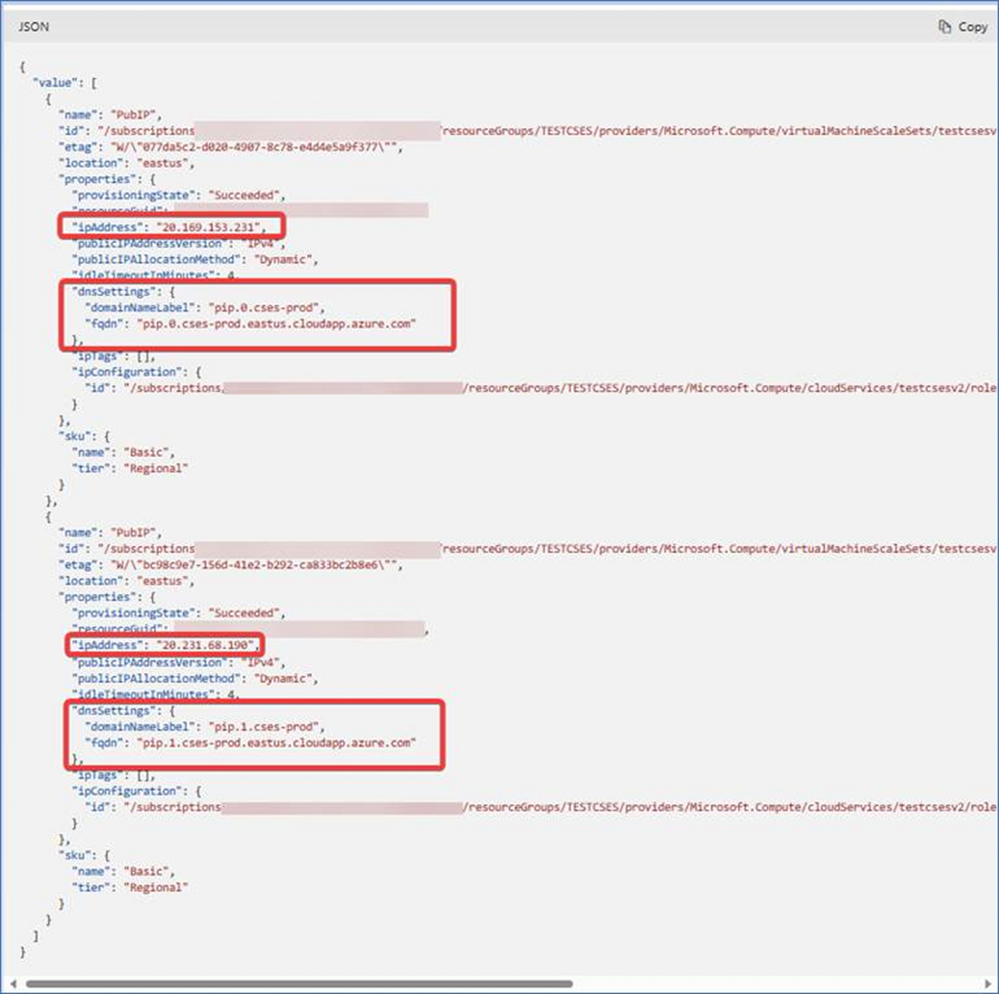
2. Then, we can use the rest api PublicIPAddress In CloudService - List Cloud Service Public IP Addresses - REST API (Azure Virtual Networks) | Microsoft Learn to get the public ip of NIC.
Published on:
Learn moreWe can help you with Instance level public ip address configuration in the cloud service.
If you want help implementing, troubleshooting, or improving this product, contact us and we’ll point you in the right direction.
Related posts
Azure Storage - TLS 1.0 and 1.1 retirement
Overview TLS 1.0 and 1.1 retirement on Azure Storage was previously announced for Nov 1st, 2024, and it was postponed recently to 1 year later...
Efficient Management of Append and Page Blobs Using Azure Storage Actions
Overview In Azure Storage, Blob Lifecycle Management (BLM) allows you to automate the management of your data based on rules defined by...
[Azure AI Search] Internal Server Error when creating CMK encrypted objects
Scenario Customers follow the Microsoft doc to create CMK encrypted objects (data source, index etc.), but get the 500 Internal Serv...
Optimizing Azure Table Storage: Automated Data Cleanup using a PowerShell script with Azure Automate
Scenario This blog’s aim is to manage Table Storage data efficiently. Imagine you have a large Azure Table Storage that accumulates logs from ...
Optimizing Azure Table Storage: Automated Data Clean-up using a PowerShell script with Azure Automat
Scenario This blog’s aim is to manage Table Storage data efficiently. Imagine you have a large Azure Table Storage that accumulates logs from ...
Restoring Soft-Deleted Blobs with multithreading in Azure Storage Using C#
Blob soft delete is an essential feature that safeguards your data against accidental deletions or overwrites. By retaining deleted data for a...
Performing simple Azure Table Storage REST API operations using curl command.
The blog provides guidance to perform simple Table Storage REST API operations such as Create table, Delete Table, Insert entity, Delete entit...
Bulk delete all the old jobs from the batch account
Deleting a Job also deletes all Tasks that are part of that Job, and all Job statistics. This also overrides the retention period for Task dat...
Utilizing Azure Storage and Runbooks for scheduled automated backups of Azure SQL Databases
In this article, we are going to provide detailed steps to create a scheduled Azure SQL Database backup to storage account using automation. T...
[Azure Service Bus] JMS messages getting dead-lettered
The article discusses a problem where numerous messages end up in the dead letter queue (DLQ) when the JMS service bus consumer connects to th...