
Announcing Public Preview of Personal Desktop Autoscale on Azure Virtual Desktop
In August 2022, we announced the availability of one of our most anticipated features, Pooled Desktop Autoscale on Azure Virtual Desktop. Today, we are happy to announce that Personal Desktop Autoscale is now available in public preview!
Personal Desktop Autoscale
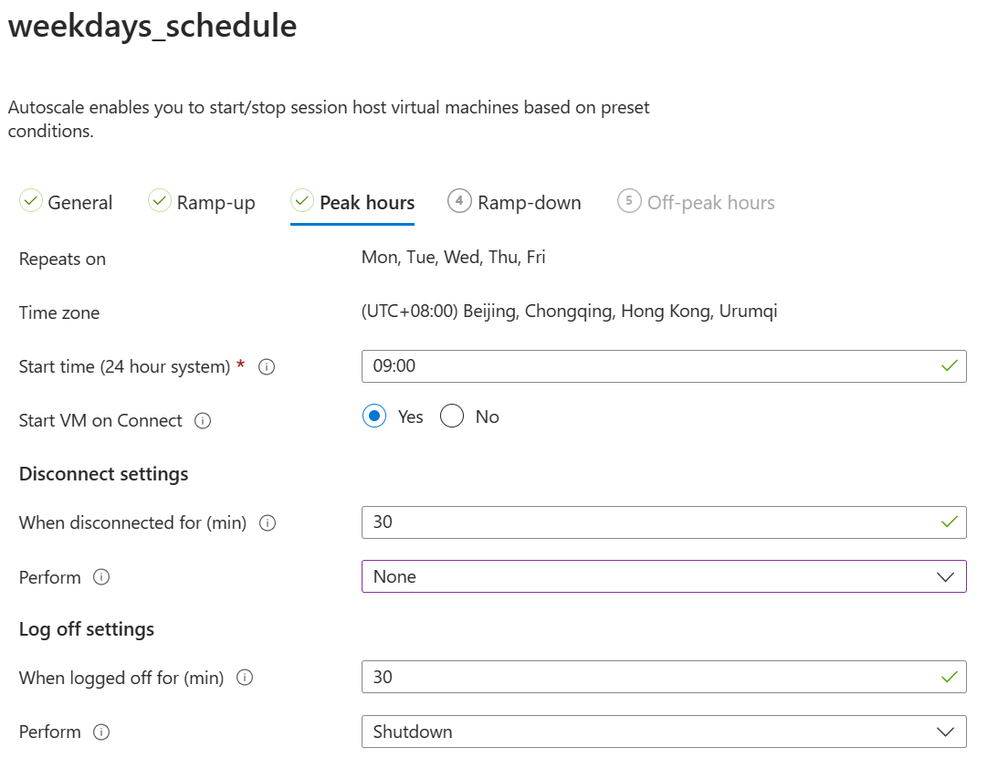
Personal Desktop Autoscale is Azure Virtual Desktop’s native scaling solution that automatically starts session host virtual machines according to schedule or using Start VM on Connect and then deallocates session host virtual machines based on the user session state (log off/disconnect). With Personal Desktop Autoscale, you can save costs by shutting down idle session hosts while ensuring session hosts can be started by users when needed.
The following capabilities are now in public preview with Personal Desktop Autoscale:
- Scaling plans are available in all regions where Azure Virtual Desktop host pool objects are, including Australia East, Canada Central, Canada East, Central US, East US, East US 2, Japan East, North Central US, North Europe, South Central US, UK South, UK West, West Central US, West Europe, West US, West US 2, and West US 3.
- You can use the Azure portal to enable and manage Personal Desktop Autoscale in the public preview.
Getting Started
To enable this feature, simply create a personal scaling plan, define whether to enable or disable Start VM on Connect and what action to perform after a user session has been disconnected / logged off for a configurable period of time (deallocate the personal desktop or do nothing) across 4 phases in a day, and assign personal scaling plan to one or more personal host pools.
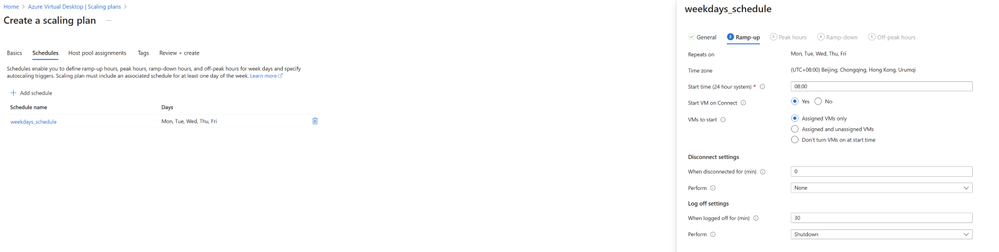
Learn more about setting up autoscale and find answers for frequently asked questions about how to use autoscale for Azure Virtual Desktop.
Also check out this new video from Azure Academy that walks you through the process of enabling and managing Personal Desktop Autoscale.
Published on:
Learn moreRelated posts
App attach now integrates with partner solutions
For many IT admins, application delivery management is one of their most complex tasks. However, with the recent general availability of App a...
New features for Azure Virtual Desktop for Azure Stack HCI
Today, we’re excited to announce new features and capabilities for Azure Virtual Desktop for Azure Stack HCI that will benefit admins responsi...
MMR Call Redirection for Azure Virtual Desktop, Windows 365 now available
Today, I am pleased to share the launch of Multimedia Redirection (MMR) Call Redirection for Azure Virtual Desktop and Windows 365. Call Redir...
OneDrive support for RemoteApp in Azure Virtual Desktop
We are excited to announce that Microsoft OneDrive support is now available for RemoteApp in Azure Virtual Desktop! Previously, OneDrive could...
Custom Shortpath settings for host pools now available
We are excited to announce the general availability of custom Shortpath settings at the host pool level. Now you can granularly control how RD...
Recovery options for Azure Virtual Desktop session host VMs
Last week an update issue caused unresponsiveness and startup failures on Windows machines using the CrowdStrike Falcon agent, including some ...
Connection Reliability in Azure Virtual Desktop Insights
We are thrilled to announce that the Connection Reliability tab in Azure Virtual Desktop Insights is now generally available. IT administrator...
Preferred app group type settings enhance user feed display
In line with our commitment to provide seamless and efficient experiences for Azure Virtual Desktop users, we've recently implemented Preferre...
App attach for Azure Virtual Desktop now generally available
App attach for Azure Virtual Desktop allows IT admins to dynamically attach applications from an application package to a user session in Azur...
Hibernation support now available for Azure Virtual Desktop
Today we are happy to announce the general availability of hibernation support in Azure Virtual Desktop. Explore additional capabilities that ...