Passwordless is here and at scale

Hi everyone,
I’m Sue, the VP of Identity’s Customer & Partner Success team, and I love having the opportunity to share stories from real customers via this blog series. We've designed this collection of stories from real customers that have been able to solve their identity and security challenges using Microsoft Azure Active Directory (Azure AD), part of Microsoft Entra. I hope you find valuable insights and best practices that you can apply to your own projects.
Check out more from the blog series here: Voice of the Customer
In today’s spotlight, we’ll be focusing on the journey of one of our largest partners, Accenture, as they adopted passwordless authentication and reduced their exposure to phishing attacks.
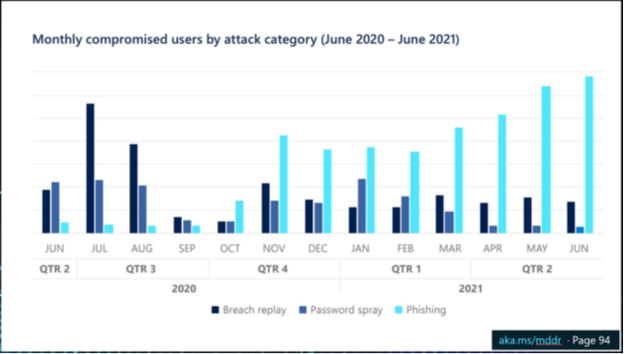
With the rise of cyber-attacks, phishing is among the primary methods that attackers use to compromise your organization’s users. In Microsoft’s latest Digital Defense report, we see it as the highest attack vector on users' credentials.
Passwords have long been a weak credential and now attackers are increasing their focus on getting your users to just surrender the clear text password to them. As Simon Gooch, Accenture’s Director for Global IT, Enterprise Technology and Security notes, “In the future, people will look back and wonder why we ever used passwords.”
Now, even though multifactor authentication (MFA) defeats over 90% of password breaches, it isn’t immune to phishing. Therefore, we see the recent emphasis on “phishing resistant” MFA methods in the Executive Order issued by the US president in 2021 to strengthen the nation’s cybersecurity. Microsoft’s vision for a passwordless world emphasizes FIDO 2.0-powered inherently phish-resistant credentials like Windows Hello for Business and FIDO 2.0 External Security Keys. For more on how FIDO 2.0 credentials are inherently phishing resistant, check out this blog by my colleague Pamela Dingle, our Director of Identity Standards, and this video explaining the technical flow. These modern credentials are not only more secure but they also create a more seamless and natural user experience. As Accenture notes, “We’ve proven the benefits. The adoption of passwordless has led to faster login times, more reliable experiences, fewer failed authentications, and improved overall security posture.”
The most impressive aspect for me throughout Accenture’s journey was the speed and efficiency with which it was executed. As we’ve shared in our passwordless journey blog, getting to passwordless means getting your apps ready, your devices ready, and your registration campaigns thought out. Accenture moved thousands of applications to Azure AD so that the passwordless sign ins would accrue to MFA login for all these apps without requiring any further devices or gestures beyond the user’s natural sign in. They emphasized readiness on multiple devices, as you’ll be able to use the right passwordless form (Windows Hello For Business, FIDO2 Keys, or Phone Sign in) that matches the user's experiences.
The end result is over 500,000 users primarily using Windows Hello For Business, 200,000 Phone Sign in users, over 10,000 FIDO2 key users, and an 80% drop in day-to-day usage of passwords across the enterprise.
For an alternative perspective on the implementation, I’d like to draw your attention to the detailed passwordless journey blog authored by our partners at Accenture. I trust you will agree with Accenture’s dual goals of improving security and the user experience.
Until next time,
Sue
Learn more about Microsoft identity:
- Get to know Microsoft Entra – a comprehensive identity and access product family
- Return to the Microsoft Entra (Azure AD) blog home
- Join the conversation on Twitter and LinkedIn
- Share product suggestions on the Entra (Azure AD) forum
Published on:
Learn moreRelated posts
Sync identities from Rippling to Microsoft Entra ID
Today, we’re thrilled to announce that customers using Rippling HCM can now automatically provision users to on-premises Active Directory and ...
Microsoft Entra ID Governance for government
I’m pleased to announce that as of November 1, 2024, Microsoft Entra ID Governance is available for federal agencies, state and local governme...
Update to security defaults
As part of the Secure Future Initiative, we’ve evolved our security approach to align with three security principles: secure by design, secure...
Meet Microsoft Entra at Ignite 2024: November 18-22
Microsoft Ignite is just around the corner, taking place from Monday, November 18, 2024 through Friday, November 22, 2024, in Chicago, Illinoi...
Manage Microsoft Entra ID role assignments with Microsoft Entra ID Governance
I’m excited to announce that we now support Microsoft Entra role assignments in Microsoft Entra ID Governance's Entitlement Management feature...
The latest enhancements in Microsoft Authenticator
Hi folks, I'm thrilled to announce three major Microsoft Entra ID advancements that will help you protect your users with phishing-resi...
Microsoft Security announcements and demos at Authenticate 2024
The Microsoft Security team is excited to connect with you next week at Authenticate 2024 Conference, taking place October 14 to 16 in Carlsba...
What's new in Microsoft Entra - September 2024
We’re excited to announce the general availability of Microsoft Entra Suite—one of the industry’s most comprehensive secure access solutions f...
Explore the key benefits of Microsoft Entra Private Access
The traditional network security models are becoming increasingly ineffective in a world where remote work and cloud services are the norm. Co...
Join us at the Microsoft Entra Suite Showcase!
This fall, we are bringing the Microsoft Entra Suite Showcase to cities worldwide. Join us to explore how our latest advancements in secure id...