
Altair ultraFluidX™ on Azure

Simulation engineers looking for aerodynamic characteristics of passenger and heavy-duty vehicles can now use Altair ultraFluidX™ on Azure. With ultraFluidX on Azure, simulation can be sped up by 75 to 450 percent, depending upon the boundary conditions and the size of the model being analyzed, greatly accelerating product development processes in aerospace and automotive industries.
We tested ultraFluidX on Azure on two types of automotive models:
- Altair Roadster (simple geometry scaling)
- Altair CX1 (representative automotive production-level case)
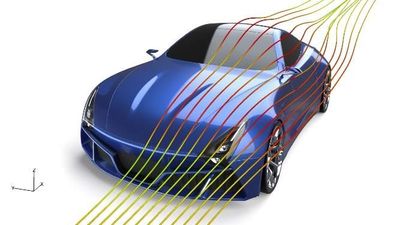
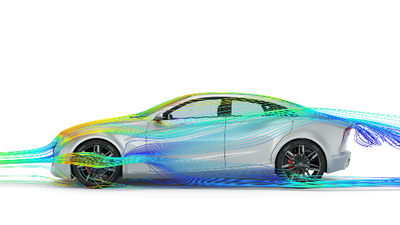
ROADSTER CX1
We ran both these models on our Azure NDv4 VMs and found that fluid dynamics simulations sped up significantly depending upon the model complexity and number of GPUs used. The ND A100 v4 series starts with a single virtual machine powered by eight NVIDIA A100 Tensor Core GPUs. ND A100 v4-based deployments can scale up to thousands of GPUs with 1.6 Tb/s of interconnect bandwidth per VM. Each GPU within the VM is provided with its own dedicated, topology-agnostic 200Gb/s link, via NVIDIA Quantum InfiniBand networking. These connections are automatically configured between VMs occupying the same virtual machine scale set, and support NVIDIA GPUDirect RDMA.
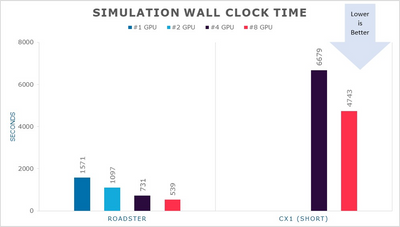
This infrastructure makes a big difference in speed-up of simulation for high-end applications like ultraFluidX. The total simulation consists of two phases, ultraFluidX runs a mostly CPU-based pre-processing phase and the GPU-based computation phase. We carried out the simulation to test the performance of the GPU on the ND A100 VM and found the following results:
Wall clock time in seconds:
|
Model Name |
#1 GPU |
#2 GPU |
#4 GPU |
#8 GPU |
|
Roadster |
26 min 11sec |
18 min 17 sec |
12 min 11 sec |
8 min 58 sec |
|
CX1 |
NA |
NA |
111 min 18 sec |
79 min 2 sec |
Speed-up (Between GPUs):
|
Model Name |
#1 GPU |
#2 GPU |
#4 GPU |
#8 GPU |
|
Roadster |
1.00 |
1.43 |
2.15 |
2.91 |
|
CX1 |
NA |
NA |
1.00 |
1.41 |
Note: "NA" Denotes that the model requires more than 100GB of GPU memory, hence simulation can't perform with #1 GPU and #2 GPU.

“We are excited to partner with Altair and bring ultraFluidX to Azure. This represents the latest successful joint initiative in a long-standing collaborative relationship between two strategic partners. With ultraFluidX on Azure, our shared automotive and manufacturing customers can more rapidly innovate by gaining real-world performance insights when running some of the largest CFD jobs on purpose-built GPU VMs powered by NVIDIA. We invite customers to explore ultraFluidX on Azure and gain from our collective experience.”
Kurt Niebuhr, Azure Compute HPC | AI Workload Incubation & Ecosystem Team Lead
"ultraFluidX is Altair's high-fidelity solution for transient external aerodynamics. Thanks to the native GPU implementation, ultraFluidX naturally leverages the massive power and memory bandwidth of modern GPUs. In combination with a powerful multi-GPU environment, such as Azure’s ND A100 V4 VMs powered by NVIDIA A100 Tensor Core GPUs, ultraFluidX enables the ultra-fast prediction of aerodynamic properties of passenger and heavy-duty vehicles, aero-acoustics, and building and environmental aerodynamics. Highly transient aerodynamics simulations now can be resolved overnight on a single server, which is a breakthrough for simulation-based design."
Christian F. Janßen, Director ultraFluidX
About Altair ultraFluidX:
ultraFluidX is a GPU-based Lattice Boltzmann solver that delivers unbeatable performance and overnight transient simulations of full vehicle aerodynamics on a single server. A couple of key features for ultraFluidX include automated meshing that allows for quick evaluation of hundreds of part configurations and efficient post processing features with a reduced memory footprint
Published on:
Learn moreRelated posts
Upcoming Changes to Instance Size Flexibility Ratios for Reserved VM Instances for M-series: What Yo
Overview In the ever-evolving landscape of cloud computing, it is crucial to stay informed about changes that may affect your usage and busine...
Exploring SUSE Enterprise Linux on Azure
Exploring SUSE Enterprise Linux on Azure In today's cloud-centric world, leveraging robust and reliable operating systems is crucial for busin...
Announcing Public Preview of new attach/detach disks API for VMs/VMSS
We are excited to announce the public preview of a new API that will make attaching and detaching disks to a VM faster and easier. The new API...
Fine-tuning a Hugging Face Diffusion Model on CycleCloud Workspace for Slurm
Introduction Azure CycleCloud Workspace for Slurm (CCWS) is a new Infrastructure as a Service (IaaS) solution which allows the users to purpos...
Public Preview Announcement-On Demand Capacity Reservation in Azure in China
Today, we're announcing the public preview of on demand capacity reservations for Azure Virtual Machines in Azure in China Cloud . Y...
Breaking change for Window Server 2022 Image Users with .NET 6
Azure Marketplace media images for Windows Server 2022 currently include .NET 6, but going forward will not include a .NET version with the im...
Announcing the public preview of the new Azure FXv2-series Virtual Machines
Today, Microsoft is announcing the public preview of the new Azure FXv2-series Virtual Machines (VMs), based on the 5th Generation Intel® Xeon...
Effortlessly Migrate Azure VMs between zones
For various reasons you might come across a situation when you need to migrate your Azure VMs from one zone to another. Migrating Azure VMs be...
Announcing Public Preview of Instance Mix on Virtual Machine Scale Sets
Today, we’re excited to announce that the ability to specify multiple different VM sizes in your Virtual Machine Scale Sets (VMSS) with Flexib...
Announcing General Availability of Attach & Detach of Virtual Machines on Virtual Machine Scale Sets
Today, we’re thrilled to announce that the ability to attach or detach Virtual Machines (VMs) to and from a Virtual Machine Scale Set (VMSS) w...