
Service Fabric Explorer (SFX) web client CVE-2023-23383 spoofing vulnerability
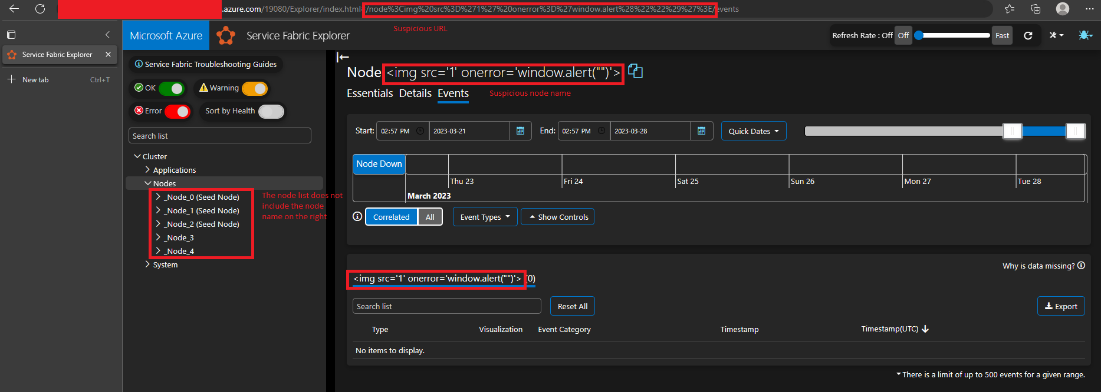
Service Fabric Explorer (SFX) is the web client used when accessing a Service Fabric (SF) cluster from a web browser. The version of SFX used is determined by the version of your SF cluster. We are providing this blog to make customers aware that running Service Fabric versions 9.1.1436.9590 and below are affected. These versions could potentially allow unwanted code execution in the cluster if an attacker can successfully convince a victim to click a malicious link and perform additional actions in the Service Fabric Explorer interface. This issue has been resolved in Service Fabric 9.1.1583.9589 released on March 14th, 2023, as CVE-2023-23383 which had a score of CVSS: 8.2 / 7.1. See the Technical Details section for more information.
Affected versions
This vulnerability affects Service Fabric versions 9.1.1436.9590 and below. Information on Service Fabric versions can be found at Azure Service Fabric versions.
Fix
The CVE-2023-23383 was published on March 14, 2023, released as Service Fabric version 9.1.1583.9590 fully addresses this issue.
- All Service Fabric Clusters with auto upgrade enabled are already on version 9.1.1583.9590 that protects against this issue. No further action is needed.
- All Service Fabric customers that do not have auto upgrade enabled should act to upgrade to 9.1.1583.9590 to be fully protected against this issue. See more details on how to upgrade by visiting Manage Service Fabric cluster upgrades.
Technical Details
An attacker could send an authenticated cluster operator a specifically crafted URL which includes the cluster’s address, a specific path, and an encoded payload. The victim would need to click the malicious link and authenticate to the cluster, at which point Service Fabric Explorer would load and display like below.
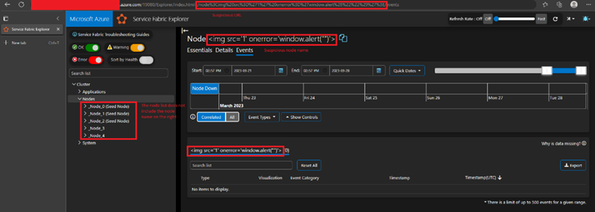
The user would then need to click the “Event Type” drop down.
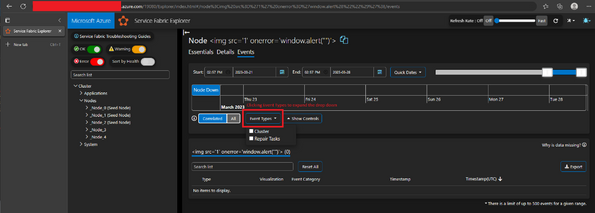
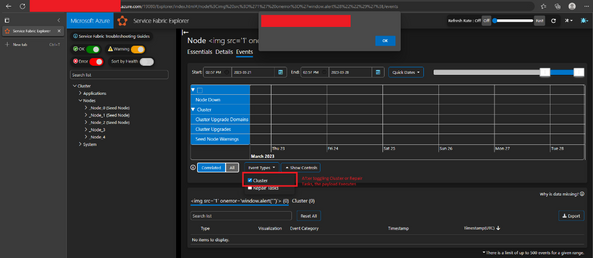
Then the user would need to toggle either Cluster or Repair Tasks, at this point the payload embedded in the URL would be executed in the context of that user’s session.
We thank Orca Security for informing us of this vulnerability and working with us under Coordinated Vulnerability Disclosure to help protect our customers.
Published on:
Learn moreRelated posts
Azure Storage - TLS 1.0 and 1.1 retirement
Overview TLS 1.0 and 1.1 retirement on Azure Storage was previously announced for Nov 1st, 2024, and it was postponed recently to 1 year later...
Efficient Management of Append and Page Blobs Using Azure Storage Actions
Overview In Azure Storage, Blob Lifecycle Management (BLM) allows you to automate the management of your data based on rules defined by...
[Azure AI Search] Internal Server Error when creating CMK encrypted objects
Scenario Customers follow the Microsoft doc to create CMK encrypted objects (data source, index etc.), but get the 500 Internal Serv...
Optimizing Azure Table Storage: Automated Data Cleanup using a PowerShell script with Azure Automate
Scenario This blog’s aim is to manage Table Storage data efficiently. Imagine you have a large Azure Table Storage that accumulates logs from ...
Optimizing Azure Table Storage: Automated Data Clean-up using a PowerShell script with Azure Automat
Scenario This blog’s aim is to manage Table Storage data efficiently. Imagine you have a large Azure Table Storage that accumulates logs from ...
Restoring Soft-Deleted Blobs with multithreading in Azure Storage Using C#
Blob soft delete is an essential feature that safeguards your data against accidental deletions or overwrites. By retaining deleted data for a...
Performing simple Azure Table Storage REST API operations using curl command.
The blog provides guidance to perform simple Table Storage REST API operations such as Create table, Delete Table, Insert entity, Delete entit...
Bulk delete all the old jobs from the batch account
Deleting a Job also deletes all Tasks that are part of that Job, and all Job statistics. This also overrides the retention period for Task dat...
Utilizing Azure Storage and Runbooks for scheduled automated backups of Azure SQL Databases
In this article, we are going to provide detailed steps to create a scheduled Azure SQL Database backup to storage account using automation. T...
[Azure Service Bus] JMS messages getting dead-lettered
The article discusses a problem where numerous messages end up in the dead letter queue (DLQ) when the JMS service bus consumer connects to th...