
Introducing Machine Learning based recommendations in Azure AD Access reviews

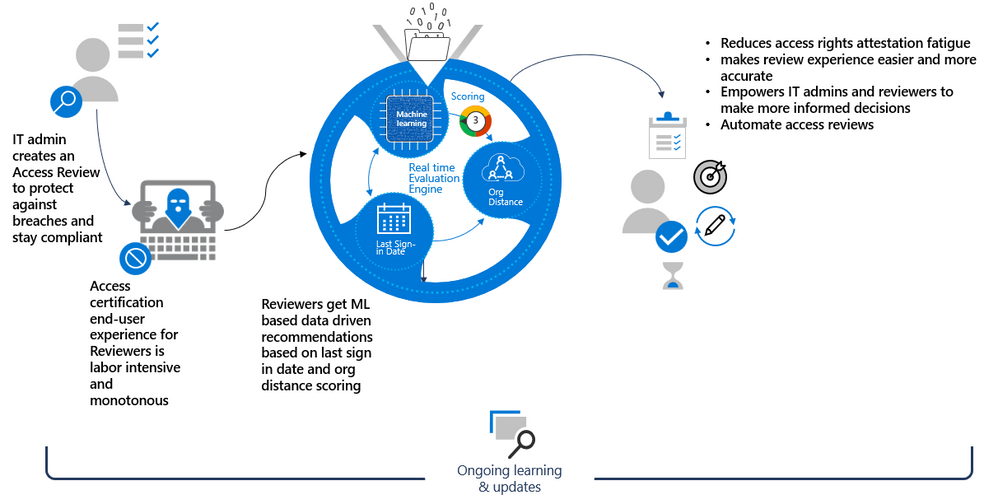
Many of you are already using Azure AD access reviews to govern access of your employees, guests, and workload identities to sensitive resources. Over the years, one of the top requests from our customers is to make the review process easier so that reviewers can make quicker and more accurate decisions. Today, I’m excited to share that we’ve vastly enhanced our recommendations in access reviews using sophisticated machine learning models that determine users’ affiliation to the group being reviewed, based on the organization’s reporting structure. This additional recommendation makes the entire process much easier for reviewers, thereby increasing reviewer efficiency, reducing attestation fatigue, and ensuring that your sensitive resources are secure.
Microsoft Entra Identity Governance is helping customers move beyond the traditional Identity governance approach of managing access, thereby reducing cost and increasing productivity.
What is User-to-Group Affiliation?
The User-to-Group Affiliation recommendation compares users’ relative affiliation with other users in the group, based on the organization’s reporting structure. Our machine learning based scoring mechanism identifies the distance between the users in an organizational hierarchy to detect those users who are very distant from other users in the group — i.e., have "low affiliation" — and our system then provides a ‘Deny’ recommendation.
Enabling this recommendation in access reviews is a one-click process
Switching on this recommendation while creating access reviews is easy – select the decision helper “User-to-Group Affiliation” in settings during the access review creation experience and the rest is the same as any other access review.

Recommendations for Reviewers of access reviews:
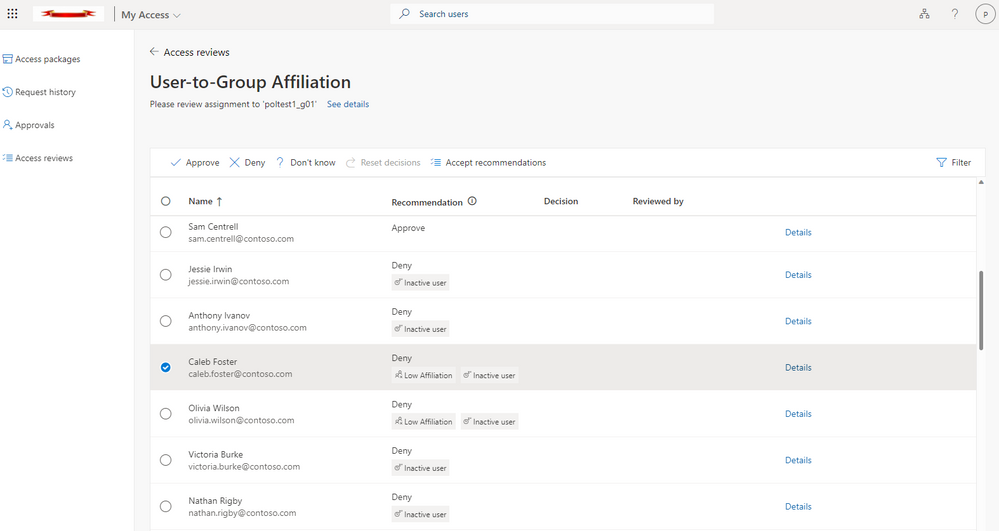
The reviewers of access reviews see the recommendations if a user has “Low Affiliation” with other users within the group along with our existing Inactive user recommendation. The reviewer can accept the recommendations by clicking on “Accept Recommendations” or can manually “Accept” or “Deny” access based on the recommendations, thereby helping the reviewer make a quick decision.
Additional details to enhance access review decision making:
A reviewer who needs additional information to make an access decision can click on “Details” and will get an option to “Accept” or “Deny” access. If the reviewer selects the recommended option, the decision can be submitted directly, whereas, if the reviewer goes against the recommended option, a reason is required before the decision is submitted.

Try it now by navigating to the Entra Identity Governance and enabling access reviews on a group.
Resources and Feedback:
For more information, please visit User-to-Group Affiliation recommendation for Azure AD Access reviews
As we work on simplifying identity governance processes through analytics, we want to hear from you! Please leave your comments down below or reach out to us on aka.ms/AzureADFeedback.
Joseph Dadzie, Partner Director of Product Management
Twitter: @joe_dadzie
Learn more about Microsoft identity:
- Related Articles: User-to-Group Affiliation recommendation for Azure AD Access Reviews
- Get to know Microsoft Entra – a comprehensive identity and access product family
- Return to the Microsoft Entra (Azure AD) blog home
- Join the conversation on Twitter and LinkedIn
- Share product suggestions on the Entra (Azure AD) forum
Published on:
Learn moreRelated posts
Sync identities from Rippling to Microsoft Entra ID
Today, we’re thrilled to announce that customers using Rippling HCM can now automatically provision users to on-premises Active Directory and ...
Microsoft Entra ID Governance for government
I’m pleased to announce that as of November 1, 2024, Microsoft Entra ID Governance is available for federal agencies, state and local governme...
Update to security defaults
As part of the Secure Future Initiative, we’ve evolved our security approach to align with three security principles: secure by design, secure...
Meet Microsoft Entra at Ignite 2024: November 18-22
Microsoft Ignite is just around the corner, taking place from Monday, November 18, 2024 through Friday, November 22, 2024, in Chicago, Illinoi...
Manage Microsoft Entra ID role assignments with Microsoft Entra ID Governance
I’m excited to announce that we now support Microsoft Entra role assignments in Microsoft Entra ID Governance's Entitlement Management feature...
The latest enhancements in Microsoft Authenticator
Hi folks, I'm thrilled to announce three major Microsoft Entra ID advancements that will help you protect your users with phishing-resi...
Microsoft Security announcements and demos at Authenticate 2024
The Microsoft Security team is excited to connect with you next week at Authenticate 2024 Conference, taking place October 14 to 16 in Carlsba...
What's new in Microsoft Entra - September 2024
We’re excited to announce the general availability of Microsoft Entra Suite—one of the industry’s most comprehensive secure access solutions f...
Explore the key benefits of Microsoft Entra Private Access
The traditional network security models are becoming increasingly ineffective in a world where remote work and cloud services are the norm. Co...
Join us at the Microsoft Entra Suite Showcase!
This fall, we are bringing the Microsoft Entra Suite Showcase to cities worldwide. Join us to explore how our latest advancements in secure id...