
Open at Microsoft: Radius

Earlier this year in our blog post highlighting Dapr, we stated our goal to empower all developers to be successful at building any application, using any language, on any platform. In the pursuit of this goal, we are committed to building open, flexible technology that makes it easy for any developer to build adaptable and dynamic applications that run on the cloud and edge.
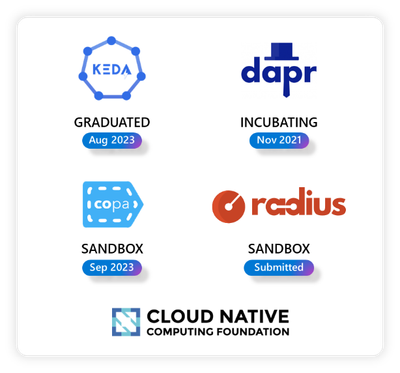
One of the many teams at Microsoft focusing on building open, flexible, technologies is the Azure Open-Source Incubations team. Projects from Azure OSS Incubations include Dapr (https://dapr.io), KEDA (https://keda.sh), Copa (https://project-copacetic.github.io/copacetic), and the most recent project, Radius (https://radapp.io). Each project is open-source, cloud-neutral, and has been donated to (or in the process of donating to) the Cloud Native Computing Foundation (CNCF).
Radius: Cloud-native application platform that works on any cloud
Last month we announced Radius, a new open-source project that seeks to improve cloud-native application development for developers and the IT operators that support them. With Radius, we’re expanding our goal to empower not just developers, but the entire application team building applications on any platform.

Radius is focused on collaboration for teams building, deploying, and managing cloud-native applications. From microservices to infrastructure, Radius allows developers and operators to focus on their areas of expertise, all in a self-service platform that accelerates team productivity. In Radius, developers define their application, including all the services, dependencies, and relationships within it. In parallel, operators define environments that encapsulate the infrastructure templates (Recipes), policies, and organization requirements for their specific platform (Azure, AWS, self-hosted). Applications deployed to a Radius Environment bind to the platform, enabling applications that can run on any cloud.
Central to Radius is the belief that applications are more than just lists of services and infrastructure; they’re also all the relationships that form the Application Graph. Radius provides teams with a way to describe, deploy, and query relationships within an application. From this graph teams can understand “what is the app?” and collaborate on this shared understanding.
Introduction to Radius
Learn from Azure OSS Incubation architect Ryan Nowak as he dives into Radius on the Open at Microsoft show. Find the episode on both Microsoft Learn TV and YouTube.
Join the Radius Community
To learn more about Radius, join the open-source GitHub project, drop into the Radius Discord server, or visit the Radius website.
How to stay updated on the latest Open at Microsoft videos
Be on the lookout for the next featured open-source episode from the Open at Microsoft show series, and how you can contribute back to the ecosystem. To get new updates of episode releases be sure to subscribe to our YouTube page here.
Published on:
Learn moreWe can help you with Open at Microsoft: Radius
If you want help implementing, troubleshooting, or improving this product, contact us and we’ll point you in the right direction.
Related posts
This Month in Azure Static Web Apps | 09/2024
We are back with another edition of the Azure Static Web Apps Community! :party_popper: September was yet another month ...
GitHub Copilot for Azure: 6 Must-Try Features
As developers, we are constantly seeking tools that streamline our workflows and boost productivity. … Enter GitHub Copilot for Azure, now in ...
Responsible AI Mitigation Layers
Generative AI is increasingly being used in various kinds of systems to augment humans and infuse intelligent behavior into existing and new a...
Streamline Your Azure Workflow: Introducing GitHub Copilot for Azure in VS Code
I'm excited to announce the public preview of GitHub Copilot for Azure - a new addition to your toolkit that seamlessly integrates with G...
Build Intelligent Apps Code-First with Prompty and Azure AI
Building Generative AI applications can feel daunting for traditional app developers. What does the end-to-end applicati...
Certificación AI-900 (Fundamentos de IA) con Chicas en IA
La inteligencia artificial ha llegado para quedarse, ¡y más aún con la revolucionaria IA generativa! Para ayudar a los profesionales a especia...
Get certified with Learn Live GitHub series!
GitHub Universe is coming, and Microsoft and GitHub are partnering to offer a new special Learn Live series in Brazilian Portuguese, English a...
Certifícate con Learn Live GitHub en Español
Microsoft y GitHub se han unido para ofrecer una nueva serie especial de Learn Live en inglés y español: GitHub 2024. Del 10 al 24 de Octubre,...
Evaluating generative AI: Best practices for developers
As a developer working with generative AI, you've likely marveled at the impressive outputs your models can produce. But how do you ensure the...
Introducing Azure Product Retirement Livestreams
The Azure Retirements team, in collaboration with key partner groups, is excited t...