
My Visual Guide to #MSBuild Keynote: 10 Things To Know
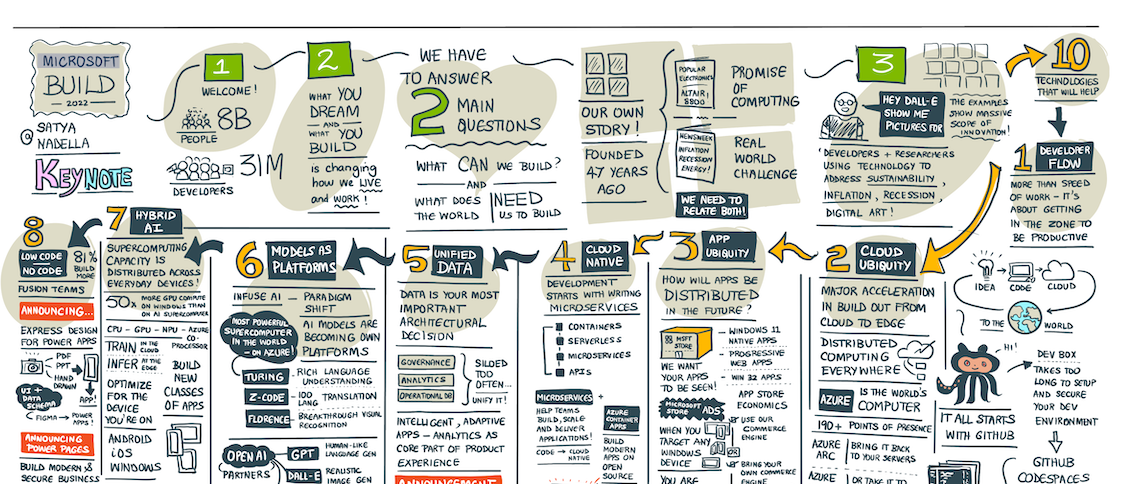
Just in case you missed it, Microsoft Build 2022 happened this past week (May 24-May 26) and it was a packed conference with 330+ sessions according to the schedule. As I do every year, I paid most attention to the opening keynote from Satya Nadella which often provides the high-level roadmap of core themes and exciting announcements that we can then use to find and attend deep-dive sessions into our topics of interest.
This year, the keynote was more packed with announcements than usual. As I do every year, I sketch-noted the entire thing and as you can see there was a lot of information covered. If you're a visual-spatial learner, having a 1-page cheatsheet might help so I thought I'd share it.
- If you want to share the image, there's a tweet to make that easier .
- If you're curious. how this was made, here's a 30-second time-lapse that may help
- If you're looking for a printable or hi-res display version, here's a link to the original.
Scroll down further to get my view of the 10 key areas of focus - with 1 thing I liked best in each. If you want a review of key announcements, check out the 2022 Microsoft Build Book Of News!
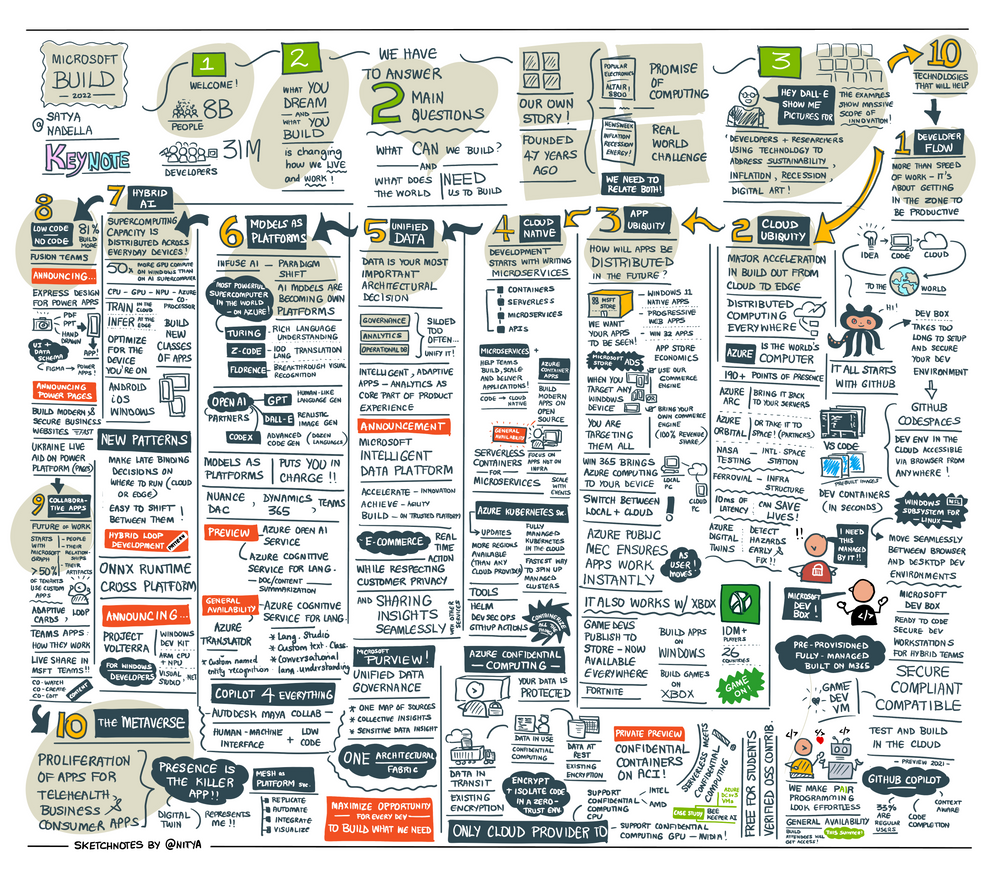
The keynote began with a simple observation- developers need to ask 2 questions:
- What CAN we build? This is really about the tools and technologies available to us.
- What does the world NEED US to build? This is really about prioritizing for impact.
The keynote then went into more detail on 10 technology areas of relevance:
1. Developer Flow.
This focused on the tools and processes that would make us the most productive as developers. There were some great shout-outs to GitHub Codespaces and GitHub Copilot - but the big announcement was Microsoft Dev Box - a cloud-based service that provides a secure, ready-to-code workstation for hybrid teams that can be managed by IT. Learn more here.
2. Cloud Ubiquity.
Was about the acceleration in building out technology support from cloud to edge, building on technologies like Azure Arc, Azure Digital Twins and Azure Orbital. The latter is a core component of Azure Space solutions targeting the needs of both Enterprise (get insights from space data) and Space Operators (get reliable connections to/from space).
3. App Ubiquity.
This asked the question "How will apps be distributed in the future?" - shining a spotlight on apps stores (like Microsoft Store for Windows apps), Windows 11 native apps and Progressive Web Apps (a focus for our #30DaysOfPWA learning series). Learn more about Windows dev here.
4. Cloud Native.
Cloud Native development starts with writing microservices - then using serverless architectures, containerized deployments and API-driven workflows, all managed with DevOps, to help teams deliver and scale modern applications. The big news was the General Availability of Azure Container Apps - and check out this Twitter thread from Craig Shoemaker for for a comprehensive list of resources to jumpstart development.
5. Unified Data.
"Data is your most important architectural decision" - the big announcement here was the Microsoft Intelligent Data Platform - that focuses on building a unified platform to manage your databases, analytics and governance needs in a unified and seamless solution.
6. Models as Platforms.
This segment started by recognizing a paradigm shift where AI models are now powerful enough to be their own platforms, driving innovative apps and experiences. There were many announcements in this segment work checking out in the Book Of News. One announcement that stood out to me was the Azure OpenAI Service now in public preview, giving you an opportunity to use large-scale generative AI models to power or reimagine your application experiences.
7. Hybrid AI
The segment began by recognizing that supercomputing capacity is now distributed across everyday devices, making it possible for us to build new classes of apps and use new patterns for effective distributed computing. One highlight was the announcement of Project Volterra a new device powered by the Snapdragon compute platform - with a Qualcomm Neural Processing SDK for Windows toolkit that can help developers build new AI-powered scenarios using CPU, GPU and NPU capabilities.
8. Low-Code / No-Code
This segment explored new capabilities available to Fusion Teams using Power Platform technologies. The two key announcements that caught my attention were: Power Pages (preview, quickly build business websites with no code, rich templates) and Express Design For Power Apps (create functional mobile and web apps directly from captured images of a design sketched on paper/board or provided as digital assets from services like Figma).
9. Collaborative Apps
This focused on technologies to power the future of work, with specific emphasis on a whole set of features and updates for Microsoft Teams. You can check out all the announcements in the Book of News but the two that stood out to me were Live Share experiences within Teams, and that the Teams Toolkit for Visual Studio Code (and CLI) were now generally available.
10. The Metaverse. The focus was on apps for telehealth, business and consumer domains that could benefit from virtual environments for intuitive collaborations. The main takeaway: "Presence is the killer app" in this context.
Hope you found the visual guide and links useful! What topics or announcements did YOU find most interesting? Leave me comments in the notes - I am still catching up with all the Build sessions and news and want to know what I should check out.
Published on:
Learn moreRelated posts
This Month in Azure Static Web Apps | 09/2024
We are back with another edition of the Azure Static Web Apps Community! :party_popper: September was yet another month ...
GitHub Copilot for Azure: 6 Must-Try Features
As developers, we are constantly seeking tools that streamline our workflows and boost productivity. … Enter GitHub Copilot for Azure, now in ...
Responsible AI Mitigation Layers
Generative AI is increasingly being used in various kinds of systems to augment humans and infuse intelligent behavior into existing and new a...
Streamline Your Azure Workflow: Introducing GitHub Copilot for Azure in VS Code
I'm excited to announce the public preview of GitHub Copilot for Azure - a new addition to your toolkit that seamlessly integrates with G...
Build Intelligent Apps Code-First with Prompty and Azure AI
Building Generative AI applications can feel daunting for traditional app developers. What does the end-to-end applicati...
Certificación AI-900 (Fundamentos de IA) con Chicas en IA
La inteligencia artificial ha llegado para quedarse, ¡y más aún con la revolucionaria IA generativa! Para ayudar a los profesionales a especia...
Get certified with Learn Live GitHub series!
GitHub Universe is coming, and Microsoft and GitHub are partnering to offer a new special Learn Live series in Brazilian Portuguese, English a...
Certifícate con Learn Live GitHub en Español
Microsoft y GitHub se han unido para ofrecer una nueva serie especial de Learn Live en inglés y español: GitHub 2024. Del 10 al 24 de Octubre,...
Evaluating generative AI: Best practices for developers
As a developer working with generative AI, you've likely marveled at the impressive outputs your models can produce. But how do you ensure the...
Introducing Azure Product Retirement Livestreams
The Azure Retirements team, in collaboration with key partner groups, is excited t...