
Building a Unified Bible Platform: Q&A, Insights, and Ministry Matching
In today’s ever-evolving technological landscape, there are infinite possibilities to delve into and interact with Bible verses. I myself have recently evolved my personal endeavor from a single Q&A platform into a comprehensive unified application that combines three powerful Bible-focused services: AI-powered Q&A specifically tailored to the King James Version (KJV), curated insights browsing, and ministry recommendation matching.
Extracting the KJV Bible
The first step was to acquire the content. Thanks to the Bible API, extracting the full text of the KJV Bible was a straightforward process. This API offers a structured format of the Bible verses, making the extraction process seamless.
Note: Bible verses taken from the King James Version (KJV) and sourced from api.bible (bible id: de4e12af7f28f599-02).
Generating Embeddings with OpenAI
After obtaining the Bible verses, the next challenge was understanding and contextualizing them. I employed OpenAI’s text-embedding-ada-002 model. This model, renowned for its capabilities, transforms textual data into embeddings - numerical representations of the text that capture the essence and context of the content.
Storing Embeddings in Pinecone
Quickly retrieving relevant embeddings was crucial to creating a responsive Q&A interface. Pinecone, a vector search service, provided the solution. After generating embeddings from the Bible verses, I stored them in a Pinecone index. Pinecone index ensured efficient and quick retrieval during user interactions.
Creating the Unified Platform with Python Flask
With the backend prepared, it was time to focus on the user interface. Python’s Flask framework was the tool of choice, now enhanced with a modular Blueprint architecture. Flask, known for its lightweight nature and flexibility, was perfect for setting up a unified platform that houses three distinct services:
- Bible Q&A Service - The original AI-powered question answering
- Bible Insights Service - Browse curated insights from Bible books and chapters
- Ministry Matching Service - Church ministry recommendation system using OpenAI
Leveraging OpenAI for Response Generation
When users posed questions, the system needed to provide meaningful responses. By forwarding the user’s question to OpenAI, the model via LangChain’s Pinecone vector store would sift through the stored embeddings in Pinecone, corresponding to each Bible verse. This would pinpoint verses with content most relevant to the question.
Additionally, the ministry matching service leverages OpenAI’s conversational capabilities to provide personalized ministry recommendations based on user interests and calling.
Displaying Results
The unified platform now displays results from all three services through a cohesive interface. Users can seamlessly navigate between AI-powered Q&A, browse curated biblical insights, or discover ministry opportunities - all within a single application with shared navigation and consistent styling.
Modern Deployment with Azure Container Apps
Moving beyond traditional hosting, I deployed the unified application using Azure Container Apps, which provides several advantages over previous AWS EC2 deployment:
- Serverless scaling: Automatically scales from 1-10 replicas based on demand
- Managed SSL certificates: Automatic HTTPS with custom domain support
- Container-based deployment: Docker containers for consistent environments
- Integrated monitoring: Built-in logging and health checks
- Cost optimization: Pay-per-use model with efficient resource utilization
The unified platform is now live at https://uba.josephvelliah.com, showcasing all three services in one cohesive experience.
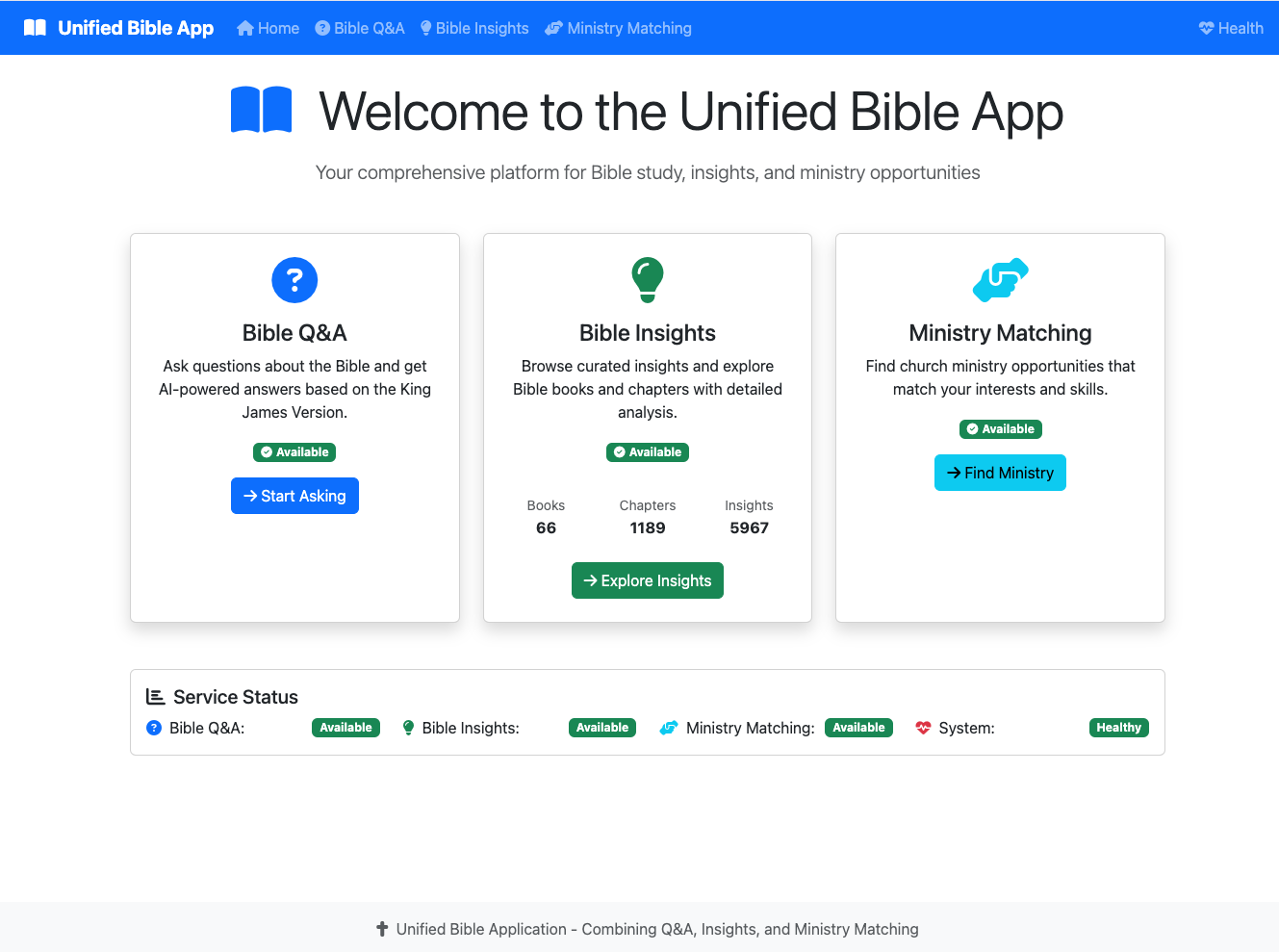
The platform has evolved to include additional services beyond the original Q&A functionality. Curated insights are now integrated directly into the unified platform as the “Bible Insights” service, making scripture more accessible and engaging for users. The containerized deployment on Azure Container Apps ensures smooth operation and automatic scaling based on user demand.
Enhanced Technical Architecture
The unified platform demonstrates modern application design principles:
- Modular Services: Clean separation of concerns with independent service functionality
- Graceful Degradation: Services work independently; missing configuration doesn’t break the app
- Security Features: Rate limiting, input sanitization, and Content Security Policy headers
- Production Ready: Health checks, structured logging, and monitoring capabilities
- Docker Containerization: Consistent deployment across environments
In conclusion, evolving from a single Bible Q&A application to a unified platform combining OpenAI’s powerful models, Pinecone’s efficient storage, curated insights, and ministry matching capabilities resulted in a comprehensive Bible study resource. It demonstrates how technology can enhance our understanding of Bible verses while providing practical tools for spiritual growth and community engagement, all brought closer to the modern user through thoughtful platform design.
Visit the live unified platform at https://uba.josephvelliah.com to experience all three services.
Published on:
Learn moreWe can help you with Building a Unified Bible Platform: Q&A, Insights, and Ministry Matching
If you want help implementing, troubleshooting, or improving this product, contact us and we’ll point you in the right direction.
Related posts
Vasanam Studio: How I Built a Bible Verse Video Generator for My Church as a Hobby Project
Every morning at 5 AM, the women of my church gather for prayer. At the end of the session, our pastor’s wife shares a Bible verse and sends a...
The demo worked. That was the problem.
Over a weekend I built a small Kubernetes demo to play with zero trust. Three little services calling each other in a chain, a login page in f...
Notes from building an agent on AgentCore end to end
I wanted a reason to use AgentCore end to end. Runtime, memory, guardrails, identity, the whole thing. A Bible Q&A agent felt like a good ...
Building a Rust gRPC AI Security Gateway for LLM Traffic
I wanted a small, honest implementation of the GenAI governance shape in code: a component on every LLM call that applies policy first, option...
Claude Code Security: The Smart Way to Integrate AI
Anthropic just dropped Claude Code Security, and if you’re anywhere near AppSec or DevSecOps, you’ve probably already seen the debate lighting...
How I Built a Semantic Cache Using Only AWS Services
LLM calls are expensive and slow, but here’s the thing - users ask the same questions in different ways all the time. “What’s your refund poli...
How to Build Better AI Agent Tools: Cut Costs by 70% (MCP Server Case Study)
Building tools for AI agents isn’t the same as building regular APIs. This guide shows you how to design tools that reduce token costs by 60-7...
Building a DevSecOps Pipeline on AWS (And You Can Too)
I have been working with CI/CD pipelines for a while now, and honestly, most of them just focus on getting code deployed fast. But what about ...
AWS DevOps Agent: AI-Powered Incident Investigation in Seconds
Stop spending 30 minutes investigating incidents. Let AI do it in seconds. Here is a hands-on demo you can practice in 15 minutes. The Proble...
DynamoDB Just Made Your Life Easier: Multi-Attribute Composite Keys Explained
AWS just dropped a feature on November 19, 2025 that is going to save you from one of DynamoDB’s most annoying workarounds: multi-attribute co...