The MVP trap: AI lets you do more, but often worse

There’s a narrative floating around right now: With AI, one person can do the work of a whole team.
- Code? Done.
- Design? Prompted.
- Copy? Generated.
- Voice-over, editing, visuals? All stitched together in record time.
And at first glance, that sounds like progress. AI makes it easier than ever to ship something: quickly, independently, and with just enough polish to post. But it’s also creating a very specific kind of trap.
The MVP pyramid no one wants to talk about
There’s an image I keep coming back to whenever people start throwing around the word “MVP”.
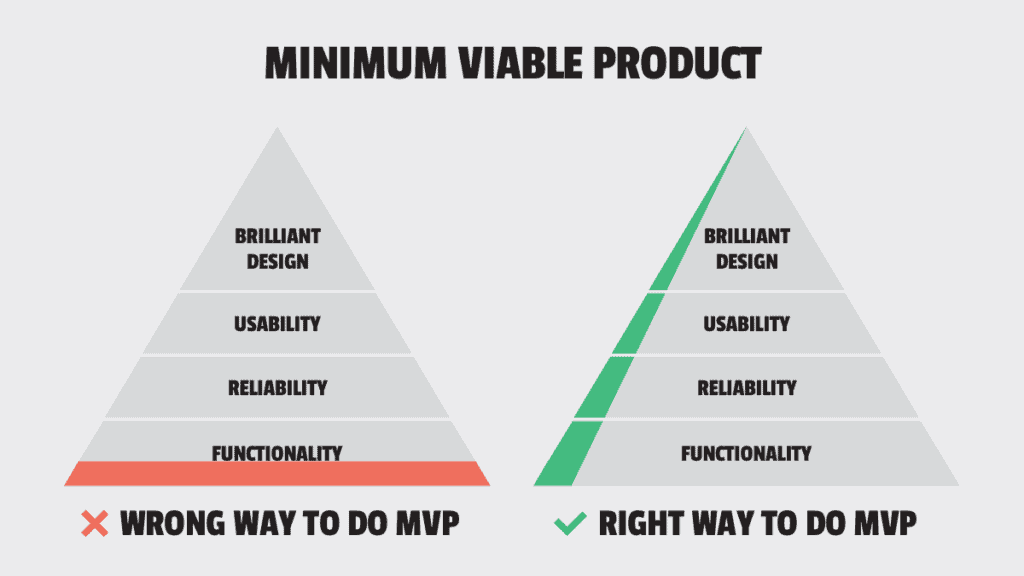
The left side is what many AI-powered projects are starting to look like: Stacked layers. Functionality without usability. Code without context. Stuff that technically works, but feels empty.
The right side? That’s how it should work. A small, testable, coherent slice. Something people can actually use. Something with value, not just features. And right now, AI is making the left-hand path faster, cheaper, and way too tempting.
Shipping isn’t the same as succeeding
Just because something runs doesn’t mean it works. Just because it’s publishable doesn’t mean it’s worth sharing. And just because AI lets you do everything yourself doesn’t mean you should. We’re now surrounded by content and tools that exist purely because they can, not because they solve a problem well, or even make sense.
Voice-overs that miss the tone.
Copy that reads like a marketing intern on autopilot (not Copilot)
Interfaces that look decent in a screenshot but fall apart under real use
The result? Lots of output. Very little value.
The “we don’t need juniors” myth
Here’s where it gets dangerous. Some folks are already saying
- “If AI can write the code, we don’t need junior devs.”
- “If ChatGPT can write posts, who needs marketing people?”
- “If design is a prompt away, why bother with actual designers?”
But juniors don’t just write code. They ask the awkward questions. They bring fresh eyes to assumptions. They grow into the people who later build the foundations you depend on. Removing them from the system doesn’t save time; it starves your future talent pipeline.
Same with marketers, designers, QA, tech writers: anyone who adds clarity, nuance, and experience to what you’re building. AI doesn’t replace them. It just replaces your excuses for skipping them.
AI lowers the cost of mediocrity
When things were expensive to build, we were careful by default. We tested. Reviewed. Debated. Improved. Now? We generate, skim, and ship. Because it’s cheap. Because it’s fast. Because it looks good enough.
But doing more isn’t the same as doing better.
What are we actually building?
AI is here. It’s useful. It’s powerful. But it doesn’t know what matters to your users. It doesn’t care about the edge cases. It won’t ask if your output is accessible, maintainable, or even remotely worth doing. That’s still on you. On your team. On your taste. So the question isn’t “how much can I build now?”, but
Am I delivering a meaningful slice of value, or just another bottom layer nobody needs?
Because in the end, tools don’t make good products. People do.
Published on:
Learn moreWe can help you with The MVP trap: AI lets you do more, but often worse
If you want help implementing, troubleshooting, or improving this product, contact us and we’ll point you in the right direction.
Related posts
You are holding GitHub Copilot Wrong!
Most developers think that one can’t really use GitHub Copilot wrong. There is a chat interface that lets you also choose a model, so th...
You are holding GitHub Copilot Wrong!
Part 0 showed why constant prompting, re-prompting, and steering GitHub Copilot feels fragile. Not because Copilot is unreliable, but because ...
Building a Multi-Hierarchy Ticket Classification System (Because Keywords Aren't Enough)
Look, I love a good keyword-based system as much as the next developer. They’re fast, predictable, and when your user says “VPN,&r...
Secretless cross-tenant dataverse access
Client secrets are like hiding your house key under the mat; easy to grab and impossible to audit. Certificates are just slightly better, beca...
How Azure CLI handles your tokens and what you might be ignoring
Running az login feels like magic. A browser pops up, you pick an account, and from then on, everything just works. No more passwords, no more...
How Dev Proxy teaches you to make your apps more resilient
I added Microsoft Dev Proxy to my Mermaid → Dataverse converter, because I wanted to test how it handled rate limits and API errors. What I go...
Building Azure functions that never store secrets — ever
What if your function could hit Microsoft Graph with no client secrets, no certs, and no Key Vault entries? That is exactly what a Managed id...
Introducing Mermaid to Dataverse Converter
Why diagrams matter (and why they usually fail us) Entity-Relationship Diagrams (ERDs) are the universal shorthand for talking about data mode...
It’s OK to be seen trying
It’s OK to be seen trying Somewhere along the way, we started believing that you’re only allowed to speak after you’ve figured everything out....
Stuck in pilot - Part 1: no foundations, no future
“We just need to test the AI. We’ll figure out the data later.” That sentence has quietly killed more AI pilots than any model failure ever ...