Auditing UK energy policy without a cluster: a laptop, a duck, and twenty years of wind
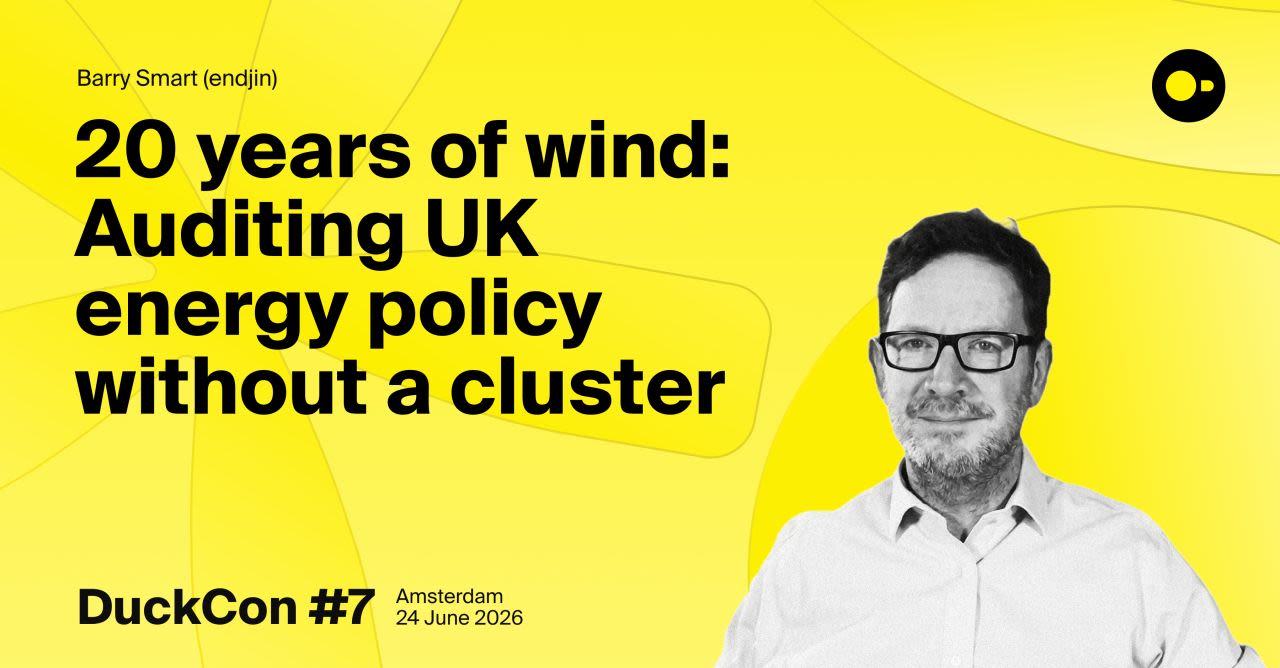
Barry Smart, Director of Data and AI at endjin, sets out to audit UK energy policy with his dad, a fellow energy-industry veteran, on a single laptop. Their question: is the dash to Net Zero quietly compromising the security, reliability, and affordability of energy? They answer it not with opinion but with twenty years of fragmented government data.
Twenty-five years ago, work like this meant a fortune and a monolithic data warehouse. This time it is simple Python ingestion guarded by strict data contracts, a DuckDB medallion model, and requirements written in Gherkin as composable, fully tested functions, running where PySpark once failed to scale. The result: man-months of cost and "data fear" collapsed into a short laptop project, and a glimpse of how data teams freed from infrastructure can finally work as innovation teams.
Chapters
- 00:00 Introduction: endjin, DuckDB, and auditing UK energy policy
- 00:50 The data challenge and lessons from a 25-year-old data warehouse
- 01:40 Architecture: data contracts, Parquet, and a DuckDB medallion model
- 02:40 A data-driven approach with Gherkin and composable relations
- 03:40 Generating insights and why DuckDB scales where PySpark did not
- 04:30 New ways of working for data teams
Published on:
Learn moreWe can help you with Auditing UK energy policy without a cluster: a laptop, a duck, and twenty years of wind
If you want help implementing, troubleshooting, or improving this product, contact us and we’ll point you in the right direction.
Related posts
Introducing Survive the Sprint: a pixel-art game built (almost) in one shot with Claude Opus 5.5
I gave Claude Opus 5.5 one prompt and the endjin 'Who we are' page, and got back most of a pixel-art browser game starring the endjineers. Her...
How to trust your AI-assisted data analysis
AI tools can produce data analysis that looks authoritative without being verifiable. Whether you're the analyst or the decision-maker relying...
Providing comparative context with DAX Calculated Tables under Row Level Security
Row Level Security in Power BI solves one problem (who sees what) but introduces another - comparisons across the full dataset become impossib...
How to Implement Generation in RAG
Understand the generation step of RAG: how LLMs use augmented context to produce grounded responses, how to enforce structured outputs with Py...
How to Implement Augmentation in RAG
Understand the augmentation step of RAG: how retrieved documents are structured into prompts, how metadata and citations improve response qual...
How to Implement Retrieval in RAG
Understand the retrieval step of RAG: Learn how database queries, keyword search, vector search, and hybrid approaches find the right informat...
TypeDeclaration: An Abstraction for Understanding JSON Schema
The Corvus.Json.CodeGeneration library analyses JSON Schema and builds a TypeDeclaration tree that maps schema patterns to code patterns. The ...
Optimising DAX: Practical Examples
The final post in the Optimising DAX series: the CALCULATE trap, variables and IF.EAGER, slicer costs, and a practical approach to isolating s...
Optimising DAX: Data Materialisation
Data materialisation is when the storage engine gives up on efficient processing and rebuilds the entire table. This post explains what trigge...
Building API Reference Documentation From Code, Part 2: Under the Hood
A deep dive into the cross-assembly linking, PDB-based source links, TFM scanning, enrichment merging, and search indexing that power our API ...