Modernizing Authentication Management

We’re thrilled to announce two key updates to how you manage your authentication experiences! The General Availability of Converged Authentication Methods and Public Preview of a modernized version of multifactor authentication (MFA) Fraud Alert.
The General Availability of Converged Authentication Methods allows all methods used for authentication and password reset to be centrally managed and with more control, providing the ability to target groups of users.
The Public Preview of modern MFA Fraud Alert brings the configuration into the authentication methods policy and integrates this user-reported signal of suspicious MFA prompts with Identity protection.
Converged Authentication Methods
Historically, methods had to be managed separately for MFA and self-service password reset. Now, they can both be managed in one policy alongside passwordless methods like FIDO2 security keys and certificate-based authentication. Newly added methods include SMS, Voice Calls, Third-party Software OATH, and Email OTP.
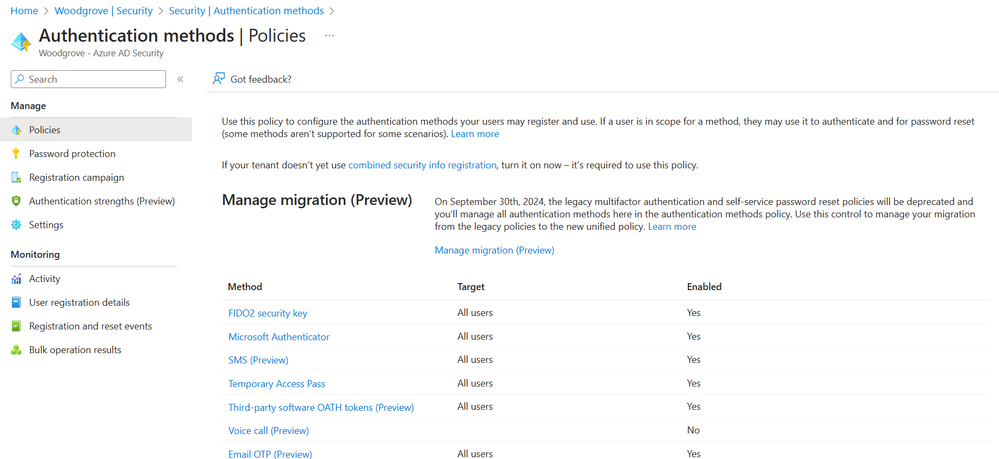
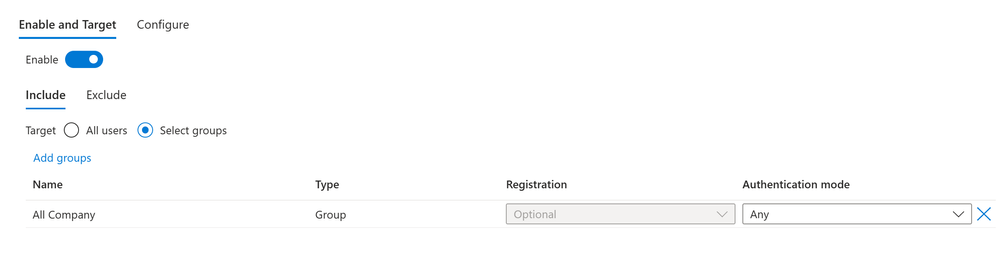
Methods can now be managed more granularly, with the option to enable them for specific groups of users instead of all users and the ability to exclude groups of users from being targeted. This means you can perform actions like trial methods with pilot groups and limit lower security methods like SMS and Voice to smaller groups of users.
We’ve also added a migration control to help you migrate methods from the legacy MFA and self-service password reset policies to the authentication methods policy. The control lets you move and test methods individually, before having to disable methods in the legacy policies.
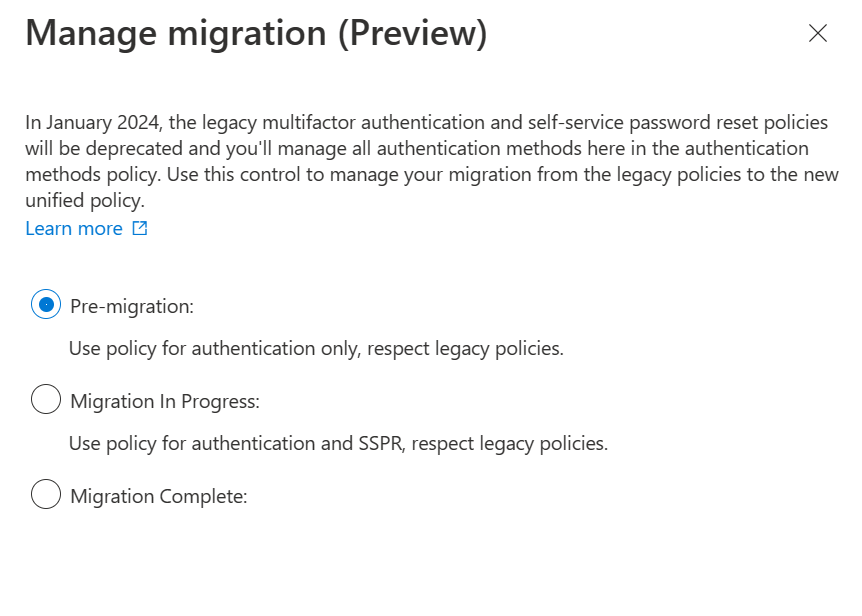
Later in 2024 we’ll be deprecating the ability to manage authentication methods in the legacy policies. As you migrate, we recommend stepping up your security posture by moving away from SMS and Voice , and enabling more secure methods like Microsoft Authenticator and FIDO2 Security keys, if you haven’t already.
Learn more about managing authentication methods and migrating to the authentication methods policy, and migrate ASAP!
Report Suspicious Activity
Azure Active Directory (Azure AD) has had the MFA Fraud Alert feature, which enabled users to report suspicious MFA prompts they received on the Microsoft Authenticator app or via phone. Users had the option to be added to a block list where the user would no longer receive MFA prompts until removed, a manual task for admins. Administration of Fraud Alert and the blocklist all required Global Admin privileges. We’ve modernized Fraud Alert with Report Suspicious Activity, moving the configuration for the feature to the authentication methods policy to enable configuration from the same location as other authentication related settings. Now we’ve integrated the alert events with Identity Protection for more comprehensive and configurable action once a user reports a prompt.
You can enable Report Suspicious Activity, and target either all of your users or an initial test group, via the new Settings in the Authentication methods UX, or via the authentication methods MSGraph API.

Once enabled, if a user reports a MFA phone app push notification or voice MFA prompt as suspicious, the user account will be marked with user risk High. You can then use risk-based policies to have greater control over the specific remediation for these users, whether it’s requiring immediate password change through self-service password reset, requiring MFA for all authentications until the risk is remediated, or blocking authentication until the risk is remediated.

If you don’t have P2, you can also use the risk event to disable the account until the risk can be remediated, for similar functionality to the legacy MFA blocklist.
Report Suspicious Activity will function in parallel with the legacy MFA Fraud Alert during preview, so if you have Fraud Alert enabled with automatic blocking, you’ll need to both remediate the risk for users in scope for Report Suspicious Activity as well as remove the user from the MFA blocklist.
Learn more about configuring Report Suspicious Activity and how to leverage risk-based policies and try Suspicious Activity now.
As always, let us know your feedback.
Best regards,
Alex Weinert (@Alex_T_Weinert)
VP Director of Identity Security, Microsoft
Learn more about Microsoft identity:
- Related Articles: How to migrate to the Authentication methods policy - Azure Active Directory (preview) - Microsoft Entra | Microsoft Learn
- Get to know Microsoft Entra – a comprehensive identity and access product family
- Return to the Microsoft Entra (Azure AD) blog home
- Join the conversation on Twitter and LinkedIn
- Share product suggestions on the Entra (Azure AD) forum
Published on:
Learn moreWe can help you with Modernizing Authentication Management
If you want help implementing, troubleshooting, or improving this product, contact us and we’ll point you in the right direction.
Related posts
Sync identities from Rippling to Microsoft Entra ID
Today, we’re thrilled to announce that customers using Rippling HCM can now automatically provision users to on-premises Active Directory and ...
Microsoft Entra ID Governance for government
I’m pleased to announce that as of November 1, 2024, Microsoft Entra ID Governance is available for federal agencies, state and local governme...
Update to security defaults
As part of the Secure Future Initiative, we’ve evolved our security approach to align with three security principles: secure by design, secure...
Meet Microsoft Entra at Ignite 2024: November 18-22
Microsoft Ignite is just around the corner, taking place from Monday, November 18, 2024 through Friday, November 22, 2024, in Chicago, Illinoi...
Manage Microsoft Entra ID role assignments with Microsoft Entra ID Governance
I’m excited to announce that we now support Microsoft Entra role assignments in Microsoft Entra ID Governance's Entitlement Management feature...
The latest enhancements in Microsoft Authenticator
Hi folks, I'm thrilled to announce three major Microsoft Entra ID advancements that will help you protect your users with phishing-resi...
Microsoft Security announcements and demos at Authenticate 2024
The Microsoft Security team is excited to connect with you next week at Authenticate 2024 Conference, taking place October 14 to 16 in Carlsba...
What's new in Microsoft Entra - September 2024
We’re excited to announce the general availability of Microsoft Entra Suite—one of the industry’s most comprehensive secure access solutions f...
Explore the key benefits of Microsoft Entra Private Access
The traditional network security models are becoming increasingly ineffective in a world where remote work and cloud services are the norm. Co...
Join us at the Microsoft Entra Suite Showcase!
This fall, we are bringing the Microsoft Entra Suite Showcase to cities worldwide. Join us to explore how our latest advancements in secure id...