
Scale Azure Databricks secure network access to Azure Data Lake Storage

Many organisations store their data in a centralised data lake on Azure Storage accounts. In this post we will look at a solution to scale the secure network access between the centralised data lake storage account and Azure Databricks workspaces VNets.
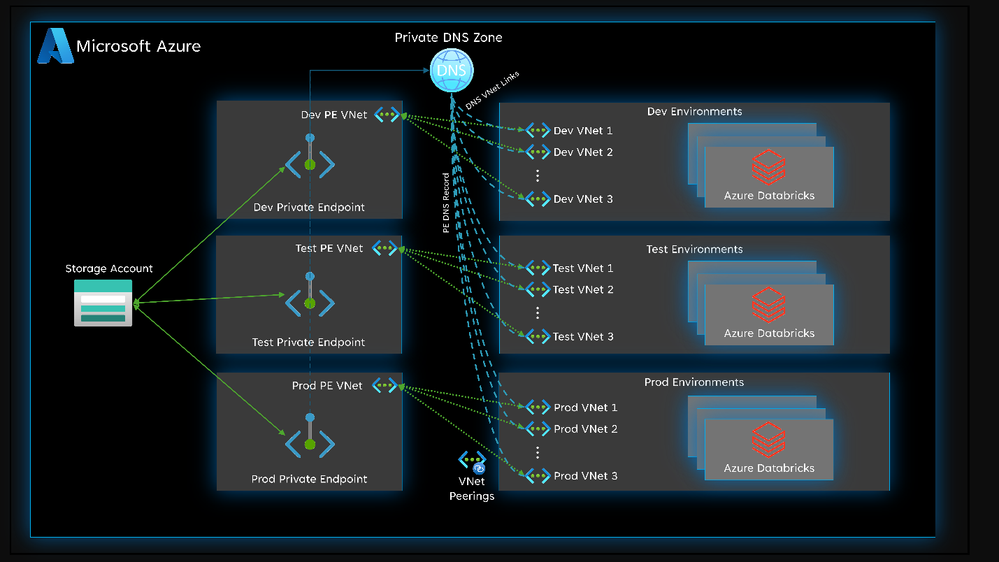
The recommended approach to achieve a scalable and secure network access to the data lake storage is to use Private Endpoints for the storage accounts.
Private Endpoint relies upon DNS resolution to automatically route the connections from the VNet to the storage account over a private link. When you create a Private Endpoint, it creates a private DNS zone attached to the VNet with the necessary updates for the private endpoints. However, if you're using your own DNS server, you might need to make additional changes to your DNS configuration.
For better scalability, create a dedicated VNet for Private Endpoints grouped based on environment - (e.g. Dev, Test, Prod) or projects. Next establish a VNet peering connection between the Private Endpoint VNet and all the VNets where your Azure Databricks workspaces are hosted. Additionally, you should establish virtual network link between the VNets and the private DNS zone that contains the records pertaining to the Private Endpoint.
Each storage account supports up to two hundred private endpoints and each VNet supports up to 500 VNet peering connections. With this approach we could scale to support up to 100,000 VNets to connect to the single centralized data lake storage.
Cost Optimization:
With this approach there are additional costs involved. Each Private DNS Hosted Zone costs $0.5/month and $0.4/million DNS queries. Each Private Endpoint costs $0.01/hour (e.g. $7.2/month). Private Endpoint incurs data processing charges of $0.02/GB (both inbound and outbound together) and VNet peering within the same region has a data processing charges of $0.02/GB (both inbound and outbound together), therefore for example to process 500GB of data it will cost $20.
The cost scales linearly according to the amount of data processed hence to optimise the cost utilisation you should combine this solution (using Private Endpoint and VNet peering) along with enabling access only to specific VNets in the storage account networking firewall rules. For the scenarios where there are lots of data needs to be processed, using the public endpoint with the network access restricted to specific VNets helps to avoid data processing charges.
Published on:
Learn moreWe can help you with Scale Azure Databricks secure network access to Azure Data Lake Storage
If you want help implementing, troubleshooting, or improving this product, contact us and we’ll point you in the right direction.
Related posts
End-to-End Full-Stack Web Application with Azure AD B2C Authentication: A Complete Guide
Application Overview The purpose of this sample application is to demonstrate the usage of Azure Active Directory B2C (Azure AD B2C) for authe...
Complex Data Extraction using Document Intelligence and RAG
Section 1: Introduction Historically, data extraction from unstructured documents was a manual and tedious process. It consisted of a c...
Harnessing Generative AI with Weaviate on Azure Kubernetes Service and Azure NetApp Files
Table of Contents Introduction Prerequisites Install Weaviate Approximate Nearest Neighbor (ANN) Benchmarks ANN Benchmarks Setup ANN Benchmark...
Securing Containerized Applications with SSH Tunneling
As cloud engineers and architects embrace containerization, ensuring secure communication becomes paramount. Data transmission and access cont...
Exploring AI Agent-Driven Auto Insurance Claims RAG Pipeline.
Introduction: In this post, I explore a recent experiment aimed at creating a RAG pipeline tailored for the insurance industry, specificall...
Azure NetApp Files now stores sensitive data DoD IL5 compliant in Azure US Government regions
Table of Contents Introduction Why Azure NetApp Files? DoD IL5 compliance in Azure Government Azure NetApp Files reaches feature parity betwee...
Data Intelligence End-to-End with Azure Databricks and Microsoft Fabric
This Azure Architecture Blog was written in conjunction with Isaac Gritz, Senior Solutions Architect, at Databricks. The Data Inte...
AI Studio End-to-End Baseline Reference Implementation
Azure AI Studio is designed to cater to the growing needs of developers seeking to integrate advanced AI capabilities into their appli...
Mastering AI adoption: Essentials to building, operating and optimizing genAI workloads on Azure
Mastering your AI adoption: Essentials to building, operating and optimizing genAI workloads on Azure As the demand for scalable, efficient AI...
Optimize Azure Stack HCI with the Well-Architected Framework
Azure Stack HCI is a hyperconverged infrastructure (HCI) solution that provides storage, network, and compute resources in on-premises...