Part 1: Building Your First Serverless HTTP API on Azure with Azure Functions & FastAPI
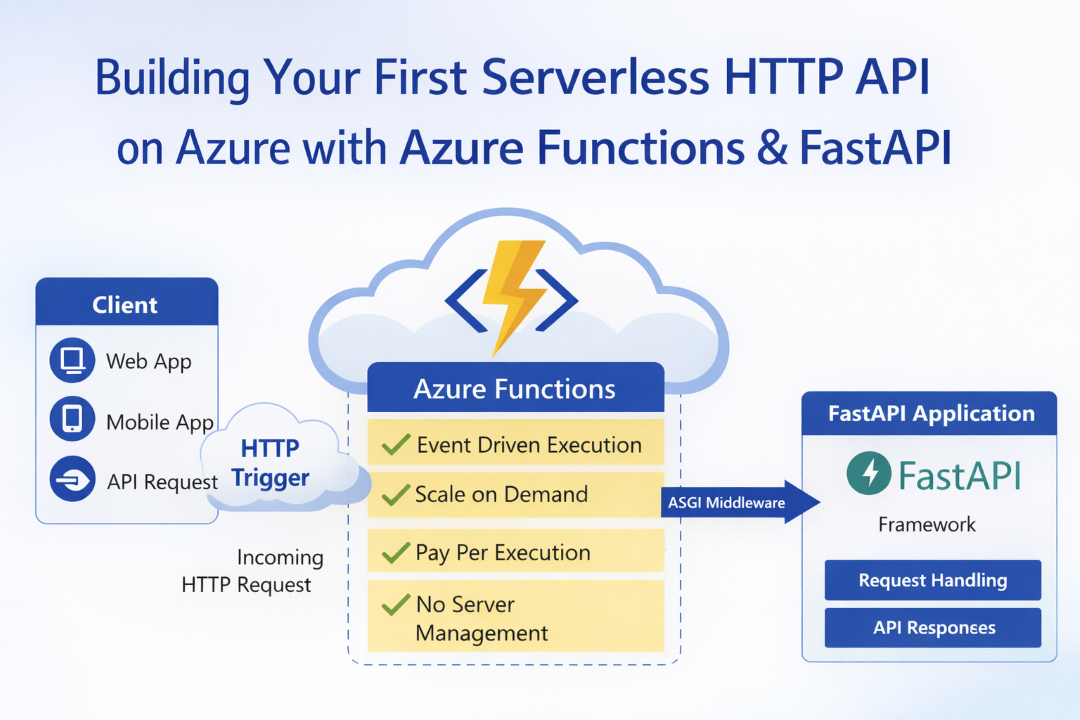
Introduction This post is Part 1 of the series Serverless Application Development with Azure Functions and Azure Cosmos DB, where we explore how to build end-to-end serverless applications using Azure Functions for compute and Azure Cosmos DB for storage. Together, these services allow you to build scalable, event-driven, cost-efficient cloud solutions without managing servers or infrastructure. […]
The post Part 1: Building Your First Serverless HTTP API on Azure with Azure Functions & FastAPI appeared first on Azure Cosmos DB Blog.
Published on:
Learn moreWe can help you with Part 1: Building Your First Serverless HTTP API on Azure with Azure Functions & FastAPI
If you want help implementing, troubleshooting, or improving this product, contact us and we’ll point you in the right direction.
Related posts
AI Agents: Meet the Azure Cosmos DB vNext Emulator
Over a typical 2 day window, we record 10 times as many emulator sessions lasting more than 30 minutes for vNext as for the legacy emulator. O...
Introducing the Native Confluent Cloud Connector Experience in Azure Cosmos DB!
Co-authored with Praveen Raja P Azure Cosmos DB already includes a powerful event foundation: change feed provides a durable, ordered record o...
From an Empty Folder to an AI Agent: Meet create-cosmos-agent
The first few minutes of a new AI project often feel productive. Create a chat endpoint, connect a model, send a prompt, and display the answe...
I’m the Only Developer on This Project. Do I Really Need RBAC?
You own the account, wrote the application, and would be the one fixing it if something broke. So role-based access control (RBAC) can sound l...
Translating an Elasticsearch Search Request to Azure Cosmos DB
This tutorial shows how common Elasticsearch search requests can be expressed using Azure Cosmos DB query patterns. Some Elasticsearch capabil...
Genspark protects live agent sessions with Azure Cosmos DB Global Secondary Indexes
The work does not end when the prompt does A user comes to Genspark with a goal: research a market, build a presentation, produce a report, an...
Azure Cosmos DB Shell is now available in the Azure portal
You can now open Azure Cosmos DB Shell directly from Data Explorer in the Azure portal. The shell gives you a terminal-style way to work with ...
Migrating Elasticsearch Mappings to Azure Cosmos DB
This post focuses on one of the most important design tasks when migrating from Elasticsearch to Azure Cosmos DB: translating an Elasticsearch...
Azure Cosmos DB Migration Guide for Elasticsearch Users
Azure Cosmos DB’s full-text search capabilities can improve price performance and simplify application architecture by consolidating operation...
Cosmos DB Mirroring in Fabric Now Supports Virtual Network Data Gateways
Azure Cosmos DB mirroring in Microsoft Fabric now offers a simpler way to connect accounts secured by private endpoints or virtual networks. A...