
CLUSTER BY in Fabric Warehouse: when the magic shows up and when it doesn’t!
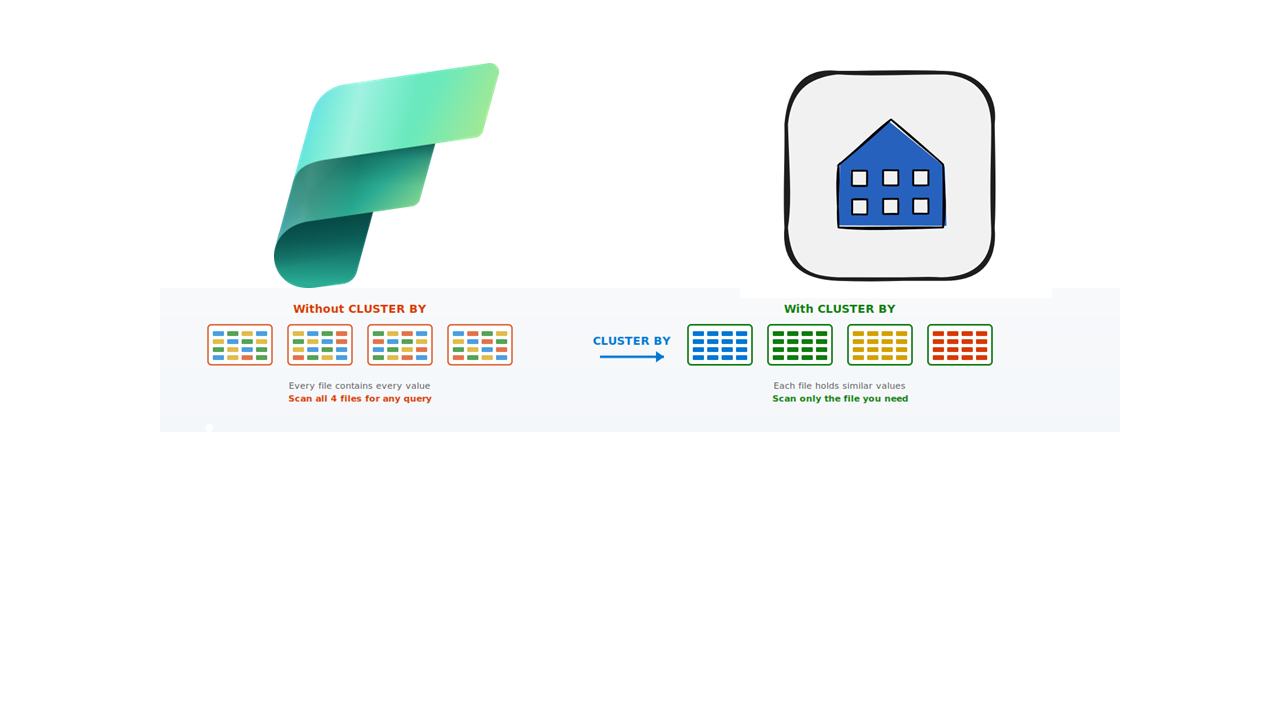
Microsoft's announcement post for data clustering in Fabric Warehouse promised 24x speedups. So I built a 100-million-row clickstream table and tested it myself. The result is more nuanced than the marketing - and more useful for anyone deciding whether to actually adopt this feature. Here's what 40% less CPU and 69% less I/O looks like - and why elapsed time barely moved.
The post CLUSTER BY in Fabric Warehouse: when the magic shows up and when it doesn’t! appeared first on Data Mozart.
Published on:
Learn moreWe can help you with CLUSTER BY in Fabric Warehouse: when the magic shows up and when it doesn’t!
If you want help implementing, troubleshooting, or improving this product, contact us and we’ll point you in the right direction.
Related posts
Agentic data engineering is here! Project Osmos: What, Why and How?
I gave Project Osmos, Fabric’s new data engineering agent, a real job: building a lakehouse from the Wiener Linien GTFS feed, across two feed ...
Dr Lakehouse: a doctor for your Fabric lakehouse tables
When I was young, I used to watch Dr House. If you’ve never seen it: a brilliant, grumpy doctor and his team get the cases nobody else c...
How your lakehouse design decisions affect Direct Lake performance
When a Direct Lake report is slow, people open the semantic model first. However, the cause usually sits one layer down! The post How your lak...
Replaying El Clásico live in a Fabric App!
Barça’s 5-0 Clásico from 2010, replayed live in a Fabric App built with Rayfin: architecture, write-back predictions, and a one-command deploy...
FabCon Europe 2026: 4 announcements that may change how we work with data and AI
Barcelona is done. Nearly 5,000 people, 130+ sessions, and a very long list of announcements. This is my cut of the ones that matter, why they...
The query finished…Why is my Fabric SQL database still consuming CUs?
Two minutes of database activity can mean 17 minutes of compute billing. And a CPU chart doesn't tell the whole story. Let's work through SQL ...
Implementing SCD Type 2 in Microsoft Fabric – The Definitive Guide!
Slowly Changing Dimensions (SCD) are one of the fundamental concepts in dimensional modeling. If you are not sure what dimensional modeling is...
How to check table sizes in a Microsoft Fabric warehouse
If you've tried to check how much storage your Fabric warehouse tables consume, you've probably discovered that the usual SQL Server approache...
(Don’t) Stop materializing your silver layer!
Why is your silver layer a set of tables? Challenging the fully materialized medallion pattern - with benchmark numbers and reproducible demo ...
Liar, liar! What to do when AI writes your pipelines confidently wrong?
Should we let AI write our pipelines? YES...But not the way you probably think. The post Liar, liar! What to do when AI writes your pipelines ...