
Capacity Reservation for Specialty SKUs—now available
Public Preview of on demand capacity reservations for Specialty SKUs for Azure Virtual Machines is now available. On demand capacity reservation would now allow you to deploy and manage the compute capacity required to run Azure VMs on below specialty SKUs:
- Mv3 series
- NC-series, v3 and newer
- NV-series, v2 and newer
- Lsv2 series
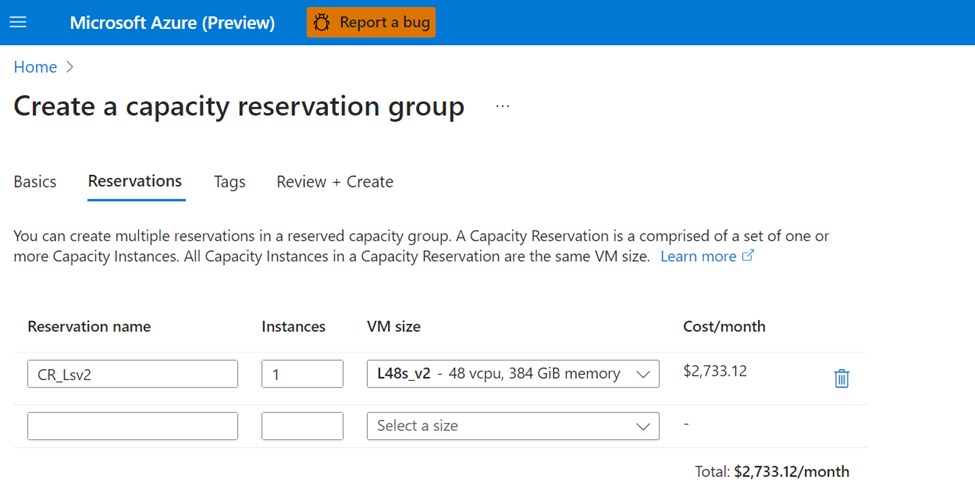
You can now get capacity SLA when reserving capacity for these specialty SKUs using On Demand Capacity Reservations. Existing capabilities will apply to specialty SKUs as well for On Demand capacity reservation. For example, unused reserved capacity and Virtual Machines using reserved capacity are both eligible for Azure Reserved Virtual Machine Instance term discounts.
Existing and Future capabilities:
For the above mentioned additional supported series for N, at VM deployment, Fault Domain (FD) count of 1 can be set using Virtual Machines Scale Sets. A deployment with more than 1 will fail to deploy against a Capacity Reservation. FD>1 will be supported at future release.
The VM deployment methods supported with on demand capacity reservations for specialty SKUs are single VMs and Virtual Machine Scale Sets using uniform orchestration mode. Virtual Machine Scale Sets flexible orchestration mode is in public preview. Please read the documentation to learn more.
Resources to get started
There are two demonstration videos currently available:
- Basic feature operation and use with single VM deployments.
- Detailed feature operation and integration with Virtual Machine Scale Sets.
Additionally, you can read the on demand capacity reservation documentation that includes sample code.
Published on:
Learn moreWe can help you with Capacity Reservation for Specialty SKUs—now available
If you want help implementing, troubleshooting, or improving this product, contact us and we’ll point you in the right direction.
Related posts
Upcoming Changes to Instance Size Flexibility Ratios for Reserved VM Instances for M-series: What Yo
Overview In the ever-evolving landscape of cloud computing, it is crucial to stay informed about changes that may affect your usage and busine...
Exploring SUSE Enterprise Linux on Azure
Exploring SUSE Enterprise Linux on Azure In today's cloud-centric world, leveraging robust and reliable operating systems is crucial for busin...
Announcing Public Preview of new attach/detach disks API for VMs/VMSS
We are excited to announce the public preview of a new API that will make attaching and detaching disks to a VM faster and easier. The new API...
Fine-tuning a Hugging Face Diffusion Model on CycleCloud Workspace for Slurm
Introduction Azure CycleCloud Workspace for Slurm (CCWS) is a new Infrastructure as a Service (IaaS) solution which allows the users to purpos...
Public Preview Announcement-On Demand Capacity Reservation in Azure in China
Today, we're announcing the public preview of on demand capacity reservations for Azure Virtual Machines in Azure in China Cloud . Y...
Breaking change for Window Server 2022 Image Users with .NET 6
Azure Marketplace media images for Windows Server 2022 currently include .NET 6, but going forward will not include a .NET version with the im...
Announcing the public preview of the new Azure FXv2-series Virtual Machines
Today, Microsoft is announcing the public preview of the new Azure FXv2-series Virtual Machines (VMs), based on the 5th Generation Intel® Xeon...
Effortlessly Migrate Azure VMs between zones
For various reasons you might come across a situation when you need to migrate your Azure VMs from one zone to another. Migrating Azure VMs be...
Announcing Public Preview of Instance Mix on Virtual Machine Scale Sets
Today, we’re excited to announce that the ability to specify multiple different VM sizes in your Virtual Machine Scale Sets (VMSS) with Flexib...
Announcing General Availability of Attach & Detach of Virtual Machines on Virtual Machine Scale Sets
Today, we’re thrilled to announce that the ability to attach or detach Virtual Machines (VMs) to and from a Virtual Machine Scale Set (VMSS) w...