
Part 4 – Creating a Power BI dataset and report using DirectLake
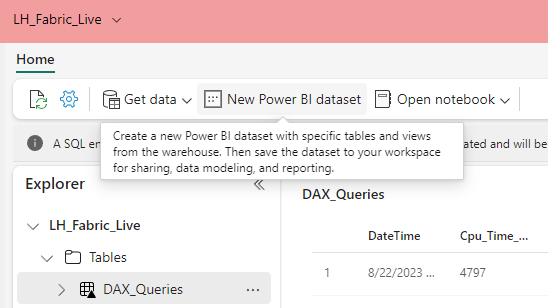
In the final part of my series, I am going to be creating the Power BI DirectLake dataset and report from my tables that I had previously loaded into the lakehouse. In this series I am going to show you all the steps I did to have the successful outcome I had with my client where I created the dataset...
The post Part 4 – Creating a Power BI dataset and report using DirectLake appeared first on FourMoo | Power BI | Data Analytics.
Published on:
Learn moreRelated posts
Reusable AI Skills for Writing to Microsoft Fabric Lakehouse Tables from Python Notebooks and to reduce Capacity Units consumption
In this blog post below, I explain what the two skills do, why I use them in Fabric Python notebooks, how they can reduce unnecessary capacity...
A Practical Guide to use OneLake Security for OneLake Object, Row, and Column Security
In this blog post, I will show you how to configure OneLake security for a Microsoft Fabric Lakehouse. We will remove the default broad-access...
Remove Hardcoded Workspace and Item IDs with Fabric Variable Libraries to use Across Dev/Test/Prod
In this blog post I’m going to show you how you can use variable libraries with connection strings as well as items. This approach allows you ...
Using Python Notebooks to Merge Data into a Microsoft Fabric Lakehouse
In this blog post I am going to show you how to use a Fabric Python runtime notebook (This is the notebook which only uses Pure Python functio...
Using GitHub Copilot CLI to Build a Microsoft Fabric Lakehouse Table Health Pipeline
In this post I will show how I used GitHub Copilot CLI / Agent mode in VS Code to create a Microsoft Fabric pipeline that checks Lakehouse tab...
Seamlessly Moving Fabric Notebooks Across Workspaces with Lakehouse Auto-Binding and Git Integration
With the new Lakehouse Auto-Binding capability in Notebook Git integration, Fabric can now intelligently preserve and resolve the binding betw...
Accessing data between Private Link and Public Fabric Workspace using the Private Endpoint
In this blog post I show how it is possible to access data between a Private Link Workspace, where I want to read the data from my Public Work...
Creating a Private Link in Microsoft Fabric — No Public Access
In this blog post, I am going to walk through how I created a Private Link in Microsoft Fabric so that access routes over Microsoft’s private ...
How to set up a SharePoint Folder Shortcut using Workspace Identity in Microsoft Fabric
I really think it is ideal to use a workspace identity in Microsoft Fabric. This is because not only is it secure by default but not having to...