
Machine learning on Azure for baseball decision analysis

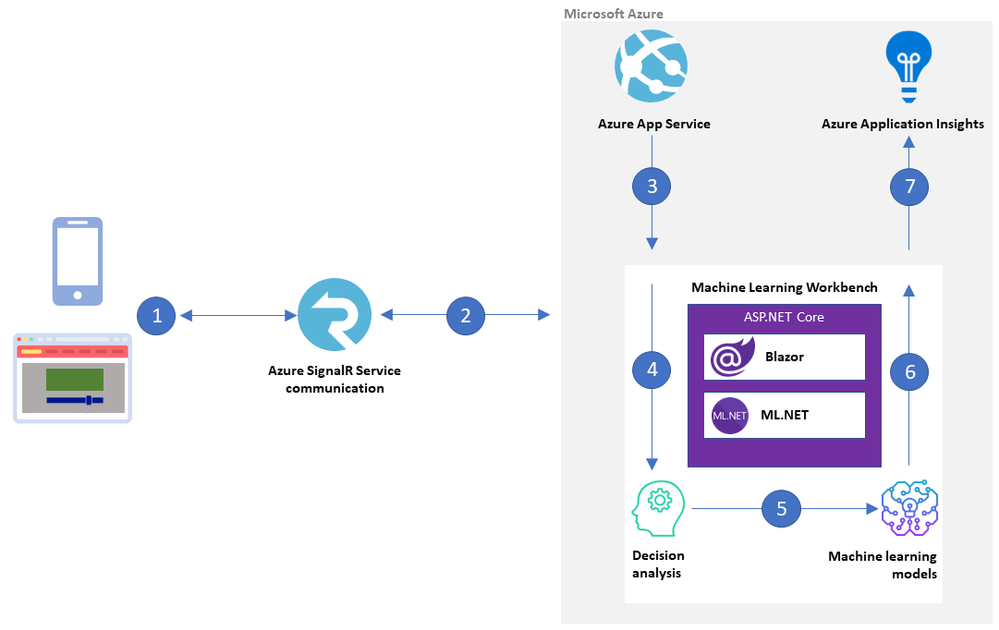
What-if analysis is a great use case for Azure machine intelligence techniques. Bart Czernicki, Principal Technical Architect with the Microsoft Machine Intelligence team, shows you how in his sample web app for baseball decision analysis based on ML.NET and Blazor called the Machine Learning Workbench. He shows you an example architecture on Azure and provides all the source code on GitHub.
Bart has created the Machine Learning Workbench as a web app with a friendly interface to a powerful what-if analysis engine. It takes historical and current baseball data and uses AI and machine learning models to make informed predictions.
The solution delivers National Baseball Hall of Fame insights, but the architectural approach applies to decision analysis systems in general, from building a fantasy baseball team to forecasting financial scenarios for budgeting and planning.
The Machine Learning Workbench is built in ASP.NET core using ML.NET, an open-source framework that provides the inference engine, and Blazor Server to render the interface. Azure SignalR Service brokers communications between Workbench and the user interface.
Published on:
Learn moreRelated posts
Large-scale docking for drug design on Azure
“Only 10 total drugs in 46 years have been intentionally developed for childhood cancer and have reached FDA approval (reference). Childhood ...
E2E deployment of a production ready NDv4 (A100) cluster targeting large deep learning training
Introduction The NDv4 series is very popular for running large deep learning training jobs, which require lots of floating-point perfo...
Performance considerations for large scale deep learning training on Azure NDv4 (A100) series
Background The field of Artificial Intelligence is being applied to more and more application areas, such as self-driving cars, natural langua...
Best Practice for Running Cadence Spectre X on Microsoft Azure
Co-authors: Richard Paw and Andy Chan Electronic Design Automation (EDA) consists of a set of software (tools) and workflows for design...
Spack in a Multi-User HPC Environment on Azure
Spack is a package management tool designed for HPC environments. In this article we will demonstrate how to install and configure Spack...
AzureHPC Lustre Marketplace Offer
The AzureHPC Lustre Marketplace offer provides a fast and easy way to deploy a Lustre Filesystem on Azure. The features include: Deplo...
Mainframe Migration to Microsoft Azure with Intel Architecture on Your Terms.
IntroductionMainframes are still in wide use today for business-critical applications in many industries. According to a 2021 survey by IBM, 7...
Why Organizations are Entrusting Microsoft Cloud with their Mainframes
There is a resurgence of interest and renewed priority to transform core enterprise systems. This resurgence is largely driven by rapidly shif...
Automated HPC/AI compute node health-checks Integrated with the SLURM scheduler
Overview It is best practice to run health-checks on compute nodes before running jobs, this is especially important for tightly coupl...
GPU Monitoring using Azure Monitor
Overview Today, many highly parallel HPC/AI applications use GPU to improve the run-time performance. It is important to be able to monitor t...