Sneak peek at new Azure edge infrastructure at Hannover Messe 2024
Written by Cosmos Darwin, Principal Group Manager on the Azure Edge & Platform team
This week is Hannover Messe 2024, the world’s biggest industrial trade fair. Microsoft is there, including members of the Azure Stack team, showcasing how the Microsoft Cloud enables end-to-end manufacturing solutions that help securely connect people, assets, and business processes, empowering organizations to be more resilient.
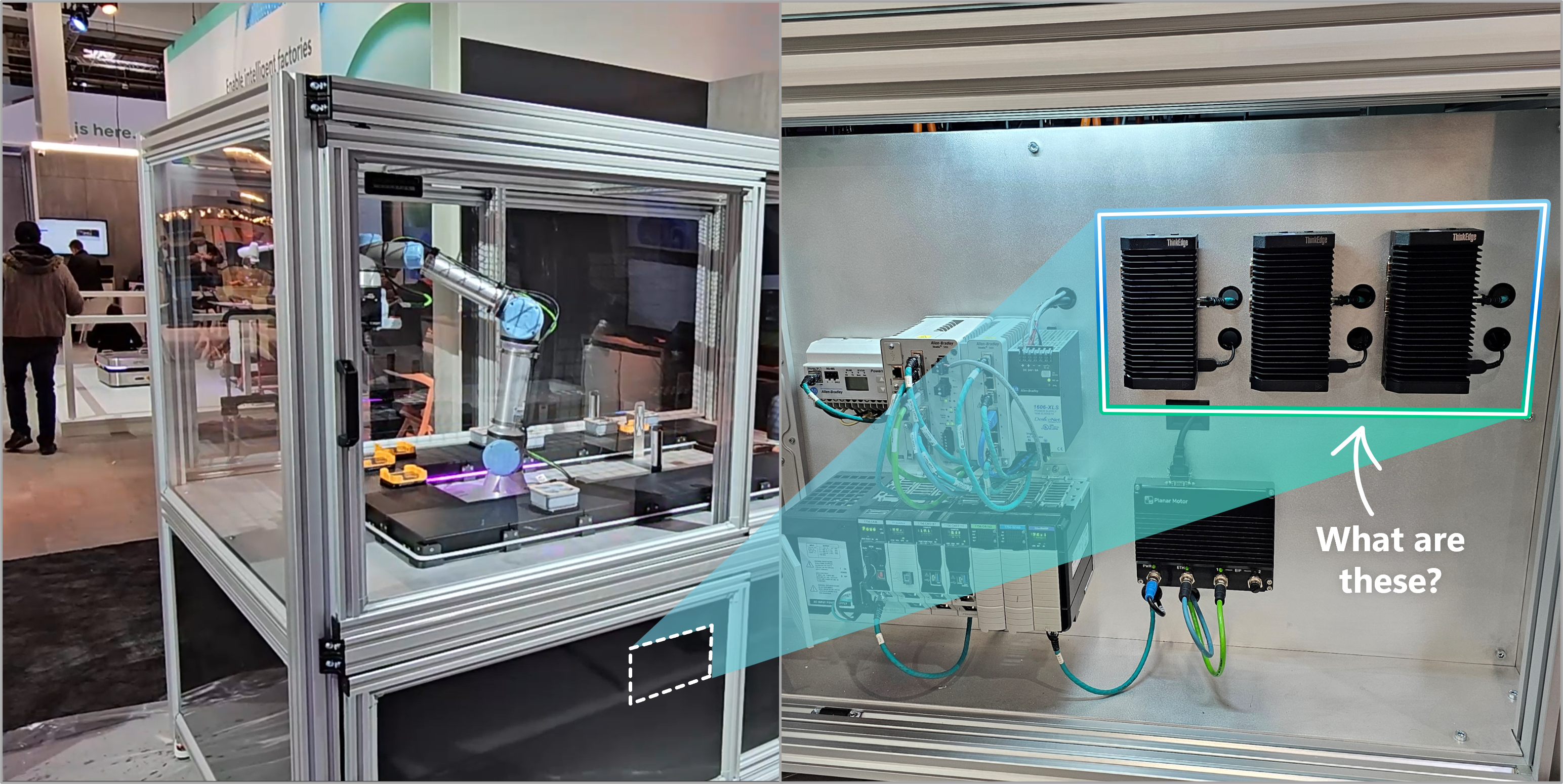
Near the center of our booth, you can watch a robotic assembly line put together battery parts. The line features standard OT assets from our partner Rockwell Automation and shows how an adaptive cloud approach together with open standards like OPC UA can accelerate industrial transformation. Azure IoT Operations enabled by Azure Arc flows data from the production line into Microsoft Fabric, enabling real-time monitoring and analysis in the cloud.
And if you look closer, you may spot an exciting new infrastructure solution hosting it all:
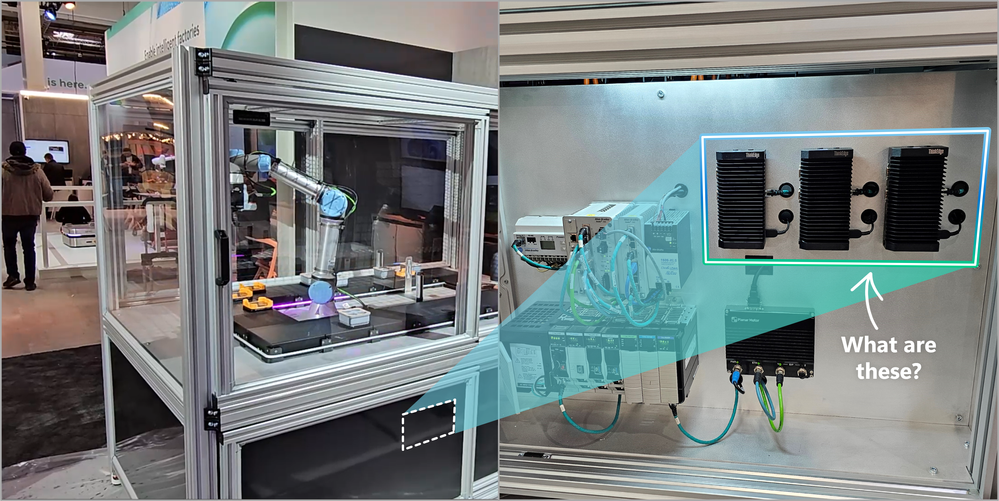
Caption: Glimpse the new Azure edge infrastructure at the Hannover Messe 2024 expo.
Hardware for the industrial edge
As organizations adopt new OT technologies like Azure IoT Operations, which runs on Kubernetes, a core challenge for IT is to provide an appropriate computing infrastructure at the edge to support it. They need an infrastructure solution that’s easy to deploy, easy to manage at-scale across many locations, and that provides all the capabilities needed to deliver the applications, like managed Kubernetes and enterprise-grade resiliency. Most important of all, it needs to work in an edge setting like a factory floor, where neither the environmental factors nor the budget can accommodate a rack of servers.
For these kinds of situations, our team is working to extend Azure edge infrastructure to smaller form factor devices: edge/industrial PCs. The demo at Hannover Messe runs on three Lenovo ThinkEdge SE30s, an exemplar of this new category. These devices are great: they’re rugged, affordable, and they provide just the right amount of capability for this application, with an Intel Core™ i5 vPro® processor and 16 GiB of memory each.
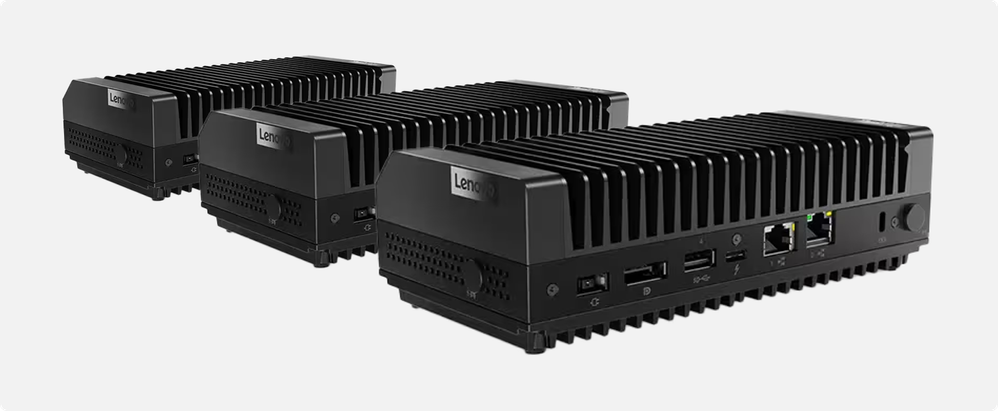
Caption: Lenovo ThinkEdge SE30 is a great example of the edge/industrial PC device category.
Optimized low-footprint architecture
To make the most of limited resources, this new infrastructure solution blends familiar elements of Azure Stack HCI with some exciting new approaches. Azure Linux is used as the host operating system, and then the Azure Kubernetes Service is used to turn those machines into a Kubernetes cluster. The result is Kubernetes running directly on bare metal, with no virtualization at all. The whole infrastructure solution is deployed and operated from Azure cloud.
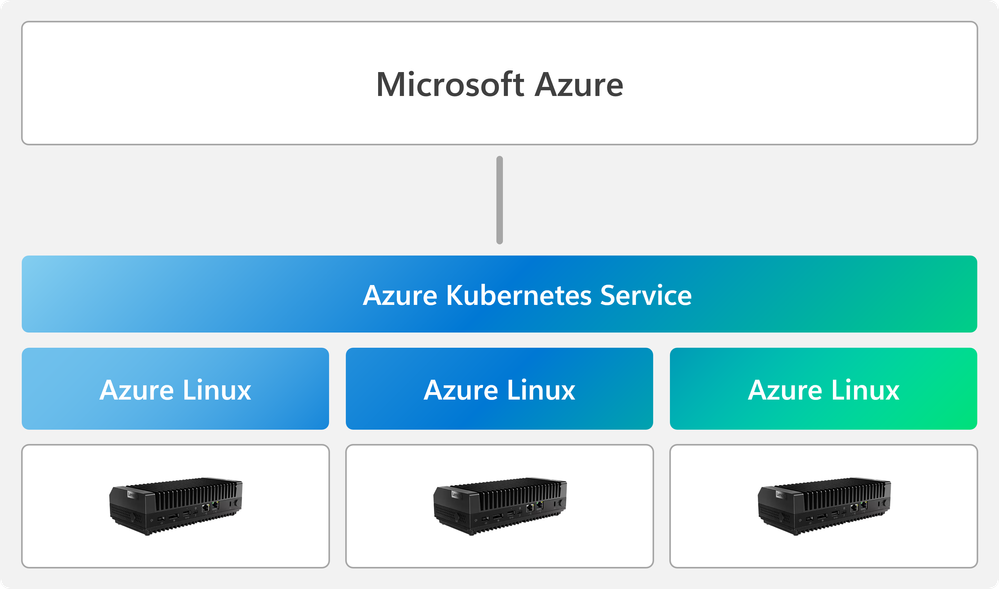
Caption: Solution architecture uses Azure Linux and AKS on bare metal to minimize footprint.
(Equivalently, for a more familiar experience, you could also run Windows IoT Enterprise as the host operating system with AKS Edge Essentials virtualized on top. We’re all one engineering team here in Azure, so we won’t be offended – pick whichever OS you prefer!)
Managed from the cloud – demo!
Beyond the on-device architecture, the core promise of adaptive cloud is a unified control plane to manage the whole solution, from apps to infrastructure. Check out this short demo to see how the Azure resource manager (ARM) and Azure Portal can be used with this new edge infrastructure: the solution is presented by a native ARM resource; its configuration is pushed from the cloud to enable repeatability and infrastructure-as-code; integration with management services like Azure Monitor is seamless; and you can even drill down into Kubernetes resources with just a few clicks.
Get ready to try it yourself
For now, this new edge infrastructure solution is a technology demonstration, but we’ve been pleasantly surprised how well it works. We plan to start previews later this year. If you’re interested, sign up now to be among the first to get early access. And in the meantime, watch this space for more news about all things edge infrastructure, from hyperconverged servers to edge/industrial PCs.
<3
- Cosmos
Published on:
Learn moreWe can help you with Sneak peek at new Azure edge infrastructure at Hannover Messe 2024
If you want help implementing, troubleshooting, or improving this product, contact us and we’ll point you in the right direction.
Related posts
Public Preview of Azure Migrate from VMware to Azure Stack HCI
Today, we are thrilled to announce the public preview of the Azure Migrate functionality to migrate VMs from VMware to Azure Stack HCI, a sign...
Apply critical update for Azure Stack HCI VMs to maintain Azure verification
Azure verification for VMs on Azure Stack HCI makes it possible for Azure-exclusive benefits to work outside of the cloud and in on-premises a...
Logical Networks in Azure Portal for HCI: Setting the Stage for Software Defined Networking
At this past Microsoft Ignite 2023, we officially announced the public preview of logical networks in Azure Portal for Azure Stack HCI. These ...
Introducing Azure Virtual Desktop workload in Azure Stack HCI Sizer!
Earlier in February 2024, we announced the general availability of Azure Virtual Desktop for Azure Stack HCI which extends the capabilities of...
Hyper-V VM Migration to Azure Stack HCI, version 23H2
Written by Kerim Hanif, Senior Program Manager on the Azure Edge & Platform team Azure Migrate is a unified platform t...
Possible MAC address assignment strategies for tenant VMs running on Stack-HCI environment
Azure Stack HCI is a hyperconverged infrastructure (HCI) cluster solution consists of windows servers (Hyper-V), Storage Spaces Direct, a...
Azure Stack HCI version 23H2 is generally available
Written by Cosmos Darwin, Principal PM Manager on the Azure Edge & Platform team Today we’re announcing the general availab...
AKS enabled by Azure Arc is now available on Azure Stack HCI 23H2
Azure Kubernetes Service (AKS) allows you to run a managed Kubernetes solution at the edge wherever you need it, with built-in support...
MAC address assignment strategies for tenant VMs running on Stack-HCI environment
Azure Stack HCI is a hyperconverged infrastructure (HCI) cluster solution consists of windows servers (Hyper-V), Storage Spaces Direct, a...
MAC address strategies for tenant VMs running on Stack-HCI environment
Azure Stack HCI is a hyperconverged infrastructure (HCI) cluster solution consists of windows servers (Hyper-V), Storage Spaces Direct, a...