
Help customers find your business with the Azure Maps Store Locator

The biggest challenge to a business is being found by customers interested in what your business has to offer. After successfully capturing their attention drawing them to your website, the next step is guiding them to your physical business locations. The Azure Maps Store Locator simplifies this process, enabling you to construct and maintain an interactive locator experience that effortlessly directs customers to your door!
Creating a basic store locator using Azure Maps is already a straightforward task, involving the loading of store locations onto a map and potentially setting up a simple search functionality. However, for larger organizations managing thousands of locations and requiring advanced filtering options, a more sophisticated solution is essential. Fortunately, the Azure Maps Store Locator, combining the power of various Azure services, caters precisely to these needs.
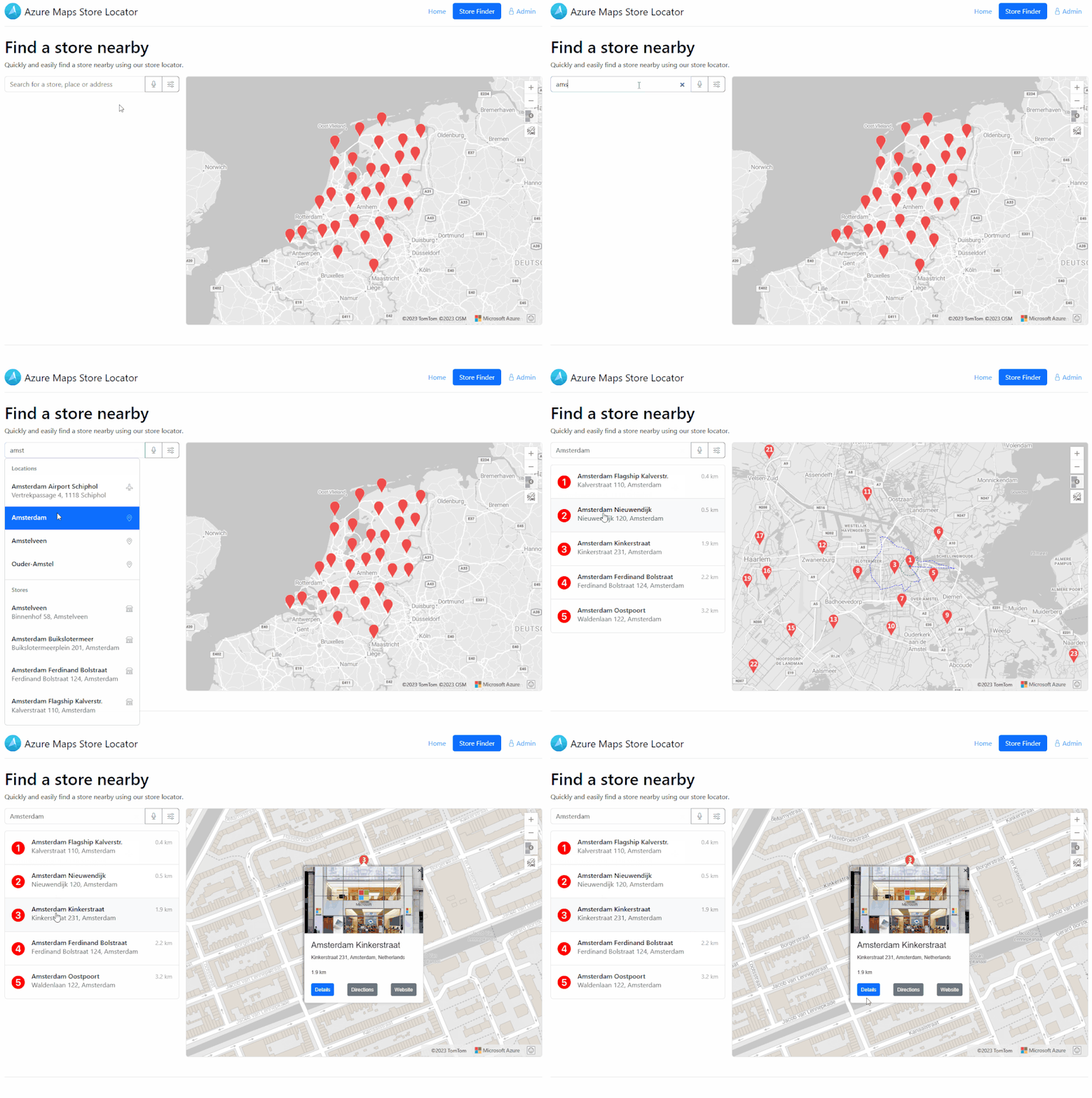
Elevate your website's locator experience with Azure Maps
Envisioning a tool that aids potential customers in seamlessly discovering the nearest location of your business based on their preferences. Whether they are seeking a specific location, service, or other points of interest, the Azure Maps Store Locator offers a user-friendly and versatile solution. It also comes with a comprehensive store location management system to construct a fully featured locator experience for your business.
Unveiling Powerful Features
The Azure Maps Store Locator provides an impressive range of capabilities to enhance your location-based services:
- Store Locator Backend: Offers REST APIs and a Store Locator Web Control.
- Robust Autocomplete Search: Enables searching for store names, addresses, points of interest (POI), or zip codes.
- High Location Capacity: Supports over 10,000 locations.
- Proximity Insights: Displays nearby stores and their respective distances.
- Location-based Search: Allows searching based on the user's or device's location.
- Travel Time Estimates: Presents travel time for walking and driving options.
- Detailed Store Information: Offers store details via popups and directions.
- Dynamic Filtering: Allows the user to filter based on dynamic store features.
- Detailed Store Page: Explore what a specific store offers with an embedded map.
- Security Measures: Utilizes Microsoft Entra ID (formerly Azure Active Directory) for secure location management system access, ensuring only authorized employees can update store details.
- Rich Store Data: Includes store details such as location, opening hours, store photos, and facilitates the addition of custom store features and services.
- Accessibility Features: Incorporates speech recognition and other accessibility options.
- Seamless Deployment: Easy deployment within your Azure subscription.
Get Started in Just 5 Minutes!
Launching the Azure Maps Store Locator is a seamless process, even if you're not a seasoned developer. Follow these three simple steps:
- Azure Subscription: Ensure you have an Azure subscription. If not, sign up for a free Azure subscription at https://azure.microsoft.com/free/.
- Access Azure Shell: Log in to the Azure Shell at https://shell.azure.com/.
- Deployment Script: Execute the provided PowerShell command (copy and paste) to install the Azure Maps Store Locator:
This setup provides you with the following architecture:

- WebApp: Hosts the backend REST APIs for the store locator, powered by .NET 8.
- Azure Cosmos DB: Utilized to efficiently store and search for stores.
- Azure Maps: Enables location search, travel time calculation, and map display.
- Microsoft Entra ID: Ensures secure access management.
Integrating the store locator into your website requires some HTML and JavaScript to call the store locator backend REST APIs. Once implemented, the solution is yours to modify and tailor the source code in your Azure Maps Store Locator according to your specific needs.
The Azure Maps Store Locator empowers you to create and maintain an intuitive location-based search experience to delight your customers. Enhance your online presence today with the power of Azure Maps!
You find the source code on GitHub: https://github.com/Azure-Samples/Azure-Maps-Locator
Published on:
Learn moreWe can help you with Help customers find your business with the Azure Maps Store Locator
If you want help implementing, troubleshooting, or improving this product, contact us and we’ll point you in the right direction.
Related posts
Introducing the Data-Bound Reference Layer in Azure Maps Visual for Power BI
Imagine managing a nationwide sales team and needing to understand how your sales align with factors like population density, competitor locat...
Enhance Azure Maps with Overture Maps Data using PMTiles!
Supercharge Azure Maps with Overture Maps Data using PMTiles! We’ve got some exciting news. Azure Maps now supports PMTiles! This me...
Where do I go if I have questions about Azure Maps?
As you might expect, just looking around on your own, or asking Co-pilot, you can find comprehensive help like Samples.AzureMaps.com, wit...
Tailor your Reference Layers in Azure Maps Visual for Power BI
We’re excited to share the latest enhancements to the Azure Maps visual in Power BI, designed to make your data visualization even mor...
Enhancing Logistics with Azure Maps and NVIDIA cuOpt for Multi-Itinerary Optimization
The logistics industry is always finding ways to optimize vehicle routing to enhance efficiency. The Vehicle Routing Problem (VRP) and Pickup ...
Introducing the Unified Azure Maps Experience
Microsoft has recently announced the unification of Bing Maps for Enterprise (BME) with Azure Maps, marking a remarkable advancement in their ...
Power BI Azure Maps Visual: Enhanced Reference Layer & Embedded Support
The Power BI Azure Maps visual has received a major update which includes an expansion of the reference layer and the addition of Power BI Emb...
Enhance your indoor maps with real-time map feature styling
The ability to dynamically update and visualize the state of rooms or areas within a building is critical to understanding the status of any b...
Dynamic Clustering Aggregation with Custom Styling in Bubble Layer
The Power BI Azure Maps visual allows you to create stunning geospatial visualizations with your data. Today, we are excited to announce a new...
HO HO HO Two Point OH!
You might notice some big changes have come to the North Pole experience at NORADSanta.ORG this year. Developer elves have implemented a...