Introducing the Microsoft Intelligent Data Platform Partner Ecosystem

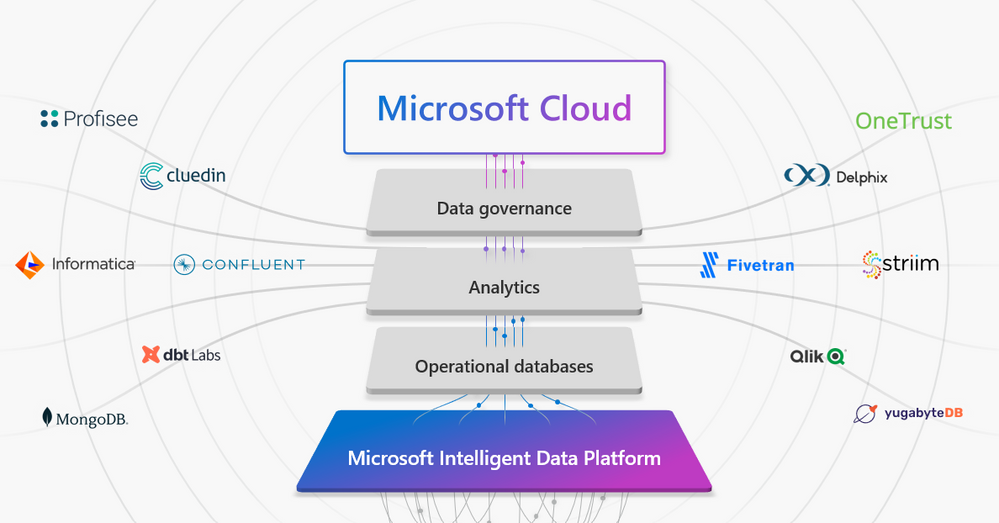
In May, we introduced the Microsoft Intelligent Data platform which deeply integrates our databases, analytics, BI and data governance products into a unified platform. This platform, which is also integrated with the Microsoft Cloud, enables seamless experience and intuitive collaboration for Developers, DBAs, Data Engineers, Data Scientists, Business Analysts and Data Officers. The platform enables customers to “do more with less”, by helping them add layers of intelligence to their applications, unlock predictive insights and drive relevant action, and govern their entire data estate.
The customer response has been very positive, and we have received rich feedback on how we can further the value of this unified platform. Some common feedback we heard is that customers want the Microsoft Intelligent Platform to extend the deep integration with the Partner products they use.
Today at Microsoft Ignite, we announced the launch of a powerful new Partner Ecosystem for the Microsoft Intelligent Data Platform. Together with our partners, we deliver category-leading and cloud-native data and AI solutions integrated with the Microsoft Intelligent Data Platform. These solutions complement capabilities to address the diverse scenarios and investments of our customers.
The Microsoft Intelligent Data Platform is the natural choice for independent software vendor (ISV) partners to build and deliver integrated solutions. This is all made possible through the platform’s open and governed foundation.
The partner ecosystem enables customers across all industries to take advantage of the Microsoft Intelligent Data Platform capabilities. Together with our partners, we’ll build upon decades of experience in helping our customers digitally transform.
Thanks to partner solutions that span every layer of the Microsoft Intelligent Data Platform, we ensure our wide range of customers get a seamless, enriched, and cost-optimized experience that meets their specific needs.
The initial set of ISV partners aligned with the Microsoft Intelligent Data Platform partner ecosystem include:
- Operational Databases: MongoDB as a leading NoSQL database, and Yugabyte as a cloud native NoSQL and Distributed SQL database, they enable integration into the broader enterprise data for Analytics and ML/AI and govern data estates with Microsoft Purview.
- Analytics: These solutions further enhance low code/no code experiences to automate building and operating complex enterprise grade pipelines. They can govern data integration and transformation pipelines in Microsoft Purview. Examples of differentiated partner solution capabilities include:
- Informatica: Cloud-native data integration for enterprise systems
- Qlik: Data integrations for enterprise systems such as SAP, Oracle, and appliances
- Confluent: Analytics for data in motion from Apache Kafka and IoT sources
- Fivetran: Low code / No code, cloud-native, automated, reliable, and secure data pipelines
- Striim: Real-time data access with continuous, streaming data integration to analytics
- dbtLabs: SQL friendly modality for data transformation pipelines
- Data Governance: Marketing leading solutions in this layer include:
- Profisee and CluedIn for Master Data Management
- Delphix data masking for pipeline data compliance
- OneTrust for privacy & security
In tandem with leading a powerful ecosystem of ISV partners to engage with our customers, we are also committed to deepening an enhanced first-party relationship with Databricks. We’re pleased to share that Azure Databricks, which aligns to the open and governed paradigm of Microsoft Intelligent Data Platform, also benefits from this partner ecosystem.
And this is just the beginning as we add more ISV partners in the coming months. We believe the Microsoft Intelligent Data Platform partner ecosystem approach is the first of its kind in the industry. Best of all, working with our valued partners, we set our customers up for success.
Learn more:
Innovate faster and achieve greater agility with the Microsoft Intelligent Data Platform
Published on:
Learn moreWe can help you with Introducing the Microsoft Intelligent Data Platform Partner Ecosystem
If you want help implementing, troubleshooting, or improving this product, contact us and we’ll point you in the right direction.
Related posts
Data for now and next: Powering a new era of AI apps
The era of AI has arrived and the organizations that are primed for learning, adapting, and scaling quickly hold the power to transform human ...
Announcing the General Availability of AMD-based Confidential VMs on Azure Databricks
We are excited to announce the general availability of AMD-based confidential virtual machines (VMs) for cluster nodes on Azure Databricks. Co...
A Data Professional's Guide to Build 2023
ChatGPT and Microsoft Copilot are stealing headlines worldwide—but data is the force that drives them both. That’s why this year at Microsoft ...
Microsoft and Databricks deepen partnership for modern, cloud-native analytics
In May, we introduced the Microsoft Intelligent Data platform which deeply integrates our databases, analytics, BI and data governance product...
SQL DB maintenance activity using Automation accounts for Azure SQL DBs(Different scenarios)
Infrastructure: Multiple Azure SQL DB instances Multiple databases in total Multiple instances consist of multiple databases Different subscr...
Zero to Hero: Your Guide to Getting Skilled on Azure Data and AI
We are excited to highlight the Zero to Hero guide, our very own journey to help developers and engineers get started on Azure. We have a larg...
A Data and AI guide to Build 2022
Microsoft Build will begin Tuesday, May 24 at 8:30 AM PDT with our annual keynote. Attendees can then participate in live segments, breakout ...
Azure Data Factory CI-CD using YAML template
Purpose of this Blog Defined the end to end Git integration and Deployment flow using YAML template from a project implementation...
Azure Data Components Network Architecture with secure configurations
Use Case : •When there is a need for the Data Components – ADF,ADB and SQL-Pool code to be promoted to higher environment se...
Data bricks Notebook Deployment using YAML code
Purpose of this Blog: We have defined end-end workflow for code check-in using two methods Notebook Revision History (standard check-in proc...