
Announcing the General Availability of AMD-based Confidential VMs on Azure Databricks
We are excited to announce the general availability of AMD-based confidential virtual machines (VMs) for cluster nodes on Azure Databricks. Confidential VMs are part of the Azure confidential computing (ACC) portfolio and provide a trusted execution environment (TEE) for Azure Databricks clusters, protecting data while in use in memory. It is important to note that Azure already encrypts data at rest and in transit, and the introduction of confidential VMs provides an additional layer of security for sensitive data in use, helping organizations meet compliance requirements and protect their most valuable data.
By using Azure confidential computing on Azure Databricks, you gain the capability to encrypt your data end-to-end. This is valuable not only for confidential workloads but also for any scenario where you need to protect highly sensitive data residing in memory and prevent unauthorized access or tampering. The solution also supports Azure Managed HSM, a hardware security module that allows the customer to manage their own encryption keys for data at-rest, in-use, and in-transit.
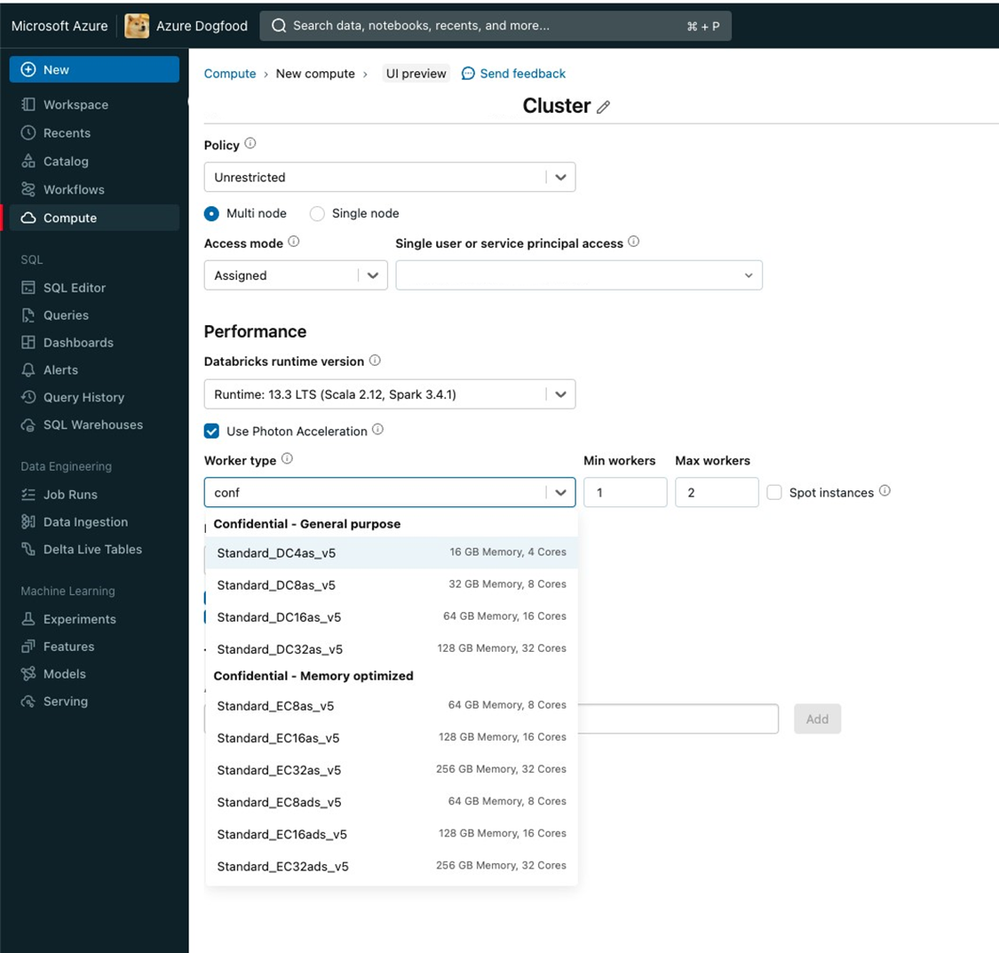
To use confidential VMs on Azure Databricks, customers need to select one of the confidential VM types when creating a cluster. This type of cluster can then be used for any workload that requires the protection of highly sensitive data in memory.
For compute-optimized needs, DCasv5 confidential VMs are available, and for memory-optimized needs, ECasv5 confidential VMs can be used. These VMs are currently available in the following regions: East US, West US, North Europe, West Europe, Southeast Asia, Central India, East Asia, Switzerland North, Japan East and Italy North, and coming to additional regions soon.
Databricks partnership in Confidential Computing:


Tune into Microsoft Ignite this week to learn more about the recent innovations with Azure confidential computing on Azure Databricks.
Learn more:
Watch the demo: Azure Databricks on Confidential VMs Overview and Demo
Read the documentation: https://aka.ms/CVM-ADB-docs.
Published on:
Learn moreWe can help you with Announcing the General Availability of AMD-based Confidential VMs on Azure Databricks
If you want help implementing, troubleshooting, or improving this product, contact us and we’ll point you in the right direction.
Related posts
Data for now and next: Powering a new era of AI apps
The era of AI has arrived and the organizations that are primed for learning, adapting, and scaling quickly hold the power to transform human ...
A Data Professional's Guide to Build 2023
ChatGPT and Microsoft Copilot are stealing headlines worldwide—but data is the force that drives them both. That’s why this year at Microsoft ...
Introducing the Microsoft Intelligent Data Platform Partner Ecosystem
Microsoft Intelligent Data Platform Partner Ecosystem In May, we introduced the Microsoft Intelligent Data platform which deeply integr...
Microsoft and Databricks deepen partnership for modern, cloud-native analytics
In May, we introduced the Microsoft Intelligent Data platform which deeply integrates our databases, analytics, BI and data governance product...
SQL DB maintenance activity using Automation accounts for Azure SQL DBs(Different scenarios)
Infrastructure: Multiple Azure SQL DB instances Multiple databases in total Multiple instances consist of multiple databases Different subscr...
Zero to Hero: Your Guide to Getting Skilled on Azure Data and AI
We are excited to highlight the Zero to Hero guide, our very own journey to help developers and engineers get started on Azure. We have a larg...
A Data and AI guide to Build 2022
Microsoft Build will begin Tuesday, May 24 at 8:30 AM PDT with our annual keynote. Attendees can then participate in live segments, breakout ...
Azure Data Factory CI-CD using YAML template
Purpose of this Blog Defined the end to end Git integration and Deployment flow using YAML template from a project implementation...
Azure Data Components Network Architecture with secure configurations
Use Case : •When there is a need for the Data Components – ADF,ADB and SQL-Pool code to be promoted to higher environment se...
Data bricks Notebook Deployment using YAML code
Purpose of this Blog: We have defined end-end workflow for code check-in using two methods Notebook Revision History (standard check-in proc...