
D365 FO Finance and Operations : AOT Browser

It is only available in a development box using Visual Studio

In Dynamics AX 2012 and earlier it was possible for power users
to be able to open and browse the contents of the AOT (Application Object Tree)
from the UI. This functionality was removed in Dynamics 365 for Finance and
Operations as all development is now done in Visual Studio. This means that in
order to browse the contents of the AOT, one now needs access to a development
environment with Visual Studio.
AOT Browser to save the day! With the AOT Browser it is now possible to browse the objects in the AOT from the D365FO web interface. Arbela Technologies , who is one of the top Microsoft partners, has developed an enhancement that has basically replicated the old AOT user experience right in the Dynamics 365 Finance and Operations application. Arbela is giving this out for free on GitHub which is so awesome!
How To Get The AOT Browser
The AOT
Browser is available for free on GitHub here. Click on the “Releases” link.

After you have deployed the AOT Browser you will
need to run the “Populate AOT objects” job. This job will populate the list of
objects in the AOT.
To check how to D365 F&O Install a deployable packagefrom command line / Apply the latest platform update to environments
It
is recommended to run this as a recurring batch job because the initial run may
take a few minutes and you will want to keep the AOT up to date for any
modifications you make to Dynamics 365 Finance and Operations.
To do
this Navigate to the AOT Browser workspace on the homepage.

From here click the “Populate AOT objects”.

Open Table Browser
1. Select the table or view you wish to browse the data for and select “Open table browser”


View Source Code
Enabled

Disabled

View Extensions Inline
At the top of the AOT browser form is a toggle button to turn on or off the ability to view the extensions inline in the tree. The setting will be remembered in the user’s usage data once the form is closed.

Viewing extensions as separate node
When the toggle is disabled, the extensions show up as a separate node at the bottom of the tree.

Search/Filter
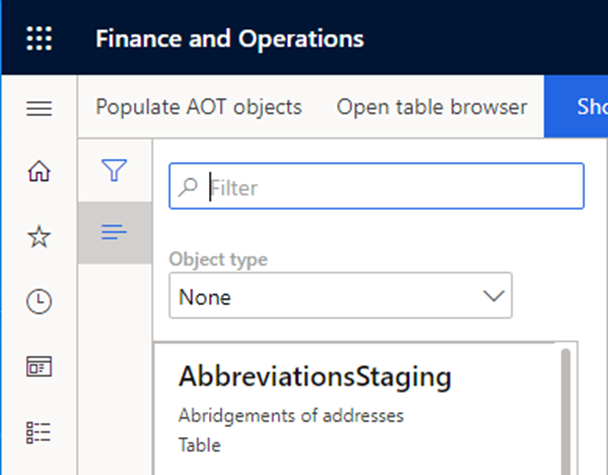
Search by object name or label
Search both by the AOT node name


Search by the object label property


Filter by object type


Open from Form Personalization
1. Open the form in the web UI that you would like to browse
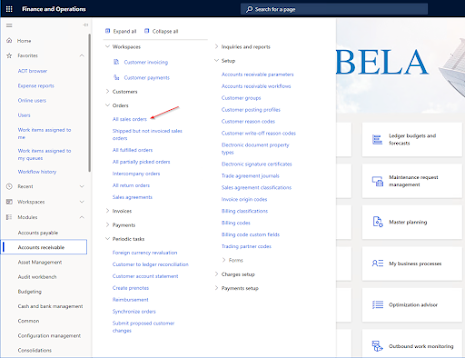
2. Right click on any element of the form and select form information

3. Click on the form name

4. At the bottom of
the dialog click “Open in AOT browser”

5. The AOT browser will open for the form and select the control
that was right-clicked in the calling form

Open from Data Entities Form
1. Navigate to System
Administration > Workspaces > Data management

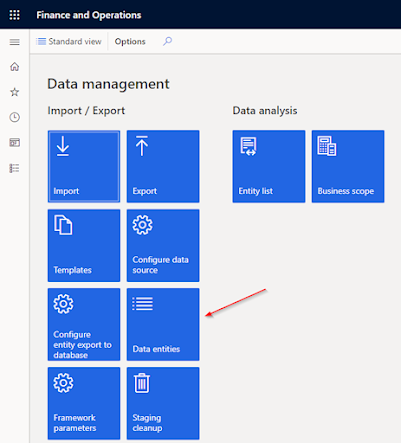
3. Select the entity you want to browse and click “Open in AOT
browser” at the top

4. The AOT Browser will open and display the data entity

Published on:
Learn moreWe can help you with D365 FO Finance and Operations : AOT Browser
If you want help implementing, troubleshooting, or improving this product, contact us and we’ll point you in the right direction.

Related posts
D365 Sending Email with Customer Account Statement SSRS report as attachment using X++
D365 Sending Email with Customer Account Statement SSRS report as attachment using X++ custTable _custTable; &...
clicking link on info message X++ to Open form
Message::AddAction() method can be used to embed an action within a message sent to the message bar. This method supports adding a singl...
D365 FO - Send Email with attachments by X++
Go to System administration >> Setup >> Email >> System email templatesCreate New template [ExtensionOf(clas...
D365 FO Data entity Export using X++
This post provides information on exporting data entity through X++ in D365 FO. The post includes a code snippet written in X++ that can be us...
D365 FO Encryption And Decryption Using A Symmetric Key(AES) using X++
If you're looking to encrypt and decrypt data using a symmetric key in D365 FO, this tutorial is the right place to be. The post details the s...
Get multiple selected rows using D365 X++
This blog post offers a valuable insight into D365 X++, offering a detailed guide on how to get multiple selected rows. Multi-select for Butto...
D365 Solution for Cloud Dev machine show error ' The remote certificate is invalid according to the validation procedure. '
You are getting 'The remote certificate is invalid according to the validation procedure.'Error show with all reports and tired Ro...