
Dataverse workaround wrong Autonumber Seed during Deployment
Dataverse workaround wrong Autonumber Seed during Deployment
Have you ever encountered a weird issue while working with autonumber fields in your solutions? You might have noticed that when deploying them to different environments, the starting value ("seed value") sometimes resets to 1000, despite your efforts to change it. I recently faced this challenge and reached out to support for a solution. In this quick guide, I'll share a workaround that you can use until the seed value becomes solution-aware. Stay tuned for a simple trick to address this problem whenever it occurs. To be clear this is a workaround and not a long term solution. Lets hope this issue goes away soon which would make this article not relevant anymore.
First things first, let's dive into setting up a DEV environment. I've created a basic solution and table named 'Cars'. Our goal is to convert the 'Primary Name Column' into an autonumber field. However, we want this auto number to start from a specific value - let's say 10,000. This approach is essential because our client already has a substantial inventory of cars, and we aim to improve the data migration process later down the road to minimize any additional problems - that (if we are honest with ourselves) come anyways as with every data migration. Let's proceed with this adjustment to ensure a better transition for the client:
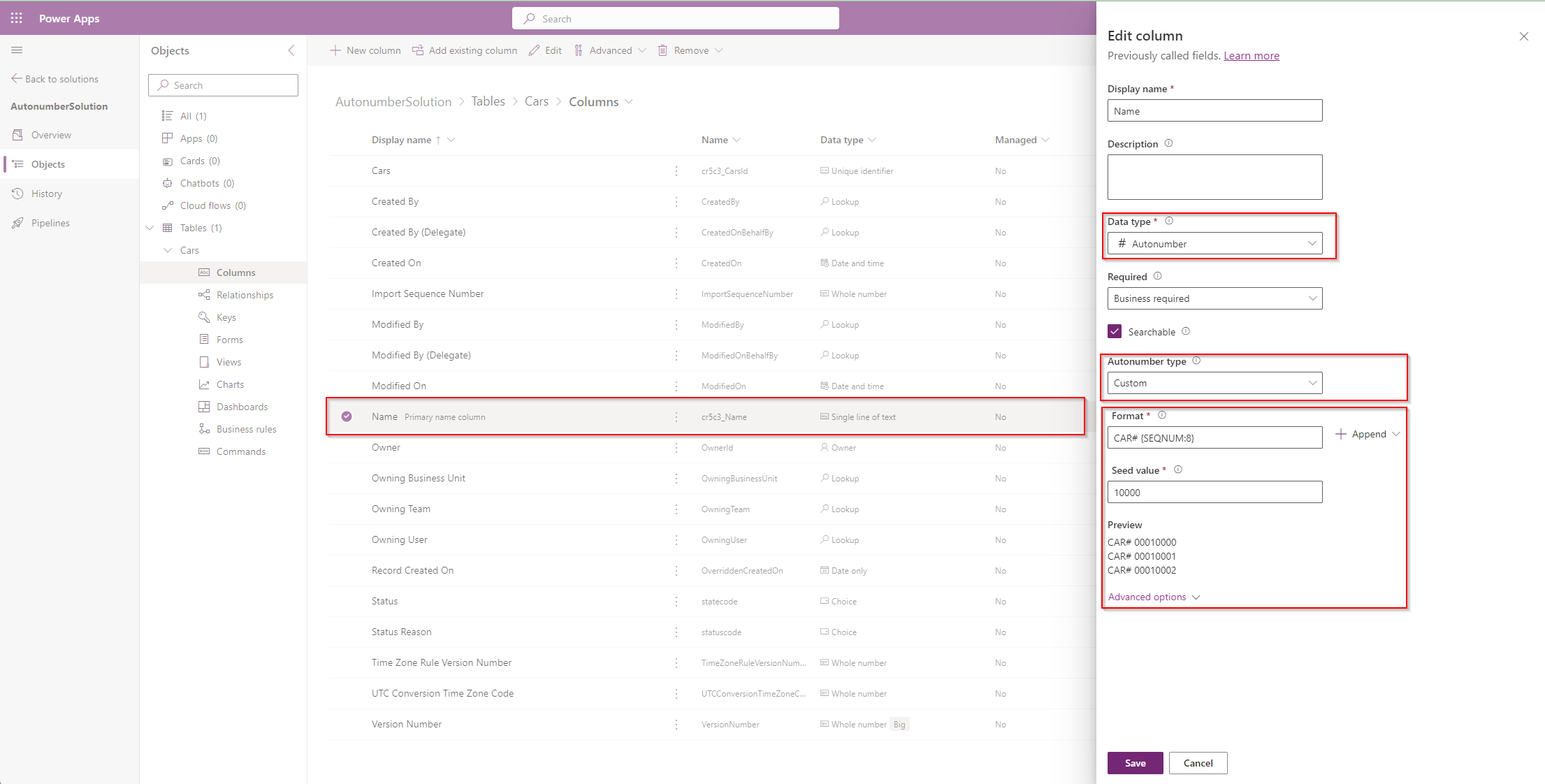
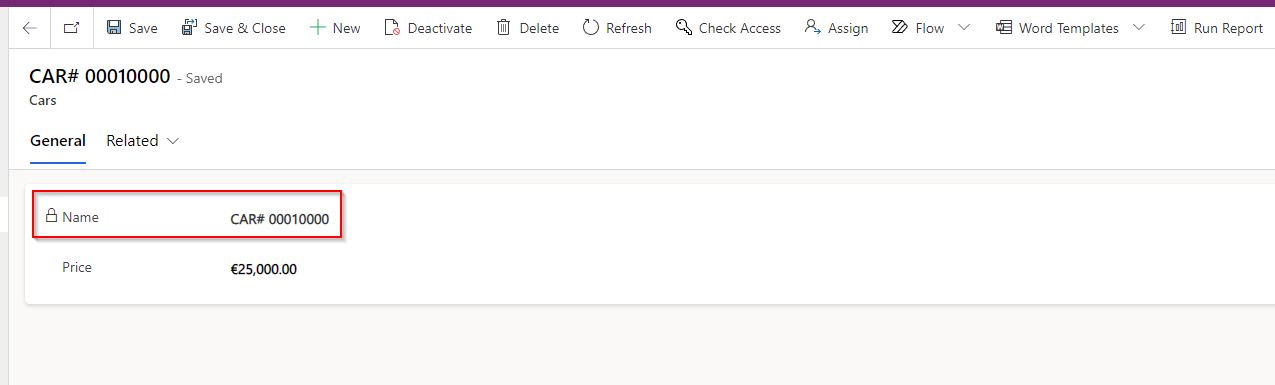
Now, this is all good. If we create a record in DEV it gets the intended number:
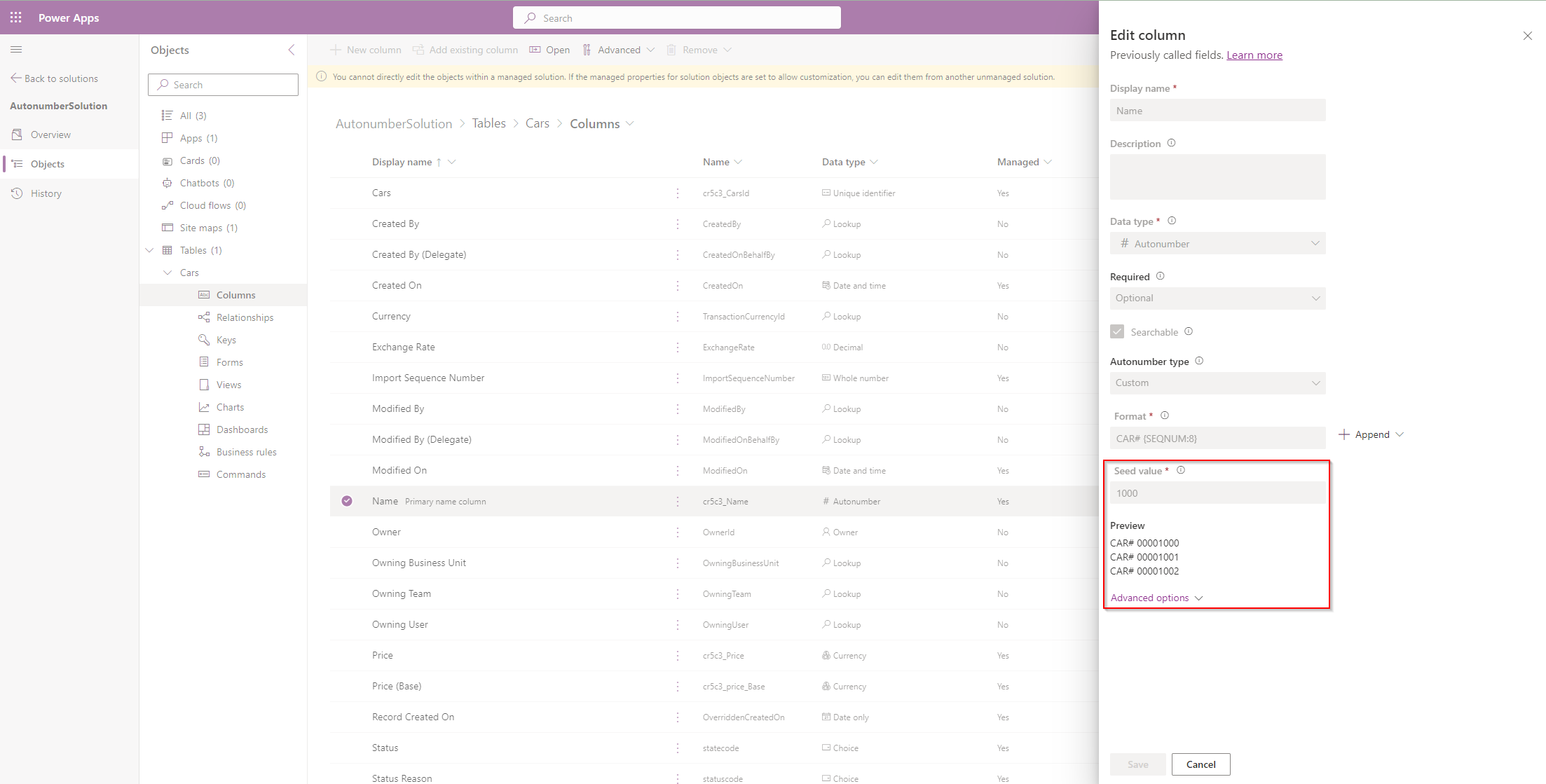
Now, we throw this solution into a pipeline, which, by the way, you should always do to avoid manual deployments whenever possible, and deploy it to a TEST environment to see our auto number field. What do we see? Well, we see that Power Platform changed the Autonumber back to the default seed value of 1000:
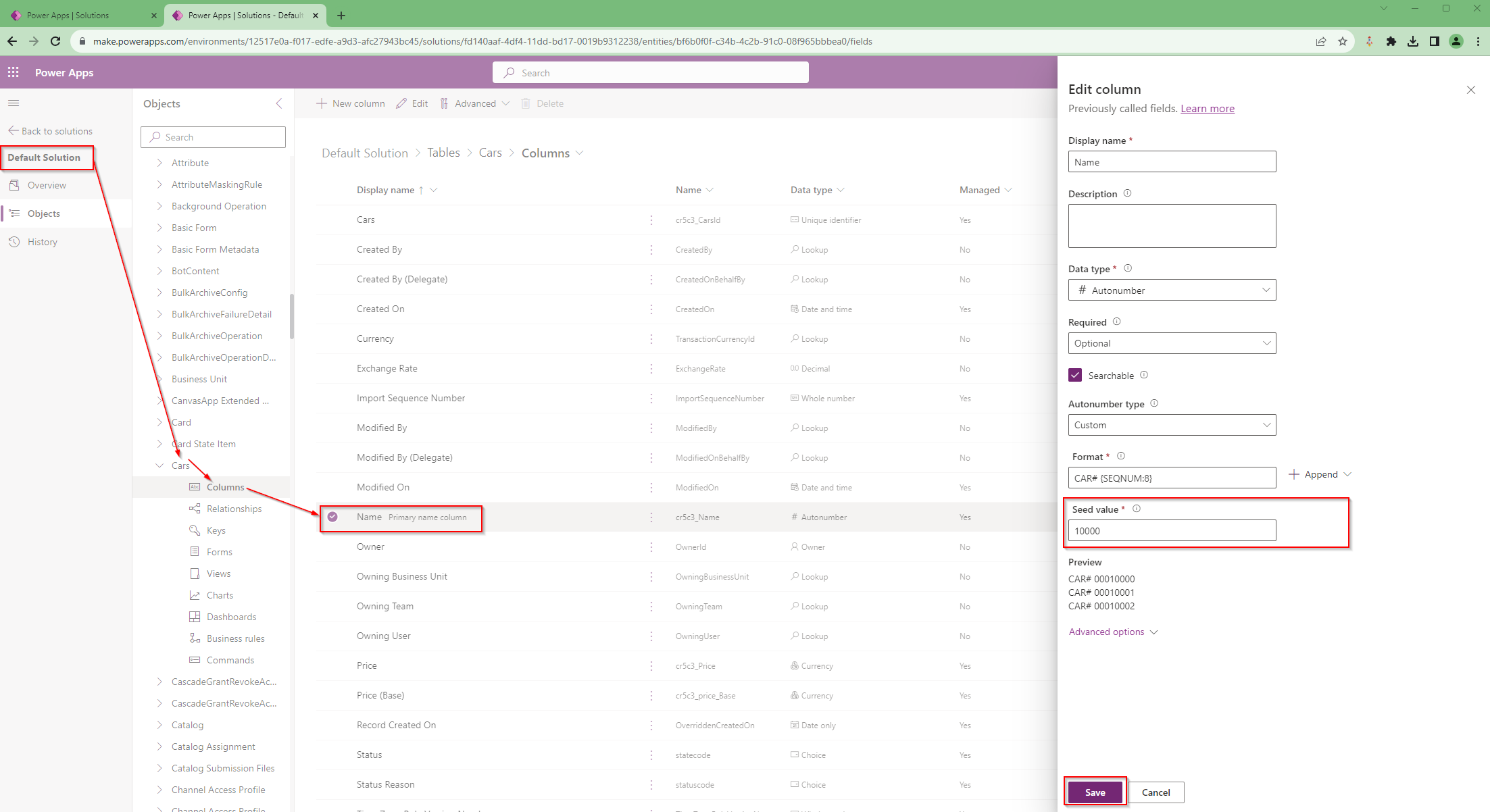
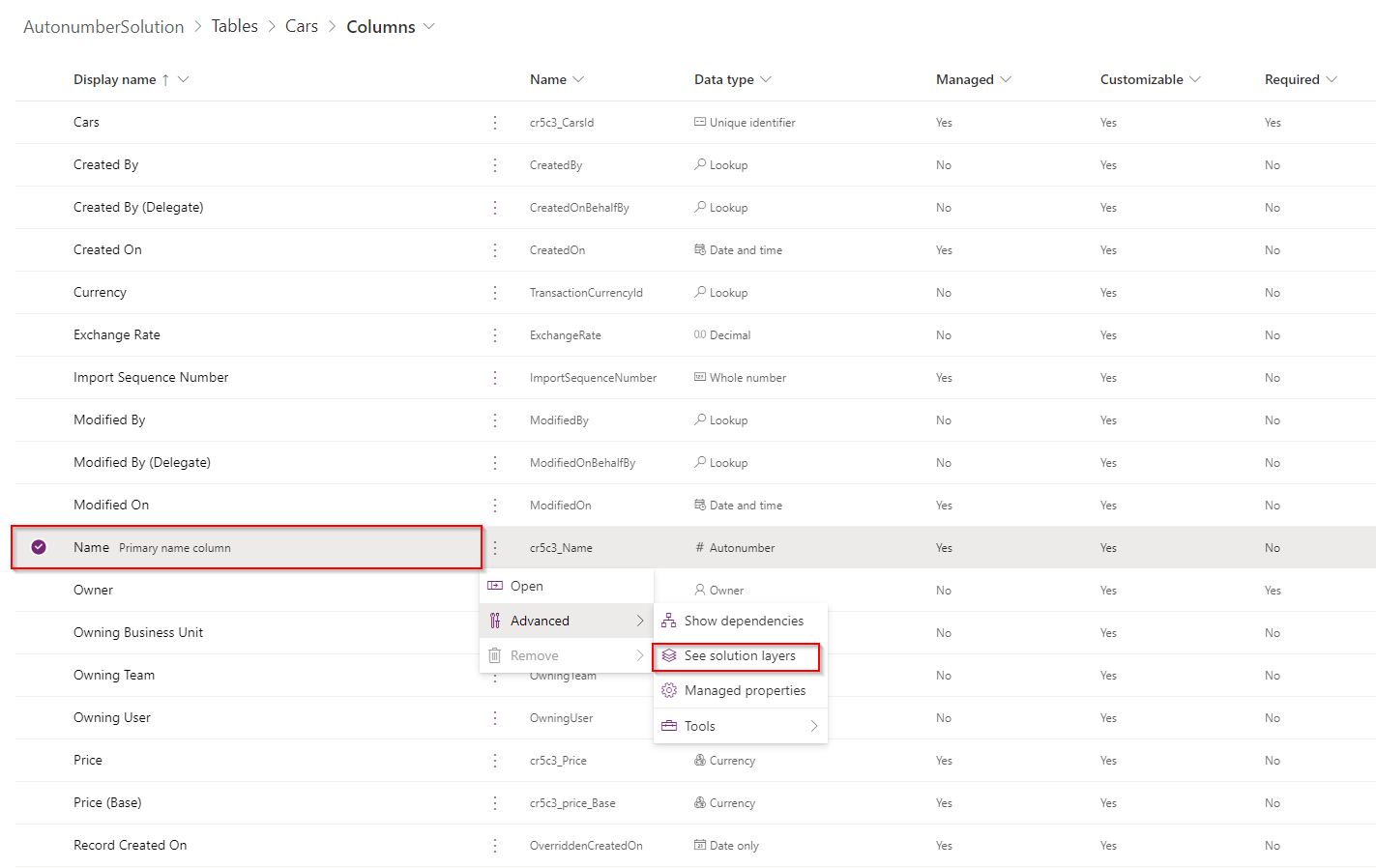
After contacting support, I was told that seed values are not solution-aware as of now (November 2023), meaning you cannot deploy them easily. This might seem weird because you might think that when you configure the column, the seed value is somehow also included in the solution, but it's not. There are methods to do that, but most of them are unsupported and/or break fundamental architectural rules. So, let's demonstrate an easy method to change this. First, go to the default solution in your TEST environment, then to the respective table and field, and change the seed value there
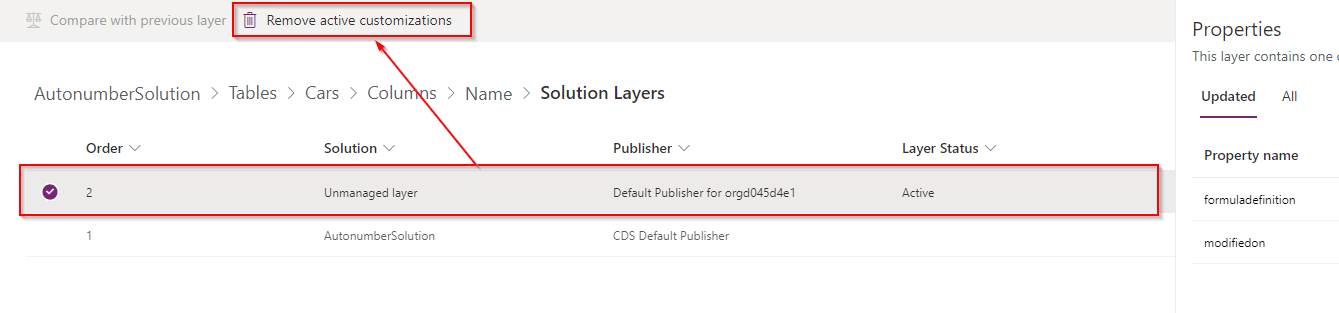
This will, of course, create an unmanaged layer inside your managed solution. Next, we jump back to our managed solution and remove the respective layer. This is important because the order of execution will otherwise always show this layer, and this is potentially not what you want for later deployments
There you can go on and remove the unmanaged layer:
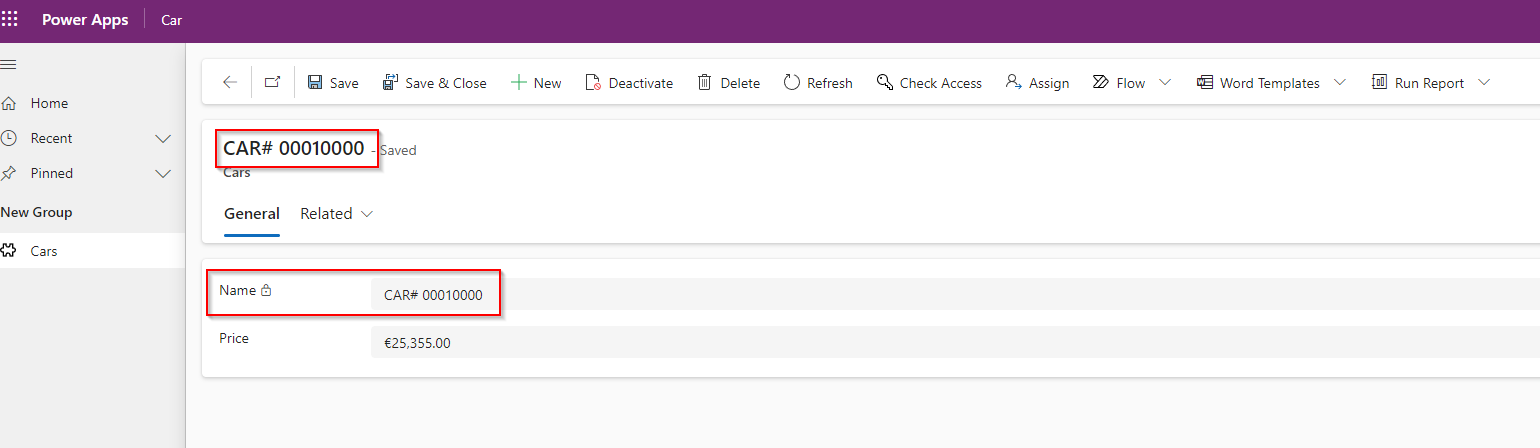
And after completing this step you should see the "correct" seed value in your app, in our case the autonumber for the cars:
Of course, this is a workaround and is classified here as a 'Trick.' However, as long as seed values are not solution-aware, which I hope will soon happen, it is a possible way to input the correct values into your target environments if you have to use custom formats for your numbers.
Dataverse workaround wrong Autonumber Seed during Deployment
Published on:
Learn moreWe can help you with Dataverse workaround wrong Autonumber Seed during Deployment
If you want help implementing, troubleshooting, or improving this product, contact us and we’ll point you in the right direction.
Related posts
Dynamics 365 plugins for Copilot Cowork: an admin setup checklist
The ERP, Sales and Customer Service plugins bring Dynamics 365 data into Copilot Cowork through MCP servers. What to configure, and where it b...
Migrate a Power Pages site to the enhanced data model with PAC CLI
A step-by-step guide to moving a Power Pages site off the adx_ tables with pac pages migrate-datamodel: modes, ALM sequence, remediation and r...
Copilot features retiring from Power Apps and Power Automate
Between November 30 and December 31, 2026, several in-studio Copilot and collaboration features disappear. What goes, what stays and what to u...
Unmanaged developer environments are ending: what to do before December 15
Unmanaged developer environments can no longer be created, are suspended on December 15, 2026 and deleted in January. Who is affected and how ...
Backfill Dataverse prompt columns on existing records
Prompt columns only ran on new or updated rows. A bulk option now fills existing records as a system job: the two settings, the steps and the ...
Reveal a masked Dataverse column with Dataverse.Unmask
A new Power Fx function lets authorised users of a canvas app reveal one masked Dataverse value on demand, while column security stays in char...
Generative pages in model-driven apps: a practical guide
What generative pages are, where they stand in November 2026, the two ways to build them, the code they produce, and the limits to plan for.
Big Update — CRMJetty Dynamics 365 Portal Now Comes with Powerful New Integrations
Enterprise portals are evolving rapidly. They are no longer mere portals through which CRM records can be viewed. Portals are now expected to ...
Power Apps Code Apps in Practice: Recreating Model-Driven App Patterns
Power Apps Code Apps went from preview to general availability in record time. With that, Microsoft has sent a clear signal that it is taking ...