
Form Component Control
Not only does the form component control allows you to edit records directly from another record's main form, it might also be a good replacement for field level security.
Imaging having some account details, which only a subset of your users are allowed to view or edit. Having field level security is often a valid choice. But maintaining a lot of columns, multiple field security profiles and the assigned users and teams are often underestimated. Alternatively, you could handle such requirements with form scripts, but those are not guarateeing security and won't work in the backend.
With the introduction of the form component control, you are now able to embedd a main form from a related entity (account details) on the main form of the base entity (account). You then have the possiblity, to assign separate security roles with different permissions to your user groups.
Let's say user group A is only allowed to read data from the account details and user group B is allowed to also modify the data. You'll just need to create two security roles with the permissions mentioned before and assign them to the users.
First create a new table with a new main form:

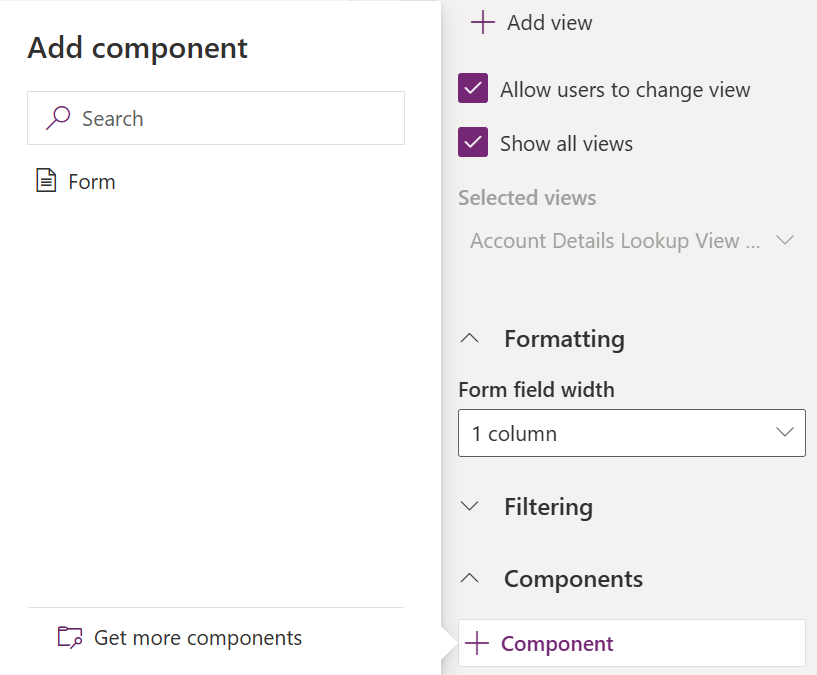
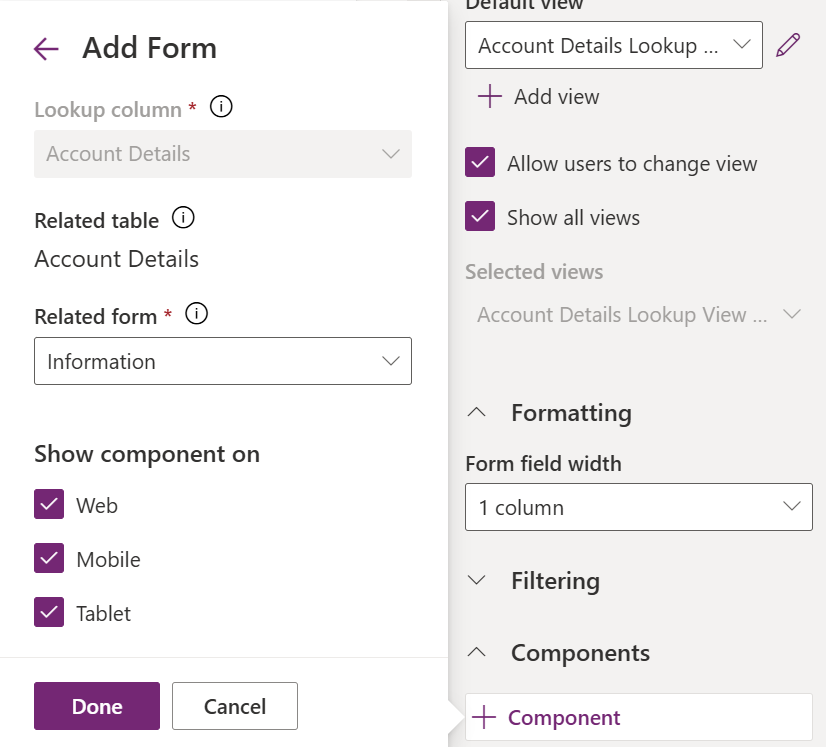
Create a lookup column on the account table referencing the account details table, add the lookup to the main form and select the "Form" component for this lookup and choose the form to be displayed:
You could simply let a flow or a plugin auto-create the account details record or use a ribbon button to create the account details record on demand.
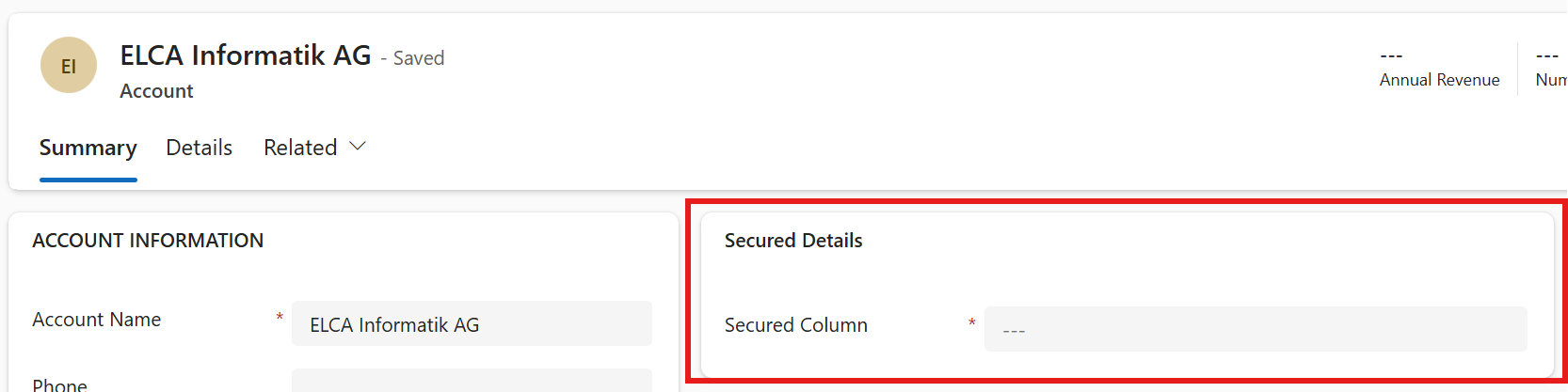
When you navigate to the account record, you'll see the account details record embedded in the main form of the account:
A few things to mention regarding the related form:
- It might contain form libraries and form events are supported
- Only the first tab will be rendered
- The header is not rendered
- Embedded canvas apps are not supported
- Using the same form for different form component controls on a single form isn't supported.
Published on:
Learn moreWe can help you with Form Component Control
If you want help implementing, troubleshooting, or improving this product, contact us and we’ll point you in the right direction.
Related posts
Generative pages in model-driven apps: a practical guide
What generative pages are, where they stand in November 2026, the two ways to build them, the code they produce, and the limits to plan for.
Big Update — CRMJetty Dynamics 365 Portal Now Comes with Powerful New Integrations
Enterprise portals are evolving rapidly. They are no longer mere portals through which CRM records can be viewed. Portals are now expected to ...
Power Apps Code Apps in Practice: Recreating Model-Driven App Patterns
Power Apps Code Apps went from preview to general availability in record time. With that, Microsoft has sent a clear signal that it is taking ...
Use XRM type definition in your Javascript file
We implement Javascript webresource for form scripting (form onload, field on change,...). Our code need to follow the official document Xrm o...
Dataverse Functions Deep Dive
Microsoft released in 2024 Dataverse low-code plugins. The promise was great : writing plugins using low-code tools. No need to have developme...
Dataverse : Get Audit Storage by table
Dynamics 365 auditing feature logs changes made to records, allowing you to view the details of those changes at any time. Whenever a record i...
D365 Sales -2025 Wave release
In this post, we highlight the latest releases from Microsoft D365 Sales' 2025 Wave updates. For a detailed breakdown, click here. Public Prev...
10 Ways Dynamics 365 Calendar Boosts Productivity for Sales & Support Teams
In today’s fast-paced business environment, time is the most valuable resource for both sales and support teams. Managing appointments, meetin...