
Session timeout setting with D365
Session timeout setting with D365
New interesting feature on Dynamics 365 V9 : Session Timeout Settings !
We have often talked about security, roles and administration in general in order to secure access within an organization.
Today, Microsoft propose a new feature allowing us to set a time out which would automatically log out a user inactive on its session.
This feature is as we can imagine a real value for security matter.
We will first see how to activate this timeout within settings and we will test it accordingly.
I - Activate Time Out Settings
In order to set an inactivity timeout, Go to Settings --> Advanced Settings : 
Click the little arrow next to Settings --> Administration : 
Click on System Settings : 
In General tab, scroll down until 'Set session timeout' and 'Set inactivity timeout' sections --> Enable those options and set the time for timeout according to your need :
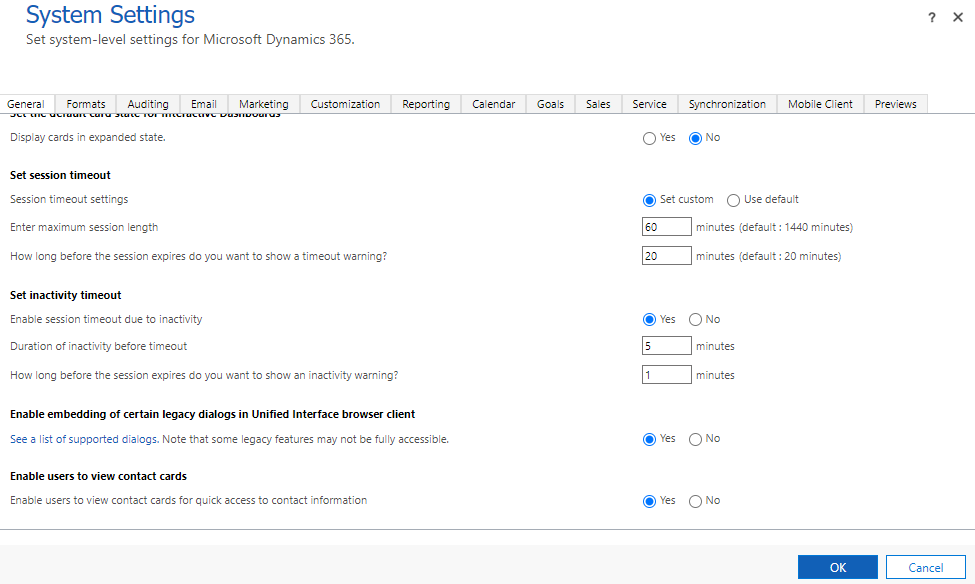
The session timeout represent how long a user can use it's session before being automatically logged out. A warning message will appear 20 minutes before.
- The minimum session length is 60 minutes
- The minimum time before a warning message is displayed is 20 minutes
The inactivity timeout represent how long a user can be inactive on its session before being automatically logged out. A warning regarding this will appear 1 minute before it logs out.
- The minimum duration of inactivity is 5 minutes
- The minimum time before a warning message is displayed is 1 minute
Let's try this now !
II - Test Time Out Settings
One of the easiest test to make : basically, log in and do nothing in order to see if the inactivity time out session is working properly (after 5 minutes):
Here is the message I get after waiting those 4 minutes :

If we click on 'Continue Session' I can continue to use my current session. If I don't, 1 minute later according to my settings, the session will be automatically logged out and the following message will appear :

It seems to work pretty well ! We imagine easily how such kind of feature might be interesting to enhance security within companies.
III - Conclusion
This very new Session Timeout feature is a great way to enhance security within companies.
Indeed, one of the major criteria in order to protect data within a company is to involve everyone and diffuse good practice as good as possible to avoid dangerous behaving.
But honestly, who never left his office without Windows + L !?
This kind of feature is definitely a great way to improve security and I am convinced that company's will warmly welcome such kind of feature to remind people to be careful with their session.
Session timeout setting with D365
Published on:
Learn moreWe can help you with Session timeout setting with D365
If you want help implementing, troubleshooting, or improving this product, contact us and we’ll point you in the right direction.
Related posts
Dynamics 365 plugins for Copilot Cowork: an admin setup checklist
The ERP, Sales and Customer Service plugins bring Dynamics 365 data into Copilot Cowork through MCP servers. What to configure, and where it b...
Migrate a Power Pages site to the enhanced data model with PAC CLI
A step-by-step guide to moving a Power Pages site off the adx_ tables with pac pages migrate-datamodel: modes, ALM sequence, remediation and r...
Copilot features retiring from Power Apps and Power Automate
Between November 30 and December 31, 2026, several in-studio Copilot and collaboration features disappear. What goes, what stays and what to u...
Unmanaged developer environments are ending: what to do before December 15
Unmanaged developer environments can no longer be created, are suspended on December 15, 2026 and deleted in January. Who is affected and how ...
Backfill Dataverse prompt columns on existing records
Prompt columns only ran on new or updated rows. A bulk option now fills existing records as a system job: the two settings, the steps and the ...
Reveal a masked Dataverse column with Dataverse.Unmask
A new Power Fx function lets authorised users of a canvas app reveal one masked Dataverse value on demand, while column security stays in char...
Generative pages in model-driven apps: a practical guide
What generative pages are, where they stand in November 2026, the two ways to build them, the code they produce, and the limits to plan for.
Big Update — CRMJetty Dynamics 365 Portal Now Comes with Powerful New Integrations
Enterprise portals are evolving rapidly. They are no longer mere portals through which CRM records can be viewed. Portals are now expected to ...
Power Apps Code Apps in Practice: Recreating Model-Driven App Patterns
Power Apps Code Apps went from preview to general availability in record time. With that, Microsoft has sent a clear signal that it is taking ...