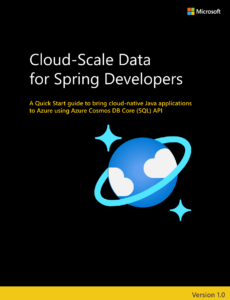
Attention Developers: The Cloud-Scale Data for Spring Developers Quick Start Guide is Finally Here!
Overview
The purpose of this developer's quick start guide is to help you build cloud-native Java applications in Azure. You’ll gain insights about using NoSQL and why you should consider Azure Cosmos DB, our fully managed, distributed NoSQL database service on Azure.
These insights are designed to be useful, starting with a NoSQL background or coming into a project with a relational mindset. Data isn’t the only thing involved in an application, and this guide will take you through working with other Azure services that integrate well with Azure Cosmos DB.
You’ll learn how to host Java applications in Azure Spring Apps or set up notifications with Azure Functions and Azure Logic Apps.
What This Guide Covers
Real-world examples will showcase Azure platforms. Since the focus is on cloud-native Java applications, this guide will use Java with Spring Boot throughout.
In addition, you’ll learn how to use Azure Cosmos DB for your data needs, such as storing product information in Azure Cosmos DB or sending notifications with Azure Logic Apps to users when products have changed.
Retail situations and suggestions for other business cases will be included. By the end of this guide, you should have the confidence to build cloud-native Java applications in Azure with Azure Cosmos DB as a data store. You’ll be able to run an application in an Azure pay-as-you-go account with the Azure Cosmos DB free tier.
Chapters
- Introduction to the Cloud-Scale Data for Spring Developers Quick Start Guide
- What is NoSQL?
- What is Azure Cosmos DB?
- Security in Azure Cosmos DB
- Get Started with Java & Azure Key Vault
- Get Started with Java & Azure Cosmos DB
- Deploy to Azure App Service
- CRUD Operations with Azure Cosmos DB
- Azure Cosmos DB Change Feed
- Create an Azure Cosmos DB Trigger for Azure Functions in Java
- Update the Azure Cosmos DB Trigger Code for Event Sourcing
- Use Send Notifications with Azure Logic Apps
- Scaling in Azure Cosmos DB
- Add the Bulk Executor Feature
- Schema Design Considerations for Azure Cosmos DB
- Use Azure Cosmos DB for Mission Critical Situations
- Migrate to Azure Spring Apps
Not covered
This guide doesn’t explain how to migrate existing Java applications to Azure. Migrating existing Java applications is covered in the Java to Azure migration strategy documentation. As well, this guide doesn’t cover relational data storage in Azure. It isn’t intended to be a complete compendium of all things Java and Azure, though there will be many Azure offerings showcased.
Get Started with Azure Cosmos DB
Azure Cosmos DB is a fully managed NoSQL database for modern app development with SLA-backed speed and availability, automatic and instant scalability, and open-source APIs for MongoDB, Cassandra, and other NoSQL engines. Discover features or capabilities at www.AzureCosmosDB.com or get started for free. For up-to-date news on all things, Azure Cosmos DB be sure to follow us on Twitter, YouTube, and our blog.
Build Your Apps for Free on Azure
Start building your next Java app with Azure by taking advantage of the free app, data, and AI services. New Azure customers can sign up for an Azure Free Account to take advantage of additional free offerings. Visit the Azure Free Account page for more details.
- Azure Cosmos DB 1000 RU/s + 25GB Storage (monthly)
- Azure DevOps with unlimited private Git Repos for up to 5 users
- Azure Kubernetes Services (AKS) with free Cluster Management
- Azure Functions with up to 1M requests for free
- Azure Cognitive Services up to 30,000 transactions free
Read the Guide Now
Published on:
Learn moreRelated posts
This Month in Azure Static Web Apps | 09/2024
We are back with another edition of the Azure Static Web Apps Community! :party_popper: September was yet another month ...
GitHub Copilot for Azure: 6 Must-Try Features
As developers, we are constantly seeking tools that streamline our workflows and boost productivity. … Enter GitHub Copilot for Azure, now in ...
Responsible AI Mitigation Layers
Generative AI is increasingly being used in various kinds of systems to augment humans and infuse intelligent behavior into existing and new a...
Streamline Your Azure Workflow: Introducing GitHub Copilot for Azure in VS Code
I'm excited to announce the public preview of GitHub Copilot for Azure - a new addition to your toolkit that seamlessly integrates with G...
Build Intelligent Apps Code-First with Prompty and Azure AI
Building Generative AI applications can feel daunting for traditional app developers. What does the end-to-end applicati...
Certificación AI-900 (Fundamentos de IA) con Chicas en IA
La inteligencia artificial ha llegado para quedarse, ¡y más aún con la revolucionaria IA generativa! Para ayudar a los profesionales a especia...
Get certified with Learn Live GitHub series!
GitHub Universe is coming, and Microsoft and GitHub are partnering to offer a new special Learn Live series in Brazilian Portuguese, English a...
Certifícate con Learn Live GitHub en Español
Microsoft y GitHub se han unido para ofrecer una nueva serie especial de Learn Live en inglés y español: GitHub 2024. Del 10 al 24 de Octubre,...
Evaluating generative AI: Best practices for developers
As a developer working with generative AI, you've likely marveled at the impressive outputs your models can produce. But how do you ensure the...
Introducing Azure Product Retirement Livestreams
The Azure Retirements team, in collaboration with key partner groups, is excited t...