
Microsoft announces new collaboration with MazeBolt RADAR™ DDoS testing
As we highlighted in our report on recent attack trends during the last holiday season, Distributed Denial-of-Service (DDoS) attacks are one of the main security concerns today. Any endpoint that is reachable through the internet, whether in the cloud or on-premises, can be a target of a DDoS attack. Having a solid incident management response plan requires planning and preparation for a DDoS attack, and DDoS attack simulations are an essential part of this plan.
Microsoft is pleased to introduce a new collaboration with MazeBolt, giving our customers a new option for DDoS simulation testing. With the unique MazeBolt RADAR™ platform, you can now non-disruptively and continuously validate your entire external attack surface for DDoS vulnerabilities without any interruption to your production environment. RADAR™ assists organizations in identifying and mitigating DDoS vulnerabilities using Azure DDoS protection services, giving you the assurance and visibility that the Azure DDoS protections deployed are tuned to be fully automated for your specific needs and prevent unnecessary reactive downtime.
Non-disruptive DDoS Attack Simulations with MazeBolt RADAR™
Even the best DDoS mitigation solutions can have misconfigurations, which lead to vulnerabilities in protections, an attacker can then use these vulnerabilities to inflict damaging downtime on online services.
The MazeBolt RADAR platform uses patented non-disruptive DDoS attack simulations that can cover an organization's entire attack surface. Due to the underlying technology RADAR is built upon, the platform takes DDoS attack simulation to a new level by automatically and continuously using thousands of attack simulations (of all known attack vectors) to identify and enable the elimination of DDoS vulnerabilities before a damaging attack interrupts business continuity.
Once RADAR identifies DDoS vulnerabilities and remediation has taken place with the relevant mitigation, RADAR then re-validates those specific targets and online services to ensure those vulnerabilities have been eliminated.
DDoS simulation results and reporting are provided in a self-service management dashboard in the RADAR platform.
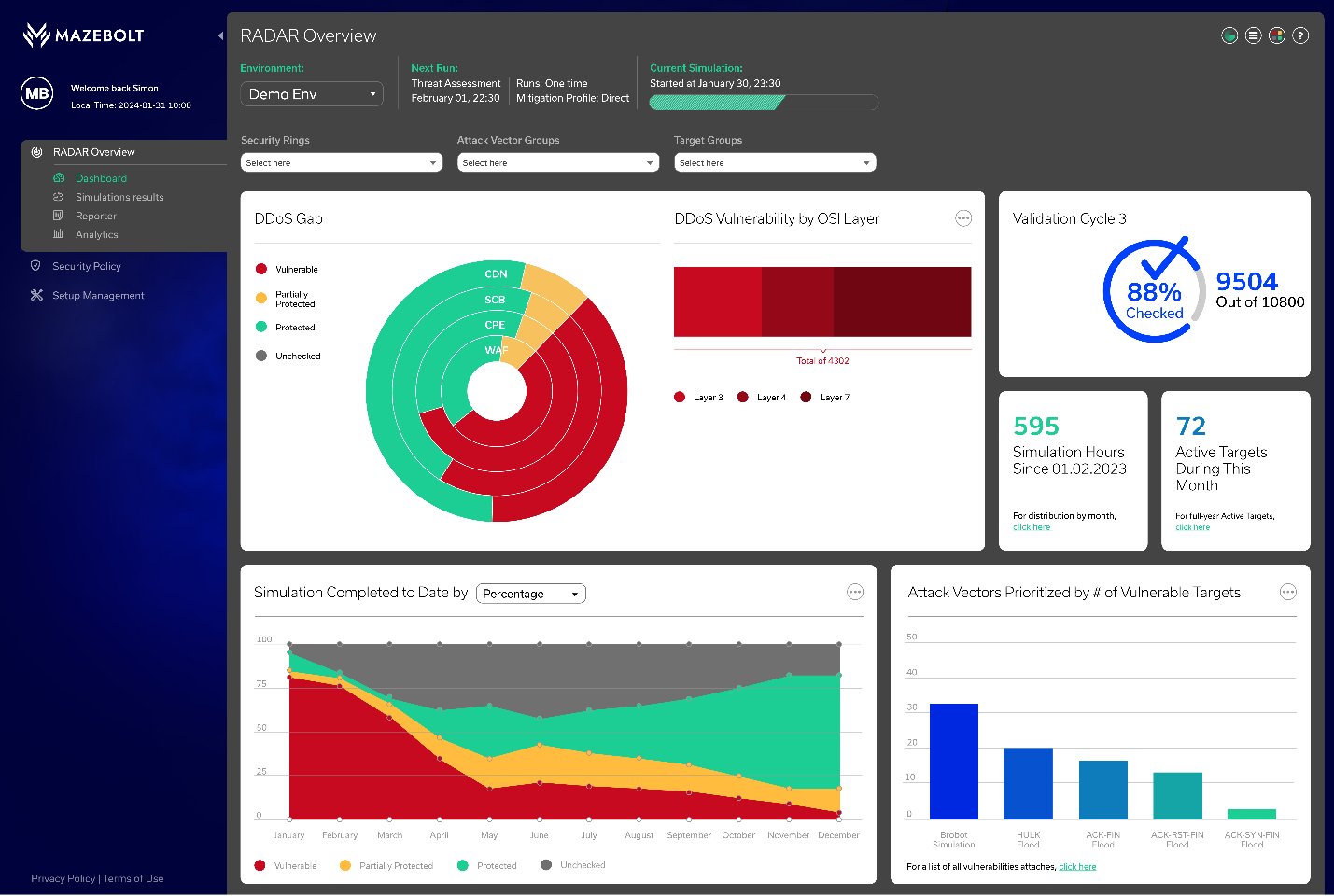
Available reporting highlights the current gaps in DDoS protections across OSI layers, and the level of vulnerability, from Vulnerable, Partially Protected to Protected states.
Reporting features
Real-time simulation view – DDoS attack simulations can be viewed in real-time. RADAR is a non-disruptive DDoS attack simulator and is fully automated. A prioritized list of the main attack vectors the attack surface is vulnerable to are used to establish an efficient remediation plan.
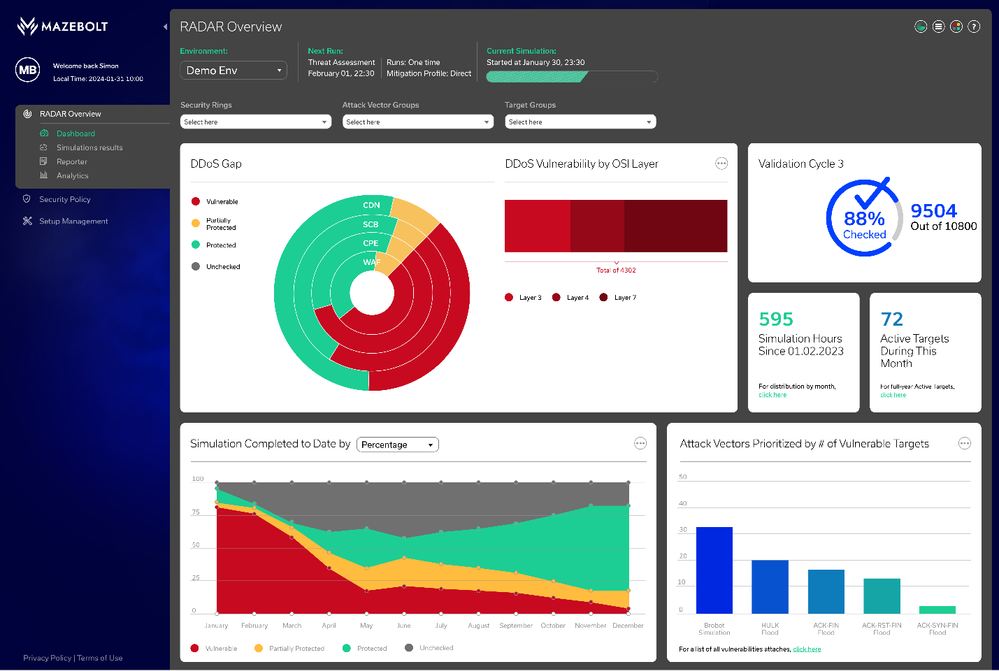
Standard RADAR view
Real time interactive analytics – Real time a high-level view on DDoS vulnerability level, simulation results filtering and analysis, metrics for month-to-month analysis.
On-demand reports – Customers can generate on-demand vulnerability reports in PDF format based on various filters.
Quarterly executive summary – MazeBolt account management provides quarterly reports in PDF format.
Other main features
Multi-tenant management – Manage and view multiple regions through a single UI. The platform management allows you to view and manage multiple deployments through a single UI and integrate your existing RADAR deployment to Azure while maintaining the same management UI.
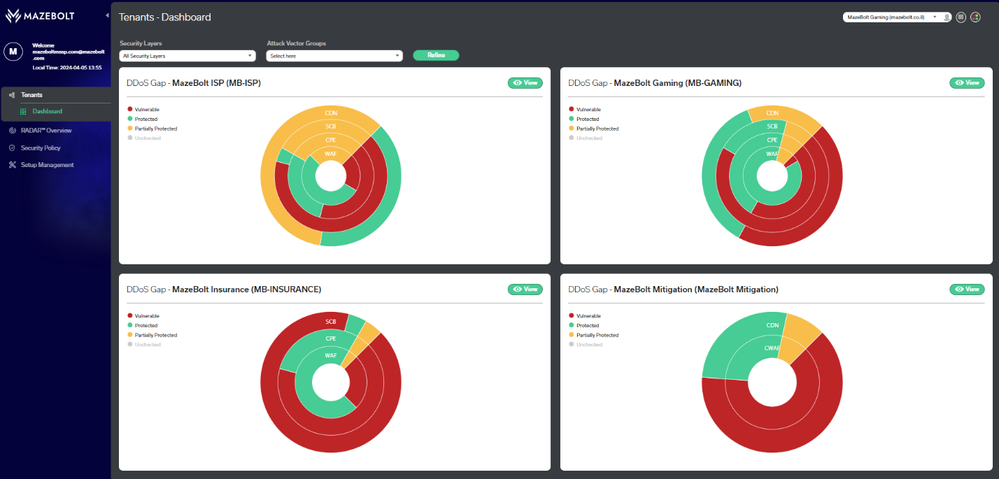
Multi-tenant RADAR view
SIEM integration – Allow integration with your preferred SIEM solution to gain alerts through RADAR attack simulations times and results.
Two factor authentication – Increased security enable two factor authentication for accessing the RADAR platform and reporting.
Azure DDoS simulation testing policy
MazeBolt's RADAR platform is deployed within Azure. You can only simulate attacks against Azure-hosted public IP addresses which belong to an Azure subscription of your own and will be validated before testing. Additionally, to run DDoS simulation with RADAR™, any target public IP addresses must be protected under Azure DDoS Protection SKU. MazeBolt services are sold separately from Azure DDoS Protection and can be purchased directly through MazeBolt.
You may only simulate attacks using our approved testing partners:
Learn more
MazeBolt: The only source of truth for DDoS readiness
Azure DDoS Protection simulation testing partners: Azure DDoS Protection simulation testing
Microsoft penetration testing guidelines: Penetration testing
Azure DDoS Protection Standard product page
Published on:
Learn moreWe can help you with Microsoft announces new collaboration with MazeBolt RADAR™ DDoS testing
If you want help implementing, troubleshooting, or improving this product, contact us and we’ll point you in the right direction.
Related posts
IPv6 Adoption: Enhancing Azure WAF on Front Door
The transition to IPv6 is a significant step for enterprise corporations, reflecting the evolution of internet technology and the need for a l...
Azure WAF’s Bot Manager 1.1 and JavaScript Challenge (Preview): Navigating the Bot Threat Terrain
Introduction Bots are a common presence on the internet, serving a range of functions from automating customer service to indexing page...
Private IP DNAT Support (Preview) and Scenarios with Azure Firewall
Introduction Azure Firewall is a cloud native security service to protect your workloads running in Azure. It is a stateful firewall as a serv...
Getting Started with Azure DDoS Protection REST API: A Step-by-Step Guide
REST API is a cornerstone in the management of resources on Azure, providing a streamlined and efficient approach for executing create, read, ...
Monitoring Azure DDoS Protection Mitigation Triggers
Monitoring Azure DDoS Protection Mitigation Triggers In today’s digital landscape, Distributed Denial of Service (DDoS) attacks pose a signifi...
Azure WAF’s Bot Manager 1.1 and JavaScript Challenge: Navigating the Bot Threat Terrain
Introduction Bots are a common presence on the internet, serving a range of functions from automating customer service to indexing page...
Utilizing Azure DDoS Protection Workbook for DDoS attack traffic Analysis
In today's digital age, the security of applications, servers, and networks is paramount. One of the most significant threats to this security...
Independent Configuration of Size Enforcement and Inspection Limits in Application Gateway WAF
Introduction In the constantly changing world of cybersecurity, both flexibility and effective security are essential for safeguarding ...
Private IP DNAT Support and Scenarios with Azure Firewall
Introduction Azure Firewall is a cloud native security service to protect your workloads running in Azure. It is a stateful firewall as a serv...
Monitoring traffic flows in Azure Firewall using Virtual Network Flow Logs
Azure Firewall is a managed service designed to protect your Azure Virtual Network resources, providing advanced threat protection and advance...