
Announcing landing zone accelerator for Azure Arc-enabled Kubernetes

Following our release a few months back of the new landing zone accelerator for Azure Arc-enabled servers, today we’re launching the Azure Arc-enabled Kubernetes landing zone accelerator within the Azure Cloud Adoption Framework. The landing zone accelerator provides best practices, guidance, and automated reference implementations so that customers can get started with their deployments quickly and easily.
The Azure Arc-enabled Kubernetes landing zone accelerator makes it easier for customers to increase security, governance, and compliance posture on clusters that are deployed outside of Azure. Along with Azure Arc, services such as Microsoft Defender for Cloud, Azure Sentinel, Azure Monitor, Azure Log Analytics, Azure Policy, and many others are included in the reference implementations that can then be extended to production environments.
In addition, the accelerator puts a lot of focus on modern DevOps-related practices and software deployment patterns in a Kubernetes architecture such as the use of GitOps, Continues Integration and Deployment (CI/CD), and Service Mesh and the automation disciplines around it.
Design areas within the landing zone accelerator
The Azure Arc-enabled Kubernetes landing zone accelerator enables customers’ cloud adoption journey with considerations, recommendations, and architecture patterns most important to customers. For deploying Azure Arc-enabled Kubernetes in the most recommended way, we created a set of ten critical design areas. Each of these specific areas walks customers through a set of design considerations, recommendations, architectures, and next steps:
- Identity and access management
- Network topology and connectivity
- Resource organization
- Governance and security disciplines
- Management disciplines
- Automation disciplines
- Extensions management
- CI/CD and GitOps disciplines
- Services observability
- Cost governance
Automation for landing zone accelerator
The Azure Arc landing zone accelerator uses the sandbox automation powered by Azure Arc Jumpstart as its reference implementation. Since launching 2 years ago, Azure Arc Jumpstart has grown to more than 100 automated scenarios, thousands of visitors a month, and a vivid open-source community sharing their learnings on Azure Arc. As part of Jumpstart, we developed ArcBox, an automated sandbox environment for all-things Azure Arc, deployed in customers’ Azure subscriptions.
Here’s what Manuel Sánchez Rodríguez, Technical Manager, Azure Evangelist, and a Microsoft MVP at NTT DATA had to say about the Jumpstart - "For us, the Azure Arc Landing Zone Accelerator helps us build with our customers a successful implementation of a platform foundation that takes care of the shared services (network, security, identity, and governance) needed to effectively build and run a landing zone. Being able to provide prescriptive guidance and accelerate implementation through Jumpstart's infrastructure templates as code has been key to preparing customer's landing zones while making sure they adhere to the architecture and best practices of the Cloud Adoption Framework."
For the Azure Arc-enabled Kubernetes landing zone accelerator, we developed the new ArcBox for DevOps, which will act as the sandbox automation solution for Azure Arc-enabled Kubernetes with services like Azure Policy, Azure Monitor, Microsoft Defender for Cloud, Open Service Mesh (OSM), GitOps, Azure Key Vault, and more.
This provides customers with a comprehensive experience that can just be deployed and have a fully operational Azure Arc-enabled Kubernetes environment.
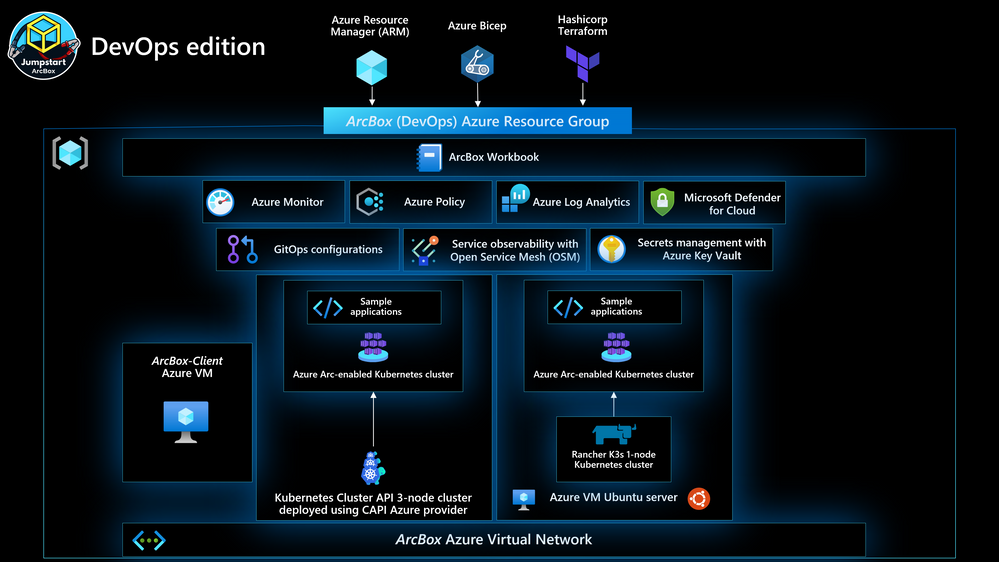
The sandbox automation supports Bicep, Terraform, and ARM templates, so customers can choose what makes sense to them and their organizations’ automation practices. This is also part of our continued investment in the ArcBox product line.
Getting started
Hop over to the Hybrid and multicloud Cloud Adoption Framework page and explore the Azure Arc-enabled Kubernetes landing zone accelerator, the critical design areas, and sandbox automation.
Learn more at the Hybrid Azure Hybrid, Multicloud, and Edge Day digital event
We will be hosting our annual Azure Hybrid, Multicloud, and Edge Day digital event on June 15, 2022. You’ll hear from Microsoft leadership and engineers on how you can innovate anywhere with Azure Arc, learn from customers using Azure solutions for their hybrid scenarios, and get to ask questions in the live Q&A chat. Register now >
Published on:
Learn moreWe can help you with Announcing landing zone accelerator for Azure Arc-enabled Kubernetes
If you want help implementing, troubleshooting, or improving this product, contact us and we’ll point you in the right direction.
Related posts
Azure Adaptive Cloud Pre-Days at Microsoft Ignite 2024
As the excitement builds for Microsoft Ignite 2024, tech enthusiasts and professionals worldwide are eagerly anticipating the Azure Adaptive C...
Launching the Arc Jumpstart Newsletter: October 2024 Edition
👋 Welcome! We are excited to kick off this monthly newsletter, where you can get the latest updates on everything happening in the Arc Jumpst...
Announcing Public Preview of Windows Server Hotpatch enabled by Azure Arc
We’re excited to announce the Public Preview of Hotpatch enabled by Azure Arc for Windows Sever 2025 Datacenter and Standard editions! ...
Public Preview of Azure Container Storage enabled by Azure Arc Edge Volumes
Release Summary We are thrilled to announce the Public Preview of Azure Container Storage enabled by Azure Arc Edge Volumes, a groundbre...
Introducing ArcBox 3.0 General Availability
Today, the Arc Jumpstart team is excited to announce the general availability of ArcBox 3.0! Since it was first introduced in 2021, Ar...
CloudCasa for Azure Arc
Azure Arc is a platform that helps users build and develop their applications by extending Azure to their datacenters, edge, or even to multic...
Generally Available: Transition to WS2012 / R2 ESUs enabled by Azure Arc from Volume Licensing
Customers that have enrolled in WS2012/ R2 ESUs through Volume Licensing for Year 1 can transition to Azure Arc for Year 2 of the program. Ext...
Comparing feature sets for AKS enabled by Azure Arc deployment options
This article shows a comparison of features available for the different deployment options under AKS enabled by Azure Arc. ...
Increasing Security for SQL Server Enabled by Azure Arc
Back in November 2023, the least privileges deployment model was introduced as a public preview. After thorough testing, we are excited to ann...
Five Key Updates on WS2012 ESUs enabled by Azure Arc
We have a myriad of key updates for customers enrolled in WS2012/R2 ESUs enabled by Azure Arc! As we continue to refine and expand the offer, ...