
Working with ADF Storage Event Trigger Over SFTP
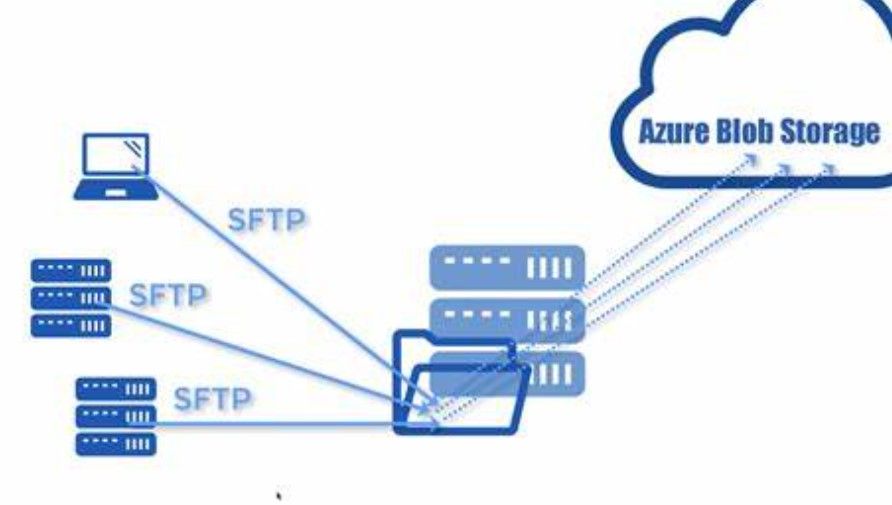
Storage Event Trigger in Azure Data Factory is the building block to build an event driven ETL/ELT architecture (EDA). Data Factory's native integration with Azure Event Grid let you trigger processing pipeline based upon certain events. Currently, Storage Event Triggers support events with Azure Data Lake Storage Gen2 and General-Purpose version 2 storage accounts, including Blob Created and Blob Deleted.
Event-driven architecture (EDA) is a common data integration pattern that involves production, detection, consumption, and reaction to events. Data integration scenarios often require customers to trigger pipelines based on events happening in storage account, such as the arrival or deletion of a file in Azure Blob Storage account. Data Factory and Synapse pipelines natively integrate with Azure Event Grid, which lets you trigger pipelines on such events.
The below document and blogs talk about how you can create ADF event trigger that run ADF pipeline in response to Azure Storage events.
Create event-based triggers - Azure Data Factory & Azure Synapse | Microsoft Learn
Storage Event Trigger - Permission and RBAC setting - Microsoft Community Hub
While the basic architecture and settings remains the same, in this blog we will be mainly focus on SFTP related storage events and the configuration changes that you make currently to trigger an ADF pipeline.
Now, as mentioned that the basic steps remain the same when it comes to the creation of trigger. We need to provide the details such as storage account name (SFTP enabled one), container name along with the pattern (blob start/blob end) to match the triggering conditions.
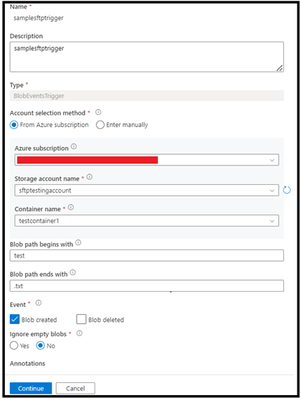
Once you perform the above step, it automatically creates Event grid configurations automatically at the backend. Below is how the configuration will look based on the filtering patten that you had selected while creating the trigger.
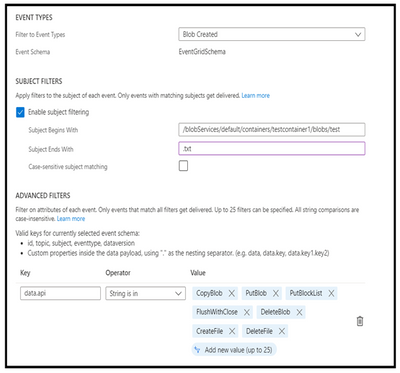
If we look at the data API’s that gets added, currently, we will see mainly the Blob Storage REST API’s and the Data Lake gen2 REST API’s. However, for SFTP storage, there are different set of REST API’s such as SFTPCreate, SFTPCommit, SFTPRename etc. You can monitor the REST APIs via diagnostic logging as well:
Monitoring Azure Blob Storage | Microsoft Learn
Based on these API’s the corresponding SFTP events are generated as discussed in the below link:
Now with the default configuration that gets added to the filtering section, if we try to perform operations via SFTP REST API’s, although the event gets generated, the event will tend to get dropped as based on the filtering conditions, it will not find the corresponding data API. As a result, the trigger won’t execute pipeline ahead. Hence, we need to add the SFTP specific REST API’s to data.api section to match the triggering conditions of the event such as below:
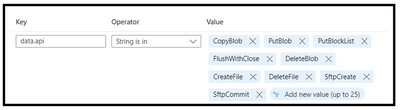
Once this has been added and you try to upload a blob via SFTP REST API’s, it will make the ADF pipeline to trigger ahead successfully.
Hope this helps!
Published on:
Learn moreRelated posts
Azure Storage - TLS 1.0 and 1.1 retirement
Overview TLS 1.0 and 1.1 retirement on Azure Storage was previously announced for Nov 1st, 2024, and it was postponed recently to 1 year later...
Efficient Management of Append and Page Blobs Using Azure Storage Actions
Overview In Azure Storage, Blob Lifecycle Management (BLM) allows you to automate the management of your data based on rules defined by...
[Azure AI Search] Internal Server Error when creating CMK encrypted objects
Scenario Customers follow the Microsoft doc to create CMK encrypted objects (data source, index etc.), but get the 500 Internal Serv...
Optimizing Azure Table Storage: Automated Data Cleanup using a PowerShell script with Azure Automate
Scenario This blog’s aim is to manage Table Storage data efficiently. Imagine you have a large Azure Table Storage that accumulates logs from ...
Optimizing Azure Table Storage: Automated Data Clean-up using a PowerShell script with Azure Automat
Scenario This blog’s aim is to manage Table Storage data efficiently. Imagine you have a large Azure Table Storage that accumulates logs from ...
Restoring Soft-Deleted Blobs with multithreading in Azure Storage Using C#
Blob soft delete is an essential feature that safeguards your data against accidental deletions or overwrites. By retaining deleted data for a...
Performing simple Azure Table Storage REST API operations using curl command.
The blog provides guidance to perform simple Table Storage REST API operations such as Create table, Delete Table, Insert entity, Delete entit...
Bulk delete all the old jobs from the batch account
Deleting a Job also deletes all Tasks that are part of that Job, and all Job statistics. This also overrides the retention period for Task dat...
Utilizing Azure Storage and Runbooks for scheduled automated backups of Azure SQL Databases
In this article, we are going to provide detailed steps to create a scheduled Azure SQL Database backup to storage account using automation. T...
[Azure Service Bus] JMS messages getting dead-lettered
The article discusses a problem where numerous messages end up in the dead letter queue (DLQ) when the JMS service bus consumer connects to th...