
Azure Data Factory\ Synapse Analytics: Validate File\Folder before using!
In real time, every project would deal with Azure storage or Azure SQL Database. It can be blobs, folders/directories, files. It becomes a crucial step to validate the file\folder\table before actually using them.
Few usecases:
- Suppose we have to load a file named SalesData.csv from a folder that gets created everyday in the format yyyy/MM/dd. Before we use this file in a copy data activity or a data flow activity, we have to first validate, if the folder exists or not.
- If the folder exists, we might want to validate the size of the file. This is important, because, sometimes the files bring no data, i.e. a 0 kb file.
- Another usecase would be to validate a table structure or file structure and make sure it is compliant with what we expect.
In ADF\Synapse, we can use Validation activity and\or getmetadata activity to validate files, folders and tables.
Validation Activity Settings & short description follows:
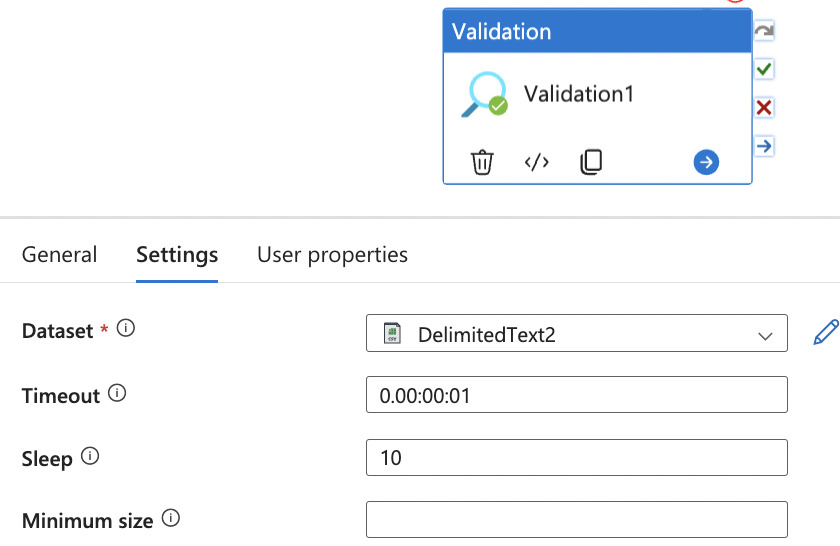
In the above image, we have a referenced a dataset called DelimitedText2, which would point to either a folder or file in azure blob storage or a table in a Azure SQL DB. Timeout property holds the time afterwhich the activity would timeout (note that, it wont fail). For instance, if the validation activity is meant to validate the presence of a file\folder\table, and it doesn't find the corresponding item, after the timeout time, the activity execution stops and timesout. Next, we have the sleep property which makes the validation activity wait for certain number of seconds before revalidation or timeout. Minimum size property is used to mention the minimum size of a file in bytes (not applicable to table based dataset).
When the validation activity completes execution or times out, we can access the output json of the validation activity to know about the validation results.
Let us look at the GetMetadata activity and its settings.
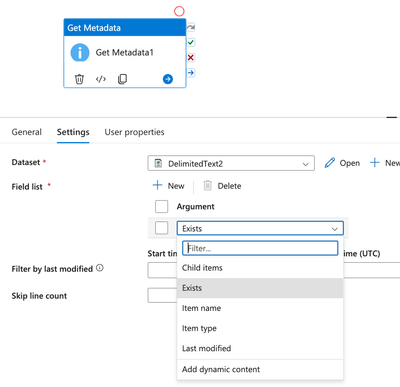
Like validation activity, we have few properties that would help us validate the file\folder\table in a GetMetadata activity in ADF\Synapse. Depending on whether the dataset points to a folder\file\table, the properties (field list) would differ.
The above image depicts the field list corresponding to a folder in ADLS. When we make the dataset point to a file, it would be as below.
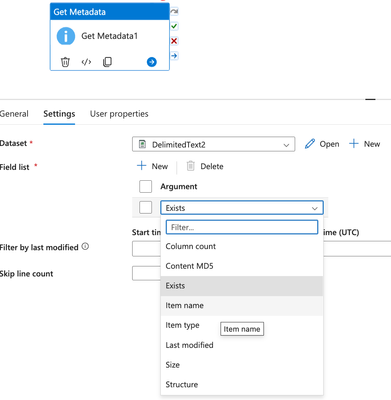
So, if the dataset points to a file or table, we see couple of additional properties like Column Count, Size, Structure.
Having seen about the individual properties\ field list of both the activities, its time to compare and know the similarities and differences.
The below table compares the capabilities of Validation activity & Get metadata activity.
| Validation Activity | Get metadata activity | Property Used | |
| Validate File | Yes | Yes | Exists (returns boolean) |
| Validate Folder | Yes | Yes | Exists (returns boolean) |
| Validate File Size | Yes | Yes |
Get Metadata Activity: Use Size property in field list Validation Activity: Use Minimum size field in Settings tab |
| Validate File Structure | No | Yes |
Get Metadata: Use the Field List: Structure. Then, Use another activity like If condition to validate the structure against the expected. |
| Validate File Column Count | No | Yes | Get Metadata:
Use the Field List: Column Count. Then, Use another activity like If condition to validate the count against the expected. |
In a nutshell, ADF\Synapse comes with a variety of activities, sometimes with similar characteristics or capabilities. When it comes to validation, it is based on the use case, we decide to use either Validation activity or Get Metadata activity or both.
Published on:
Learn moreWe can help you with Azure Data Factory\ Synapse Analytics: Validate File\Folder before using!
If you want help implementing, troubleshooting, or improving this product, contact us and we’ll point you in the right direction.
Related posts
This Month in Azure Static Web Apps | 09/2024
We are back with another edition of the Azure Static Web Apps Community! :party_popper: September was yet another month ...
GitHub Copilot for Azure: 6 Must-Try Features
As developers, we are constantly seeking tools that streamline our workflows and boost productivity. … Enter GitHub Copilot for Azure, now in ...
Responsible AI Mitigation Layers
Generative AI is increasingly being used in various kinds of systems to augment humans and infuse intelligent behavior into existing and new a...
Streamline Your Azure Workflow: Introducing GitHub Copilot for Azure in VS Code
I'm excited to announce the public preview of GitHub Copilot for Azure - a new addition to your toolkit that seamlessly integrates with G...
Build Intelligent Apps Code-First with Prompty and Azure AI
Building Generative AI applications can feel daunting for traditional app developers. What does the end-to-end applicati...
Certificación AI-900 (Fundamentos de IA) con Chicas en IA
La inteligencia artificial ha llegado para quedarse, ¡y más aún con la revolucionaria IA generativa! Para ayudar a los profesionales a especia...
Get certified with Learn Live GitHub series!
GitHub Universe is coming, and Microsoft and GitHub are partnering to offer a new special Learn Live series in Brazilian Portuguese, English a...
Certifícate con Learn Live GitHub en Español
Microsoft y GitHub se han unido para ofrecer una nueva serie especial de Learn Live en inglés y español: GitHub 2024. Del 10 al 24 de Octubre,...
Evaluating generative AI: Best practices for developers
As a developer working with generative AI, you've likely marveled at the impressive outputs your models can produce. But how do you ensure the...
Introducing Azure Product Retirement Livestreams
The Azure Retirements team, in collaboration with key partner groups, is excited t...