
Introducing Azure Well-Architected Framework for Internet of Things (IoT)

Internet of Things (IoT) projects are high in complexity, and this complexity can increase substantially over time. While IoT is widely adopted in organizations, only a quarter of those IoT projects are in use, while many fail in the proof-of-concept stage. Companies cite a lack of knowledge and technical complexity as many of the challenges preventing them from using IoT more and developing new IoT solutions.

IoT Signals Edition 3 – October 2021
Azure Well-Architected for IoT was built by a deeply technical team of architects, consultants and developers who work daily with Microsoft’s customers and partners on their IoT solutions. This team sought to synthesize their experience of designing and deploying successful IoT projects into actionable recommendations for all our customers. Well-Architected for IoT is essentially the distillation of the knowledge and experience of our experts in IoT.
The Azure Well-Architected Framework is a set of guiding tenets that can be used to improve how you build, deliver and operate great solutions. The Azure Well-Architected Framework is divided into five pillars of architectural best practices: cost management, operational excellence, performance efficiency, reliability, and security. These pillars help you effectively and consistently optimize your workloads against Azure best practices and the specific business priorities that are relevant to you or your customers' cloud journey
What is Well-Architected for IoT?
The Azure Well-Architected Framework for IoT is made up of written guidance and the Well-Architected Review for IoT.

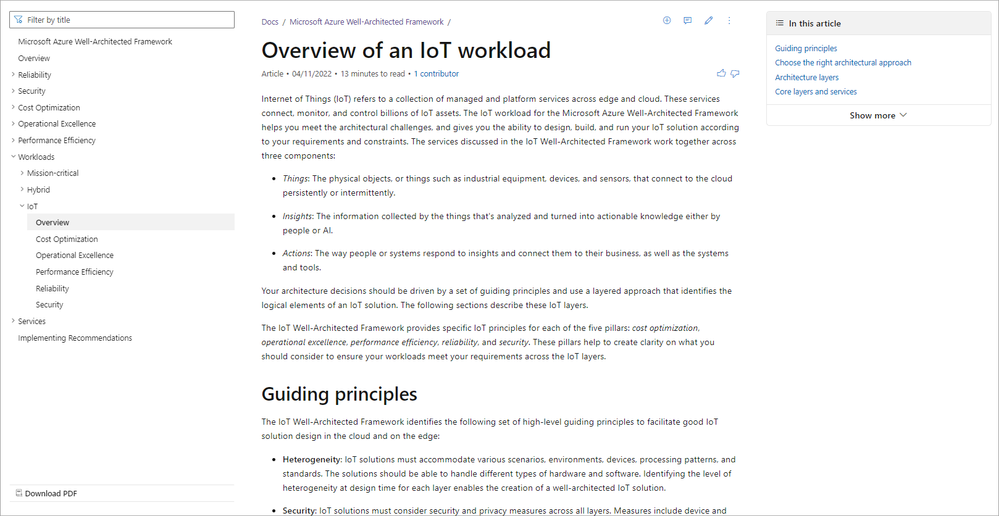
IoT Workload Guidance
The IoT workload guidance outlines the core principles that facilitate a well-architected IoT solution and provides recommendations for each of the 5 pillars of the Well-Architected Framework. This guidance highlights the key considerations and high-level principles for an IoT workload, design considerations to help you enable those principles, and tradeoffs to consider in order to meet your business goals.
IoT Workload Assessment
The Azure Well-Architected Review is designed to help you evaluate your workloads against the latest set of Azure best practices. It provides you with a suite of actionable guidance that you can use to improve your workload in the areas that matter most to your business.
The Well-Architected Review for IoT is designed to tailor the recommendations to your IoT project needs. One of the important elements of the Well-Architected Framework is that it considers tradeoffs among pillars. Understanding what the key considerations and tradeoffs, for example between cost and availability/redundancy, are key to making a practically effective cloud IoT solution.
You can also evaluate your IoT workload anytime during your development process, from creating a pre-deployment checklist to refining your solution architecture to optimize along one of the pillars, such as reliability or cost optimization.
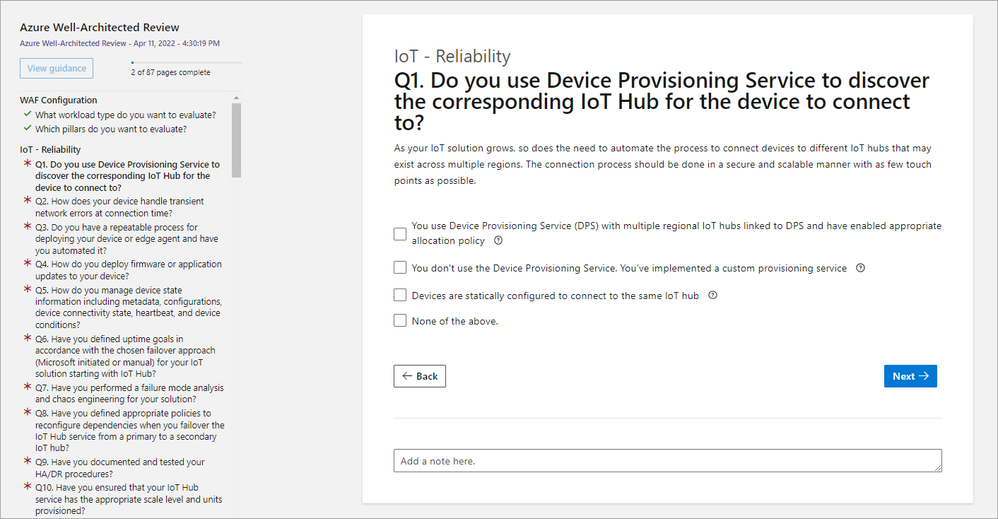
Once you complete the assessment, you're provided with a score for each pillar that you chose to evaluate and an aggregate score across the entire workload. You also receive a set of actionable recommendations that you can follow to better align the workload with your business priorities. This score is a tool to help track improvements as recommendations are being implemented.

These recommendations, coupled with Azure Advisor insights, can then be integrated into an operational process for continuous workload improvement. Scripts are provided to automate the import of these recommendations in your DevOps approach (Azure DevOps or GitHub), triage the newly established backlog and help you prioritize the implementation of chosen improvements.
Get Started with Well-Architected for IoT
You can get started with the Azure Well-Architected Framework for IoT:
- Read the IoT workload guidance at Azure Well-Architected Framework.
- Take the Azure Well-Architected Review for IoT on Microsoft Assessments.
- Learn more about IoT security this new post: Microsoft best practices for managing IoT security concerns
Published on:
Learn moreWe can help you with Introducing Azure Well-Architected Framework for Internet of Things (IoT)
If you want help implementing, troubleshooting, or improving this product, contact us and we’ll point you in the right direction.
Related posts
End-to-End Full-Stack Web Application with Azure AD B2C Authentication: A Complete Guide
Application Overview The purpose of this sample application is to demonstrate the usage of Azure Active Directory B2C (Azure AD B2C) for authe...
Complex Data Extraction using Document Intelligence and RAG
Section 1: Introduction Historically, data extraction from unstructured documents was a manual and tedious process. It consisted of a c...
Harnessing Generative AI with Weaviate on Azure Kubernetes Service and Azure NetApp Files
Table of Contents Introduction Prerequisites Install Weaviate Approximate Nearest Neighbor (ANN) Benchmarks ANN Benchmarks Setup ANN Benchmark...
Securing Containerized Applications with SSH Tunneling
As cloud engineers and architects embrace containerization, ensuring secure communication becomes paramount. Data transmission and access cont...
Exploring AI Agent-Driven Auto Insurance Claims RAG Pipeline.
Introduction: In this post, I explore a recent experiment aimed at creating a RAG pipeline tailored for the insurance industry, specificall...
Azure NetApp Files now stores sensitive data DoD IL5 compliant in Azure US Government regions
Table of Contents Introduction Why Azure NetApp Files? DoD IL5 compliance in Azure Government Azure NetApp Files reaches feature parity betwee...
Data Intelligence End-to-End with Azure Databricks and Microsoft Fabric
This Azure Architecture Blog was written in conjunction with Isaac Gritz, Senior Solutions Architect, at Databricks. The Data Inte...
AI Studio End-to-End Baseline Reference Implementation
Azure AI Studio is designed to cater to the growing needs of developers seeking to integrate advanced AI capabilities into their appli...
Mastering AI adoption: Essentials to building, operating and optimizing genAI workloads on Azure
Mastering your AI adoption: Essentials to building, operating and optimizing genAI workloads on Azure As the demand for scalable, efficient AI...
Optimize Azure Stack HCI with the Well-Architected Framework
Azure Stack HCI is a hyperconverged infrastructure (HCI) solution that provides storage, network, and compute resources in on-premises...